
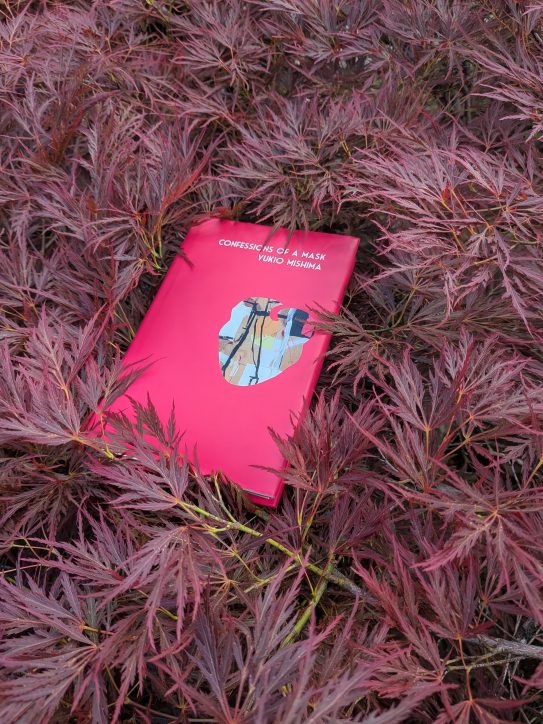
Recommend: No
Yukio Mishima is a captivating icon of Japanese literature.
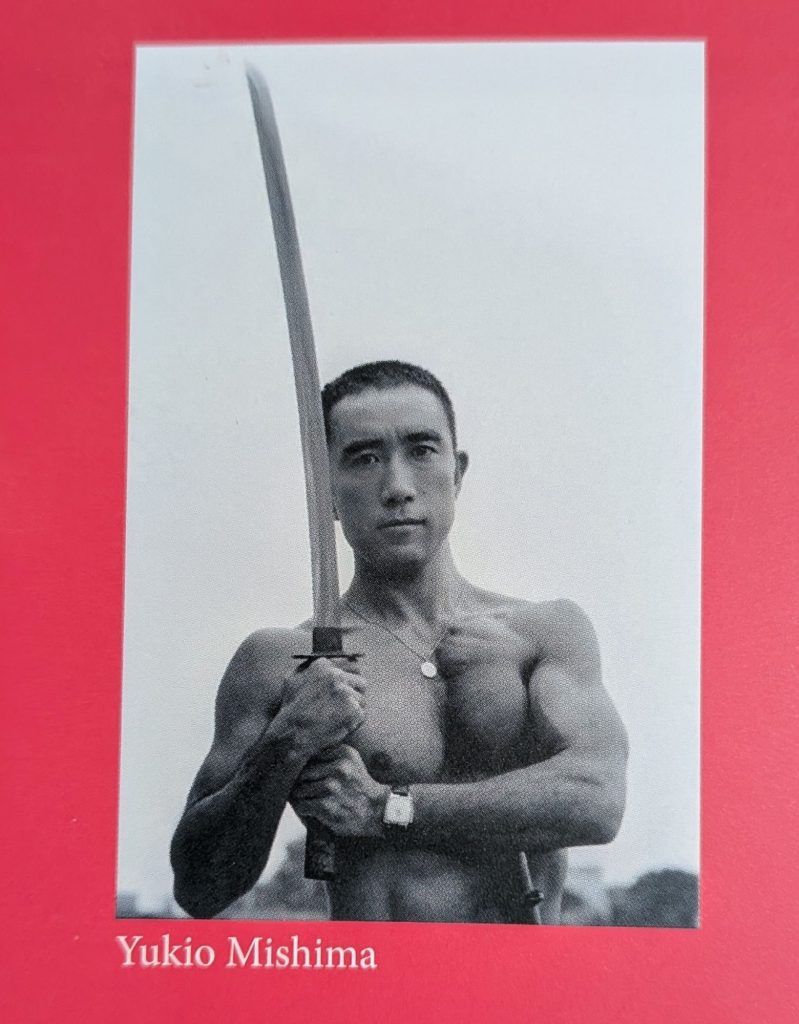
He was a famous gay author prominent in the 1950s and 1960s who ended his life in 1970 by ritual suicide after participation in a failed political coup. With only the smallest bit of research effort I can confidently attest that ritual suicide is brutal.
Mishima then committed seppuku, a form of ritual suicide by disembowelment associated with the samurai. Morita had been assigned to serve as Mishima’s second (kaishakunin), cutting off his head with a sword at the end of the rite to spare him unnecessary pain. However, Morita proved unable to complete his task, and after three failed attempts to sever Mishima’s head, Hiroyasu Koga had to step in and complete the task.
Confessions of a Mask – not to be confused with Isla Fisher’s light-hearted romcom Confessions of a Shopaholic – is an excruciatingly reflective account of Mishima’s adolescence and early adulthood struggles with being a gay man in Tokyo.
Published in 1949, Confessions of a Mask is classed as fiction but, if the term had been popular at the time, could easily be termed ‘autofiction’. The intimate narration takes the reader so close to the author that the whole novel does indeed read as confession.
‘Trivial’ memories which I should have cleaned up tidily and thrown away two years before had now grown strangely large and been restored to life before my very eyes – just like a bastard child who has been forgotten and then suddenly turns up, fully grown.
The structure itself is also confessional in nature. Large swathes of self-analysis are interrupted only occasionally by memories of actual events. These recollections of particular moments in Mishima’s childhood are the bursts of plot that must sustain the reader throughout the chapter.
The narrator of novel is a reclusive child that spends most of his time indoors. At school, he pines for teenage boys. He clearly has a ‘type’, preferring boys that are powerful and dumb. After high-school, he is persuaded to go to university by his father and study law. Although Mishima (I mean, the ‘narrator’) is somewhat intellectually interested in the argumentative nature of legal studies, when his time at university is impacted by WWII he doesn’t experience any grief over the loss of his ‘normal life’. It is in this ‘normal life’ that he feels like he must always wear a mask and hide his queerness from conservative 1940s Japan.
Confessions of a Mask is possessed by sex. Nearly every page is a mediation of the narrator’s sexual orientation, its secret expression in private and its blatant denial in public. However, in no way is this a sexy book. There’s not one sex scene. The most ‘action’ that the narrator gets is holding the bag of a female acquaintance who is infatuated with him. That’s not true actually, later on this female kisses the narrator but the narrator struggles through it with such paucity of passion that it hardly counts. The novel is weighed down with the constant implication that the narrator is outside society’s accepted sexual norms and must suffer in silence, potentially forever alone in this way.
While technically Confessions of a Mask is queer fiction it is of a totally different breed to the queer fiction of modern day (see: Just By Looking at Him; Family Meal). There is no physical delight taken from men, only craven lust and the temporary relief of being in the presence of male beauty. All the page space is instead given to expressing the sheer misery and loneliness of the narrator. It is a book of repression, not celebration.
The war actually works as a way for the narrator to hide from the every day social obligations of being a young Japanese Male. The surrender of Japan therefore represents a devastation to the narrator. No longer will the narrator be able to effortlessly shy away from the pressures of marriage and children – the focus of society will quickly shift from war to “everyday affairs”.
I had never dreamed this could happen. I had failed to take into account the fact that Sonoko and her family might have an attitude toward the war markedly different from my own. I was a student, still under twenty-one and working in an aeroplane factory; moreover, having grown up during a series of wards, I had thought too much of the romantic sway of war. Actually, however, even during such times of violent disaster as these to which the war had now brought us, the magnetic needle of human affairs still remained pointing in the same direction as always.
A full section of the book spans 1944. WWII is ratcheting up into its final throes. This setting was interesting to me. I’ve never known about Japan’s civilian experience of WWII, having not encountered in school curriculums or media. For example, we are currently watching Band of Brothers and I don’t think there is one mention towards even the nation of Japan. As a general note, I do feel as though I am learning more about WWII as I read more of the ‘classics’. Yes, it compromised majority of my Modern History class in highschool but I truly only engaged with that module through the 900 page biography of Leni Riefenstahl that I read cover to cover. It’s hard to think of a better signifier that I was never destined to be a ‘big picture’ thinker.
Confessions of a Mask is the second Mishima work I have read. The first was a short story, Star. I found the two works worth my time but both suffered from clunky prose. This may be a common translation issue with Mishima’s writing, it’s hard to say. An example:
She came running down the platform toward me with a graceful motion like the trembling of light.
It is hard to conceptualise light being in any motion, let alone for it to be ‘trembling’. It’s therefore hard for me to relate the action of running to any action performed by light. This is not the only disjointed metaphor in the book.
I enjoyed Star more because it was a very clearly scoped piece of fiction writing. By contrast there is far too much naval gazing, repetitive in nature, that makes Confessions of a Mask sometimes a feat of endurance. The writing can be so crystal clear and lovely in one sentence and then completely muddied by strained emotive language in the next. If I had to drink a shot of Baileys for every time the words “grief” and “agony” were used I wouldn’t be able to make it through a chapter sober.
Which is such a shame because Mishima’s scenes are often beautiful and luscious, not unlike watching a film. My favourite example of this setup comes right in the final page of the book. The narrator, now an adult, is out with a married woman named Sonoko that he has a deliberately vague relationship. The two of them are at a dance hall and the narrator is startled by an extremely attractive young man. For the first time in the whole book, right at its conclusion, the writing turns from pensive to passionate.
At this sight, above all at the sight of the peony tattoed on his hard chest, I was beset by sexual desire. My fervent gaze was fixed upon that rough and savage but incomparably beautiful body. Its owner was laughing there under the sun. When he threw back his head I could see his thick muscular neck. A strange shudder ran through my innermost heart. I could no longer take my eyes off him.
‘There’s just five minutes left.’ Sonoko’s high, sad voice reached my ears. I turned to her wonderingly.
At this instant something inside of me was torn in two with brutal force. I was as though a thunderbolt had fallen and cleaved asunder a living tree. I heard the structure, which I had been building piece by piece with all my might up to now, collapse miserably to the ground. I felt as though I had witnessed the instant in which my existence had been turned into some sort of fearful non-being. I closed my eyes and after an instant regained a hold on my icy-cold sense of duty.
There is also this incredible scene, again fairly late in the novel, of the narrator at a party where the guests are playing a lively game akin to musical chairs. In her giddy rush for a ‘safe’ space when the music is turned off, a woman doesn’t notice her skirt has been hitched up and is exposing her thigh.
Perhaps it was because she was a little intoxicated, but I remember how I once saw the prettiest of the girls laughing excitedly, not noticing that in the confusion of falling to a cushion her skirt had been pulled up far above her thighs. The flesh of her thighs gleamed whitely. If this had happened a short time before, I probably would have imitated the way other young men shy away from their own desire in such a situation and, using all my skill at playing a part that was never forgotten a single moment, would have instantly averted my eyes. But since that certain day I had changed. Without the slightest feeling of shame – that is, without the slightest shame at my innate shamelessness – I stared at those white thighs as calmly as though I were examining some piece of inanimate matter.
Suddenly I was struck by the astringent pain that comes from staring too long at something. The pain proclaimed: You’re not human. You’re a being who is incapable of social intercourse. You’re nothing but a creature, non-human and somehow strangely pathetic.
I think these two excerpts display the best of Mishima. These are the two times where the ‘mask’ drops and the reader can truly see the narrator for the first time: completely and utterly divorced from the reality he is forced to engage with every day, yearning for a different life and, having been denied access to it, deadened to the touch.


Leave a Reply