
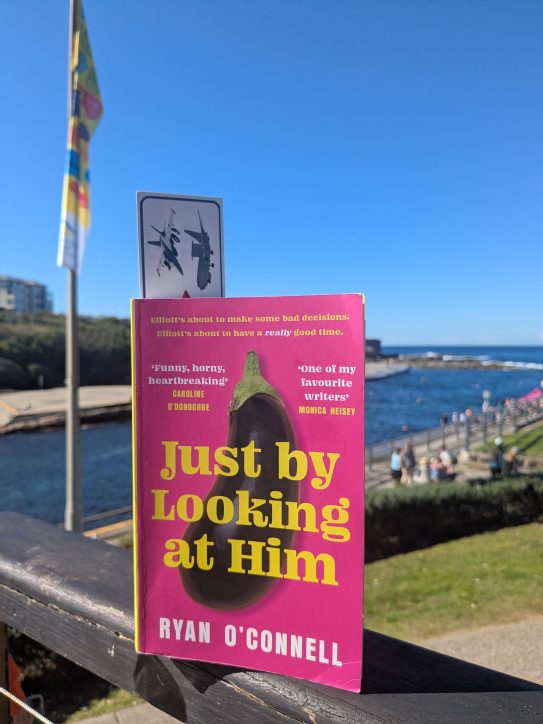
Recommend: No
On the same weekend as I read Just By Looking at Him, I went to Olympic Meats with the GBs. Olympic Meats in Marrickville is Instagram famous and Google Review infamous for their beef tallow triple cooked chips. We knew these chips were not really food, not in the usual nutritional sense of the word. Still, scratching the timeless itch for junk is delicious. And fleeting. The joy is so ephemeral you’d take two chomps and completely forget it was ever in your mouth. Onto the next chip.
Just By Looking at Him was no different to having chips for dinner. It’s a pleasure so empty that it’s spectacular we bother indulging in it at all.
There are three spurs to the plot, rinse and repeat, chapter after chapter:
- The main character, Elliot, is gay.
- The main character, Elliot, is disabled (cerebral palsy).
- The main character, Elliot, works as a writer on a sitcom.
My interactions with BookTok are minimal but I am confident Just By Looking at Him is the archetype. It’s a technically entertaining “of it’s time” commercial enterprise. It is more pithy pop-culture references than it is art. It’s a book that doesn’t expect to be relevant in a year’s time, let alone ten years. The medium of a book is incidental – this could be a podcast or a tv show or a series of YouTube Shorts or a blog (!) – and only got chosen as it’s got the highest chance of extracting your $23. At no point can you shy away from the fact this is a product being marketed to a specific target market.
How did I, lover of obscure 1970s fiction, end up here, a sucker for mass entertainment just like the worst of them? It’s partially Bert C.’s fault (Town Hall Dymocks Flash Card Recommendations wall). It’s partially blamed on the yearning for a purchase after a late night at work. It’s mostly just that I’d had carrots for lunch (Kairos by Jenny Erpenbeck).
Just By Looking at Him has two things going for it, meaning in the universe of shit things it’s more Gossip Girl than Vampire Diaries.
Firstly, the writing’s no good but the pop-culture references are perfectly suited to my demographic. The first page references a specific episode of Girls (Season Three, Episode Seven: Beach House https://www.youtube.com/watch?v=5_fgIwiCqfU). Every few pages there’s another callback to media of a more iconic status than this book:
Ethan was being so real. It was like seeing Vanessa Hugens try to act: alarming and sort of cringeworthy, but you can’t take your eyes off it.
Secondly, the writing’s no good but it can be funny. Elliot works as an exorbitantly paid writer on a Neighbour’s-like drama and is in constant conflict with his boorish boss, Ethan. I liked Ethan’s scenes. Ethan was designed with just enough detail and edge to be his very own sitcom character. He’s this old, wrinkled, dried out Californian queer who is more successful than his underlings but not successful enough to be respected.
“Oh, and tell my shaman I have three words for him: fuck off!” he screamed at his assistant, Gail, a woman in her mid-fifties who had to have endured some childhood trauma to be able to put up with Ethan’s bullshit.
There are so many smirk-worthy moments crafted by O’Connell but the issue is that he can’t take the humour past one-liners. The jokes aren’t developed gradually. There’s not much nuance. So the payoff in the humour is brief and disconnected: punchlines stitched together. It’s nothing like the subtle, character driven scenes of complete comedic genius in The Dud Avocado.
Chips are tasty. Chips will always be on the menu and chips will always be ordered. You eat too many, you get sick, you swear you’ll never eat them again.
You’ll be back.
BookTok will endure.
The house always wins.



Leave a Reply