
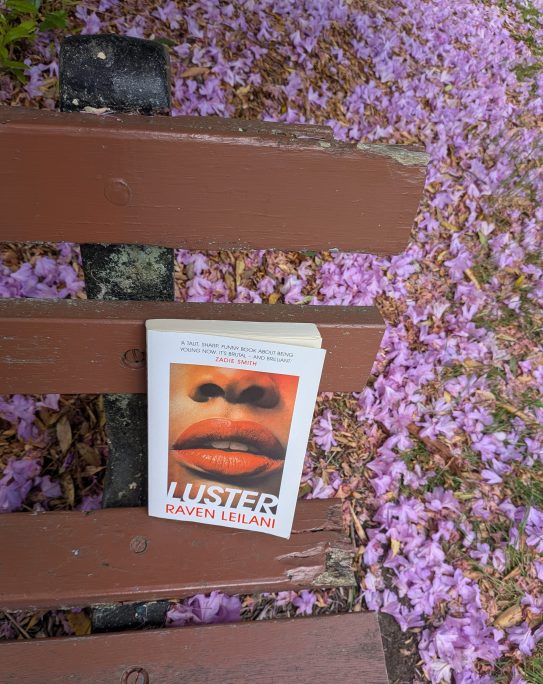
Recommend: No
Luster is a competent addition to the very marketable genre of Young, Broke and Hopeless New Yorker. Each book that leans in heavily to this particular generation of existentialism requires one or two Unique Features that ensure it will rise to the Dymocks Recommends wall. Luster’s point of distinction is established early and successfully: the main character, Edith, is black.
Other things to know about Edith/Edith’s experiences:
- she rents a mice-infested apartment in Manhattan
- she sleeps with her coworkers
- she hooks up with men via online apps
- one of these men is named Eric
- he has a wife
- he has an adopted black teenage daughter
- drama ensues
For this type of book to be good it must convince you that you are wealthier than its protagonist. Therefore, when the protagonist, inevitably, gets her shit somewhat together by the end story, the novel is effectively saying: look, if she can do it, so can you.
If I ever move to New York, hell bent on conquering Wall Street, my fated crash and burn will be thanks in no small part to these types of books.
I enjoyed Luster and was close to ranking it ‘Recommend: Yes’.
It is a perfectly scoped novel.
Edith and Eric have some degree of fun in the early stages of their dating. I am never convinced they are passionate about each other but they do seem to pass the time agreeably enough together, albeit mostly online. Eric then informs Edith he is in an open marriage. Edith is a Cool Girl so she’s like, ‘whatever’.
Then the book takes a fairly unbelievable turn. Rebecca (she’s Eric’s wedded partner) meets Edith and sort-of invites her to live with them, a bit because she’s kinky and a bit because Edith can help her adopted daughter be more comfortably Black. This is all alluded to in the blurb of the book and sounded a bit much initially as a plot but Leilani actually pulls this off with a slight of hand. The teenage daughter is believably haughty, and the relationship that develops between Edith and this young girl is quite nice without becoming insincere. Edith’s cooling off on Eric having seen him in his domestic era is also done in an understated way, as is Edith’s growing respect for Rebecca.
Leilani keeps it all together in part due to good editing (the book is only 225 pages) and in part because it always feels like this is a defined, finite slice of Edith’s life. Obviously this current situation is not going to work out long term – it is fucked up to live with your lover, his wife, and their racially distinct adopted child. But Edith is enthralled in the set up. It stimulates her artistically (she’s a painter), as well as emotionally (her childhood never had this ‘stable’ core that she is currently playing a part in), and what started as a wacky sexual pursuit develops into a more timeless yearning for comfort.
Leilani’s writing just strayed a bit too much for it to be a ‘must read’. She does dialogue and family set up very well. However, she loses control when trying to make the prose more lyrical. Repetition of phrasing is a common complaint I had. This is a deliberate choice to make the prose read more poetically, and therefore build plot on a stronger emotional ground, but I don’t think Leilani got it right. Kind of infuriating because her plot and characterisation was strong enough to stand on its own, and the repetition just served to cheapen an otherwise rich set piece.
Examples of repetition in phrasing:
I do a sweep under the bed. There are board games and unopened bags of soft, red clay. There is a battered version of Sorry, a Boggle with a cracked dome, and a sleek chessboard with a compartment for pieces. Inside, there are two queens.
When he held it, he held it casually. When I take the gun into my hands now, it does not feel casual.
I tell her that I need to speak with Eric, but when I turn and look through the glass, he is gone. I tell her I brought him a sandwich, and she looks my up and down and tells me he is out.
It’s not bad writing. At times the repetition is even successful in establishing tension. But it adds an overcompensating amount of seriousness to the novel. The book was doing absolutely fine by itself. The cause is probably as simple as this is a debut and the author was mimicking the rhythm of other authors when she didn’t need to.
I bought this book during Covid from Ariels on Oxford Street as a ‘pick me up’. Since then it has travelled around with me on several holidays, as I always thought it would make a good holiday read. At the end of each holiday, though, it hadn’t made it onto the reading list, pushed down by some other shiny book of the moment.
That’s a shame because this is a great beach read that almost made it.


Leave a Reply