
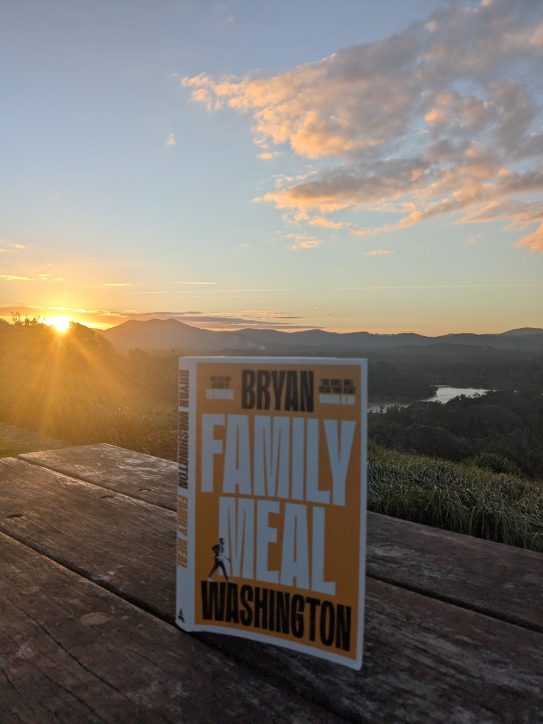
Recommend: No.
Family Meal is the same novel as Just By Looking at Him, only pitched at a different audience.
Both novels are driven by gay protagonists who become unanchored by the chaos of their non-monogamous long-term relationships. Both novels also refuse to limit their scope to gay relationships, branching out tepidly into subplots of disability, race, eating disorders and gender.
The differences come down to tone and style. Just By Looking at Him trundled along with a flippant, humous pitch; so confident in its witty one-liners that it didn’t feel the need to create a compelling narrative. In contrast, Family Meal eeks out sympathy and quiet sadness from its character’s tragic backstories, enhanced by its unconventional structure.
Chuck Palahniuk recently wrote in a blog post about a text having heart.
That was my introduction to the pre-fab broken heart. The death of John Wick’s puppy. The cancer of Walter White in Breaking Bad. The illness of everyone in a Jodi Picoult or Nicholas Sparks novel. The pre-fab broken heart must communicate to a vast audience in an elevator pitch. I just can’t do that, and that explains my poverty and obscurity.
Once you know the nature of the broken heart, only then do you rewrite the book five, six, eight more times.
Just By Looking At Him Palahniuk straight in his old watery eyes and says ‘to hell with inciting incidents, this is BookTok bitch’. In Family Meal, however, Washington takes this brief very seriously. Every character has grief to tackle. Dead boyfriends and dead parents litter the text. One quite literally so. It’s around all this grief that the loose story folds itself.
Family Meal has three main characters. Initially, the novel is narrated by Cam. Cam feels like he is in his late twenties with enough emotional baggage to age him into an early grave. He’s parents died in a car accident when he was a teenager, and he subsequently lived with his neighbours until graduating high school and moving away from his hometown of Housten. Away from home, he meets and falls in love with Kai (Character Two). Kai dies. Cam moves back home (remembering home is actually his neighbour’s place) and muddles around with the neighbour’s son, TJ (Character Three, literally the Boy Next Door).
The story moves along slowly, propelled back and forth by changes in character perspective and structure. The first act (Cam’s perspective) is the strongest. Cam is relatable. He’s gone through way too much tragedy and moves back home because what else is he meant to do? He retraces routines and relationships that he had back in a previous time – reminders of a happier place. Then we get a short second act (Kai’s perspective) that doesn’t leverage the main gimmick of the book enough (Kai is a ghost). And then a long third act narrated by TJ confuses itself by getting entwined in an unrewarding subplot about a romance with a genderless character called Noel. I will go on the record: I cannot stand characters with ‘they/them’ pronouns. I find the flow really hard to read (‘They said’; ‘their hand on my shoulder’) and I continuously feel that these characters are placed in the story to make a statement on something… Only the author isn’t trans, merely just has trans friends, so doesn’t have the confidence to actually say anything. At all times, Cam is the heart of Family Meal. Any time the novel strays too far from him it is a detriment its pacing.
I do admire the way Washington can elicit my sympathies. His plots need more tension and interest, but the writing is working. Family Meal uses a few experimental techniques effectively. The most obvious is the use of white space. Some pages only have a few sentences printed. Some pages are filled with a small black and white photo of a suburban yard. This has the effect of slowing down your reading. You come to the end of a small segment and get to pause in the luxury of white emptiness before moving to the next chapter. It organically adds emotion to the story.
There are other nice sentimental touches too. The novel begins with a small note from Washington directly talking to his readers (“Thanks for reading. Really.”). And then later on, in TJ’s section, each segment is numbered, starting at ‘2.’. The section ends on segment ‘1.’, which puts nostalgic emphasis on what would otherwise be a fairly unremarkable interaction between TJ and Cam.
Bryan Washington is a good author, but this is not a breakout novel for him. This novel dwells too much on specific minorities to crack into feelings that are universally recognisable. The characters just have too much going on; one character alone is a gay Black American-Korean who speaks Japanese and ends up dating someone who is gender neutral. If Washington relaxed into his characters in the same way he relaxes into his unhassled writing style, I think he could produce a touching and memorable novel.
Moreover, he seems like the kind of guy that would host a good family meal.


Leave a Reply