
Recommend: No.
I am borrowing again.
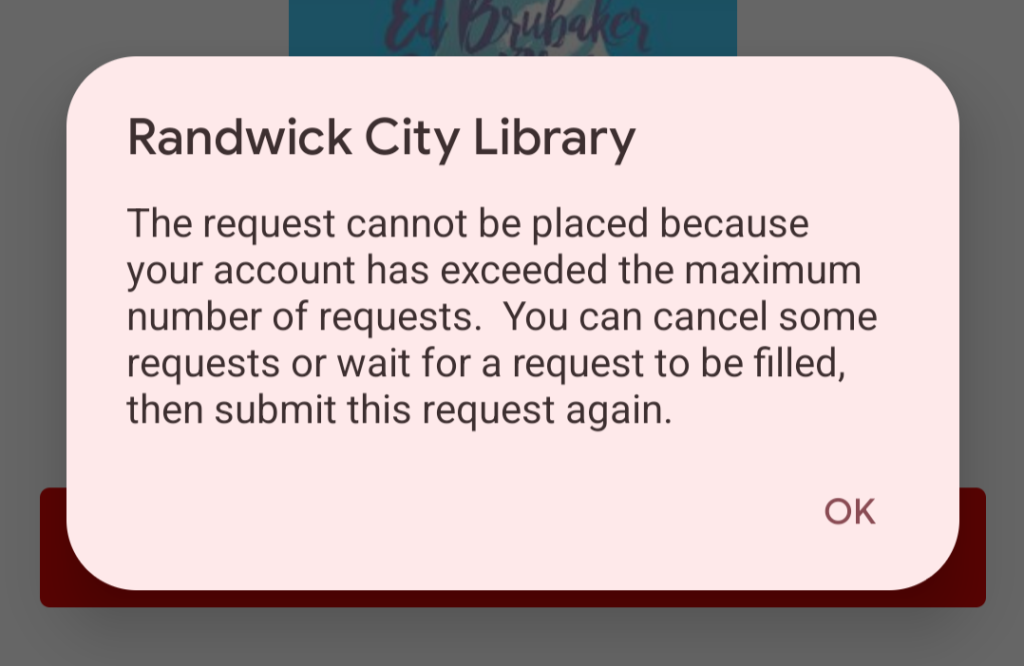
It’s a habit made dirty by my excess. A library card is intended to check out two, maybe three, books at a time, and have months spaced between hits. I don’t take this approach. I can’t. I load up my ‘holds’ list until the app spawns warnings that I have exceeded some secret limit.
When collection day comes, I leave work early to get to the library just as it shuts and then lug the stash back home in an awkward lumber. I must look like I am smuggling bricks home from Randwick Junction in an Ottolenghi promotional tote.
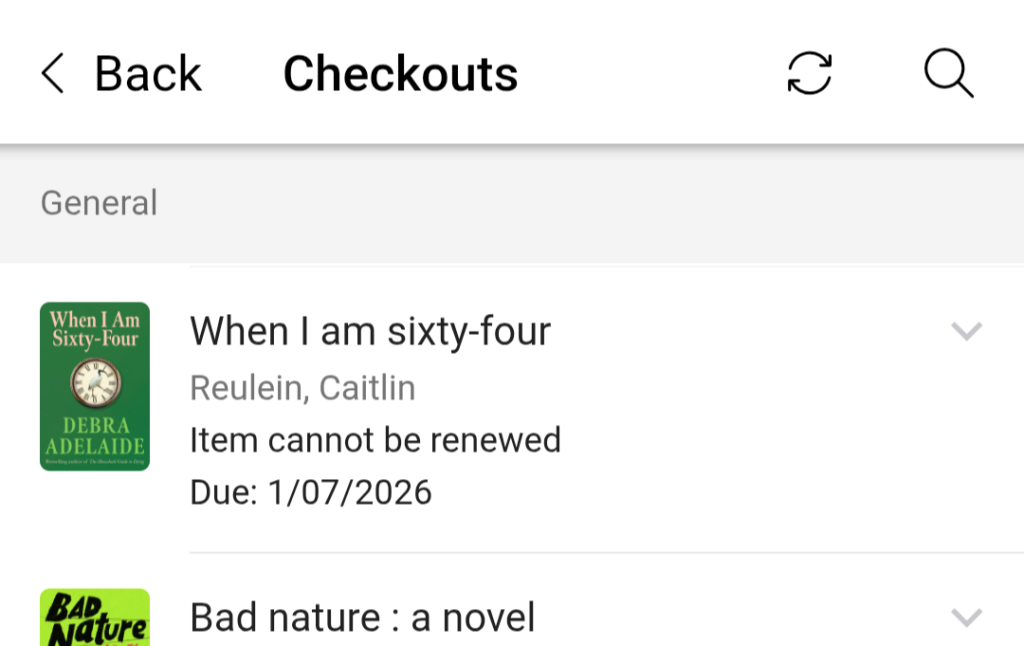
As time winds down and I get deeper into the library game, I find it harder to navigate within the rules. If a book has been reserved after me, I cannot renew it. Though failure to return the book no longer results in fines accruing, it does place a block on you from borrowing again until the offending text is returned. And my holds are coming in thick and fast. If I am blocked I will lose access to them, some of which I have been waiting for since queue position 92.
All this means I study my checkout history closely. I cannot risk reading an old, unpopular book over a recent release that will surely have subsequent claims to its name.
Fresh off the printer and a darling of Australian literary critics, it was therefore essential that I escalate When I am 64 to the top of my ‘to be read’ pile.
Deborah Adelaide has been moseying about Australian fiction for years with, to my knowledge, no exceptional success. That has now changed with When I am 64. I place this novel — self-proclaimed ‘autofiction’ — on the shelf of “Serious” books. On this shelf you will find other books that trigger furrowed brows, such as Confessions of a Mask, Kairos, and August Blue.
It was disappointing that Adelaide chose to keep this book in the watery realms of fiction. When I am Sixty-Four has been widely marketed as a reflection on Adelaide’s friendship with Puberty Blues co-author, Gabrielle Carey. In fact, Carey’s books are specifically referenced in the text and her name made explicitly public in the acknowledgments. Written in a very personal first person, I find this book very difficult to read as anything but memoir.
Carey suffered with mental illness and committed suicide in 2023.
The impacts of the suicide stretch far beyond the act itself and it is clear that Adelaide has been to some struggling to come to terms with the loss of her long term friend.
Outside of the acknowledgments, Carey is never once named in When I am Sixty-Four, despite this being so intimate a portrayal of her last years. Perhaps it was easier for Adelaide to tell this story without looking at the truth front on. But then it’s not fair to promote the book so openly as being about these two very specific women. It feels almost like a trick: the book publishers secure the the emotional investment of the readers without Adelaide having to commit to the honesty demanded when recounting reality. The whole time I was reading When I am Sixty-Four I encountered no reminders that this was a fiction.
The cynic in me believes that the fiction categorisation was chosen to help the reader forgive limitations of Adelaide’s writing. While very easy to read, if I were picking this up with no context I would be hesitant about how similar the style is to Rachel Cusk.
There is the Cuskian melding of hyper-specific character details with infuriatingly vague descriptions of time and place, or even identity. Keeping Carey’s character simply “my friend” was reminiscent of the hostile alias ‘G’ in Parade.
There is acknowledgement that the two lives under inspection have been lived in Australia, but with few clear identifiers of in what exact town or city, another Cuskian affect. Although when Cusk obscures these details it’s only because she is drawing attention to the complexity of her characters. Cusk doesn’t want you lost in Googling how to find a particular Tuscan villa. She demands you focus instead on the actions spurred by her character’s inner turmoil. I just don’t believe Adelaide has the same skill set. Her unwillingness to tell you exactly where things are happened and who they happened to feels petty. It is not serving a higher artistic purpose — or at least not one realised with tact — so why withhold this from us?
Then there is another a structural part of this novel that I thought Adelaide replicated too closely from Cusk. She uses small little vignettes to tell her story, not chapters. These vignettes weave non-linearly through time. For example, high school years are not properly touched on until page 100, whereas the whole first half of the book talks at length about these two ladies in their “impoverished old woman” years. This is a device used in all recent Cusk novels. It allows for the author to widen and narrow the perspective at any time. This can help the author slip through time and place to deliver the story in an order and pacing that maximises emotional impact. Adelaide wants to exploit this structure but doesn’t have the right scope of vision to pull it off. Her book ends up feeling like she’s written ten stories, the each of which are told simply and chronologically, and then cut them up into ten separate parts and spliced them together at random. If you were to simply regroup the vignettes into their original categories you would be able to read them as simple linear stories again. The book gives off a formulaic as sheen as a result.
I was worried when I picked this book up from the library that it would be a sentimental, lightly deluded, view of friendship and family in old age. It was not that. It was actually at times quite a harsh investigation of a friendship that had stood the test of a lot of time, but not all time. That the friend has committed suicide prevents the book from veering into wistful territory. The friendship was inherently not the be all and end all, as it did not stop the friend from taking her own life, and because this is known from page one, what you are reading is not really a testament to friendship but rather a reflection on it.
I am happy Adelaide has received plaudits for this novel as much as I think it should have been a memoir. It is a nice, almost calming, read about the not-nice subject of suicide. I am not rushing to read more from Adelaide but think that she has spent her time wisely here, studying the styles of acclaimed international middle-aged writers and putting that into service to tell her own story.
When I am Sixty-Four is not a must read to be treasured over the years but you could do a lot worse borrowing it from the library. Lucky for you, I have a bursting holds list that will force me to return it.


Leave a Reply