
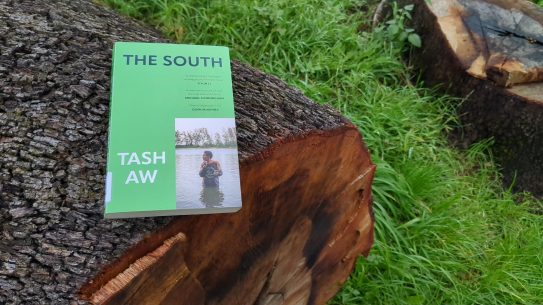
Recommend: Yes
BJ Silcox once said that she forever expects that the next book she reads will be the best one ever. I echo this mantra. That’s why I buy so many books. I pick up each one ardently believing that it will move me, teach me or locate me in the world. Any book that fails to fruit is irrelevant to my unwavering belief that the next book will take. A religious attitude that spurns the evidence and facts of history, able to live entirely self-sufficiently.
Still, The South crept up and surprised me.
The plot sounded so plain. A middle class family from the city return to their failing countryside farm after the death of the farm’s previous owner, the family’s capricious patriarch. While deciding what to do with the sprawling plot of land, they spend their days around the farm’s lower class manager and his son.
There were some tweaks to the formula of ‘family saga’ that were of light interest. For starters, the youngest child of the middle class family is Jay, and Jay is gay. From the very first page Jay is infatuated with Chaun, the son of the farm manager. Then there is the intrigue around the fact that the farm was not passed down from father to son, but from father to daughter-in-law.
But what really got this novel over the starting line for me was its setting in rural Malaysia. I am struggling to recall any work of fiction set in Malaysia, and it was this cultural novelty that let me set aside my concern that The South would be a conventional and boring pastoral family epic.
The South is a pastoral family epic but it was not boring. I thought the execution was flawless, its nuance and intimacy breathtaking.
I loved the way details of Jay’s family and Chaun’s family emerged over time. As information leeched out slowly from Aw’s plot, it became so satisfying to witness the quiet unravelling of these two families over one quick Summer. All of the seven characters – Jay and his two sisters, his mother and father, and Chaun and his dad – were drawn with great care and consistency, and their relations with one another were realistic, not sentimental.
The novel is mostly narrated by that young boy Jay, although there are glimpses of perspective from his older self, and even small swaps into his mother’s point of view. It is a structurally complicated narration that emphasises how it feels to be an outsider. Homosexual teenage Jay cannot be part of conservative Malaysia; his mother is an outsider to her husband’s family and therefore partially an outsider to her own.
Do you have a cold-box for all the meat and fish we’re going to buy? she asks Fong. I’m worried about it spoiling.
He shakes his head. How much are you planning to buy? He laughs. It’s not as if you’re staying forever.
Who knows, she says, trying to keep her voice light. Maybe I will. You might regret it then.
It’ll probably be you who regrets it, he answers in the same breezy tone.
The prose is cooled by the distance of time and the movement between narrators. Passions and disappointments that were felt so vividly over that Summer at the farm are often dulled in the recounting, as though the memories have wilted like the tamarind trees under the heat of many seasons. The bracing cold air let in because the door of hindsight is left open makes these few small weeks feel lost before they were even lived. Burned down before they could grow. The South is an account of the delicate beginning of an End that happens off-screen somewhere in the future.
Everything that happens, everything said, everything felt, is already over. A memory from a different time.
The road flattened out slightly and Lina and Yin, who had been behind us, accelerated and drew abreast of us, then Lina put her head down and narrowed her elbows in imitation of a professional racer and pulled ahead. Yin sat upright, her hair, usually so immaculately brushed it seemed never to move, fluttering haphazardly in the wind. For many years afterwards, every time I got news of her – her marriage, children, homes – it was this image of her that would come to my mind, and I would think how differently life had turned out for her.
Aw intends The South to be the first in a four book series but I don’t see how its successors can compete. This is a beautifully written, well paced novel. It captures the universal listlessness of a Summer holiday, the yearnings of early love, and the complications of growing older in a family that cannot accommodate change. All under the endlessly burning Southern Malaysian sun.


Leave a Reply