
Recommend: No
The unnamed narrator of The Hearing Test goes for a hearing test after waking up one morning with sounds like rolling thunder in her ears. In her late twenties, it’s a shock for her to be diagnosed with Sudden Deafness. After many appointments with many specialists, including multiple sessions with a palliative care hypnotherapist, the narrator must come to terms with the fact her dulled hearing is not going to return to normal and may even deteriorate further.
What to do?
The narrator, faced with this sudden loss, must decide how to proceed. She was a freelance sound editor by profession, so that has to stop. Without any work to distract her, much of the day becomes a process of reconciliation of her old surroundings to her new situation.
In the mornings I often thought about my mother saying to me once the self-proclaimed busiest women she knew did not have jobs. That simple tasks like replacing light bulbs, making phone calls, filling out forms, and scheduling dental appointments – tasks that the working woman is forced to fit into stolen minutes – become very dire for the nonworking woman. I thought, Now I am a busy woman.
The narrator reflects often on art theory, and uses it as a framework to grapple with what it means to be human. The humanity portrayed in sculpture and paintings and works of philosophy is not a humanity that depends on hearing, and by reconnecting with these forms the narrator is able to find solace that everything is not lost, just reframed.
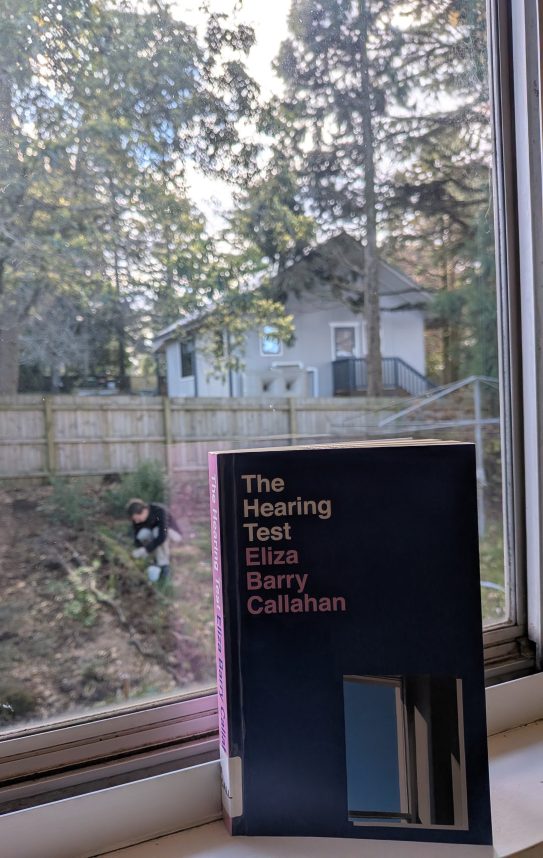
And frames are a motif used heavily in The Hearing Test. The eye catching frame in the corner of the cover of the book is deliberate. There is a new silence in the narrator’s life. It is a silence that is growing in volume. And in the spreading absence of sound, the narrator’s sense of sight begins to sharpen. Her disability has afforded her time and distance to be able to see her world with greater clarity. At first, being disconnected from the auditory world causes the narrator distress. Then, as she settles, this disconnection lends her calm. Held at more of an arm’s length from people, she can watch and observe, as though from behind a train window, silently passing through a loud and preoccupied city.
And I thought about the last time I’d seen him. The last time I had seen him, just before Christmas, when he had divided my home into two right triangles. Now he was talking and I was not listening. I was looking at him as if he were a photograph. My listening cut in again as he said he was going to butcher a quote – it was something like, It was a collision between predestination and free will, between chance and necessity. And then I was just watching again. I was willing myself not to hear a thing he was saying. I was not listening. I was just watching. I was practicing only watching. I was practicing how it would feel. I was practicing watching the girlfriend put food in her mouth and wipe vinegar off her lips. I was watching her laugh hysterically. I was practicing doing everything but listening.
The plot of The Hearing Test is not a fast paced one. The narrator is documenting a year of her life, and the text reads more like the well edited diary of an Intellectual Arts Student than a novel. There is no character development. What we learn of the narrator is limited to her interactions with people in that particular year of her life. Her mother calls her. Her ex-boyfriend hangs out with her sometimes. She is spoken to by that palliative hypnotherapist via an online video call. You never discover what her relationship is like with her mother. You don’t know why she and her ex broke up. Is this her first hypnotherapist?
That closeness to the present makes you feel empathy because all that matters is happening now. There’s no time wasted on sentimental backstory or uncomfortable dreams of the future. There’s just a woman who has been impacted by a disability she didn’t want nor expect, and her life is mostly about that for a year.
Did I love this book? No. Callahan suffers from the same tendency to digress into art theory as Rachel Cusk’s more recent work. I’ve long argued that it’s not that art theory doesn’t have merit, but that when you are writing a novel it must be acknowledged you are not writing an essay for Harper’s Magazine. Form matters. Or, to borrow an analogy from the book, the frame matters. A movie is framed differently to a refrain in a song, which is different again to the frame of a painting.
Did I like this book? Yes. It has a soothing quality.
Callahan threatens claustrophobia. Her narrator is forced into a year of introspection by losing her hearing and we the reader are entirely subjected to her interiority. However, Callahan saves us from this looming stress. The perspective of the narrator is almost methodical – she is relearning what is important to her and what is not. I felt as though this would be not dissimilar to if I quit my job. A radical change in living, one that forces a slowing. In that slowness, stock is taken of the life that has passed and expectations of the future still to come are re-evaluated.
Callahan is not good at pacing or dialogue or character nuance but she is a good writer. The sentences are impactful and the images are striking. There’s this wonderful scene that pops up a few times. Her ex-boyfriend comes over to her small flat and lies on the floor and “his body was a hypotenuse cutting the room into two right triangles”. What follows is the most emotion the narrator expresses in the whole book.
Love, he said, is obviously a form of haunting. It’s a ghost sitting at the edge of the bed, the bed being, you know, the heart. And sometimes it requires an exorcist.
I had not realised until then that he was holding my foot in his hand. I told him I found him to be un-haunt-able, uninhabitable even for ghosts. He seemed offended. What I did not tell him was that he was actually like a termite that finds its way inside the walls of a house. And the termite, like a perfect houseguest, has a sense when it’s stayed just long enough. Just long enough to have pushed the house to its absolute brink. Then it goes and leaves the house empty, eroded. I had once loved him.
This is a book to remind us that our sense of self is the window we look out of. Being behind that frame is often lonely and quiet, yet it affords us safety.

Leave a Reply