
Recommend: No.
Counterculture – cool.
Lots of sex at 40 – cool.
Gender fluidity – cool.
Toxic Masculinity – not cool.
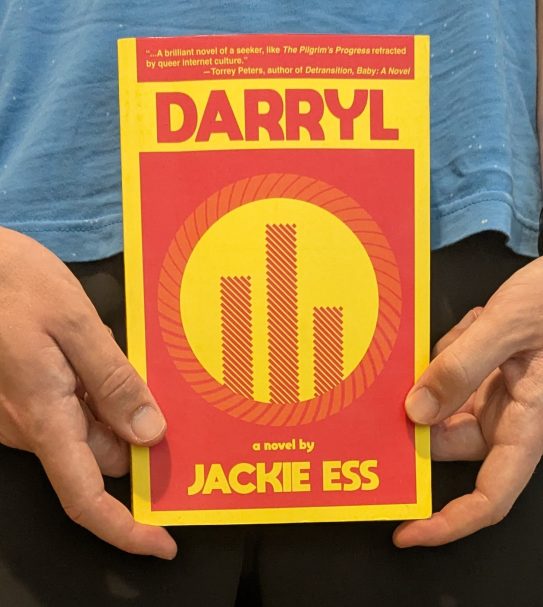
I’ve just written the blurb for Darryl by Jackie Ess.
Darryl is the annoying narrator of Jackie Ess’s aimlessly wandering, unfocused debut novel. If there’s one thing you need to know about Darryl it’s that he is part of the “cuckold lifestyle”. Actually, it’s not complete to say he’s “part” of that “lifestyle”: he was born into it. At least that’s what he tells us over and over again. What else is there to know about Darryl? He’s not gay, he’s not trans, he thinks. And another thing to know about Darryl? He explores his lack of a father figure through submitting sexually to stronger men. Okay, what about a fact about Darryl that is not to do with sex? Uhh… He sort of is starting to like sports. He lives in Oregon.
It’s frustrating that books with such a lazy, conversational drawl are sold for $30 alongside works that are at least try to reach for the status of art. While reading, I found myself in a placid, page-turning mindlessness state, not unlike scrolling Instagram. Now, writing this review, I am surprisingly angry at this novel.
I am cranky at its lack of purpose, despite pretending to a groundbreaking work by a transexual author.
It starts with a well-worn carelessness:
You live vicariously through celebrities, I live vicariously through the guys who fuck my wife.
For all intents and purposes, a strong start. There’s the juxtaposition of something clearly odd by societies standards (taking joy in other men having sex with his wife) with something that is also very odd when you think deeply about it but is widely accepted (celebrity culture).
Within that same opening paragraph, though, the flaws of the novel are in your face. The third sentence is a rhetorical question (“Let me ask you this: do you watch sports at all?”). Firstly, we’re veering too quickly away from the initial premise of celebrity culture. Stream of consciousness writing shouldn’t have thoughts ping ponging constantly off each other. It’s too chaotic to ever feel poetic or poignant. Secondly, a rhetorical question is fine. But Ess is addicted to their easy, yet pointless, rambling style. The paragraph concludes, “I could ask ‘what’s the point if you aren’t the one playing?’ but it isn’t exactly a fair question.” As readers we are aware of the intention of the sentence – to paint parallels between cuckolding and everyday life – but it’s poorly written. We’re being fed another rhetorical question. And this random, unexplained interruption “but it isn’t exactly a fair question” is distracting and doesn’t make sense. If I were Ess’s editor, I would have got my red pen and drawn a heavy line through “but it isn’t exactly a fair question”.
It’s a boring, anti-climatic end to the novel’s opening paragraph and serves as a harbinger of the underbaked writing to come.
The loose style (or lack thereof) is appearing with more regularity in modern American novels by people who are mildly famous online. There are attractions to the structure. Each chapter is on average three pages long, so time breaks and setting changes can happen with less description, which is exciting. It makes you feel like you are being flung through days with little free will.
But ultimately, the form falls flat. Often nothing phrases are repeated from one sentence to another. For example, in one paragraph there are three sentences that begin with the word “so”. Another jarring example is that there is one sentence that ends with the phrase “I guess”, only for the very next sentence to begin with that exact same phrase. This gives the overall effect of reading a novel that would have been better placed as a Substack email blast. Another barrier to entry were cultural references that were hostile in how specific they were (John Berryman; Frogman), yet they were passed over so quickly I couldn’t be bothered Googling them. After Tonight, Everything Will Be Different by Adam Gnade suffered from the same affliction: cool cover, low quality content.
These books know that they will not stand the test of time: they reveal it in their conclusions. Throughout the whole novel, because it is a slog to get through, you’re expecting some twist at the end, a surprise in which you can confess “it was all worthwhile, the author had a vision”.
When done well, a standoffish narrative voice can wrap the plot up beautifully, depicting an epiphany that takes the breath away because it has been born of such darkness. I am thinking of Ottessa Moshfegh’s final scene in My Year of Rest And Relaxation, where a woman, which could be the narrator’s best friend, falls from the high rise during 9/11, and we realise that the narrator’s complete disassociation from reality has been unpicked by calamity.
Reva was lost. Reva was gone. I watched the videotape over and over to soothe myself that day. And I continue to watch it, usually on a lonely afternoon, or any other time I doubt that life is worth living, or when I need courage, or when I am bored. Each time I see the woman leap off the Seventy-eighth floor of the North Tower—one high-heeled shoe slipping off and hovering up over her, the other stuck on her foot as though it were too small, her blouse untucked, hair flailing, limbs stiff as she plummets down, one arm raised, like a dive into a summer lake—I am overcome by awe, not because she looks like Reva, and I think it’s her, almost exactly her, and not because Reva and I had been friends, or because I’ll never see her again, but because she is beautiful. There she is, a human being, diving into the unknown, and she is wide awake.
That is an ending of tragic beauty – a moment catharises. But Darryl is not a good book. It can’t achieve such heights. Instead it has a typical ‘internet’ sensation book ending: rushed, boring and bordering on nonsensical. Characters that you don’t care about intermingle in unbelievable circumstances, with motivations that are never explained. You realise that the narrator’s voice has no greater meaning. The plot was stupid. You’ve wasted your time and money.
Also, this whole time I have been talking about cuckolding as though it’s well-known subculture. That’s really me just mimicking the novel, which constantly made me feel a bit guilty for yucking someone’s yum. It was sort of cool to think about the ‘new’ gay, or the ‘new’ trans – essentially, the ‘new’ transgressive that society shuns but will eventually become more commonplace. And at times the exploration was interesting, especially when it framed cuckolding in an existential lens.
I said to Oothoon that I thought we cuckolds are the only sexual orientation that’s about truth. Everybody else is about performance, pleasure, recognition. Maybe watching and listening are the bravest things a guy can do. Can you face your own inferiority? Can you watch yourself be replaced?
But Darryl took himself (itself?) too seriously. When the prose is that low energy, with little in the way of relatable content or poetic attraction, it’s a hard ask for the reader to stay prurient. Reading this novel was like having sex with concrete – cold, unresponsive, and distinctively unfun.


Leave a Reply