
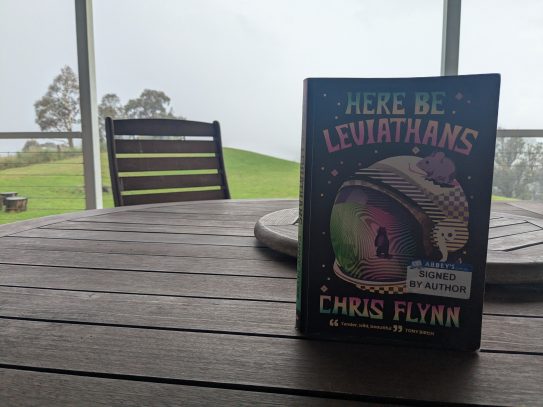
Recommend: Yes
Australian short story collections are often disappointing. A great short story usually requires intricate characterisation and an ostensibly understated plot. I love when a small decision reveals a depth of complexity, or a past life-changing event trickles quietly through present relationships. Australian authors don’t seem to have the same talent as American and British authors in capturing these subtleties. There is no modern-day Australian equivalent of Tessa Hadley. We just can’t capture silent personal disappointments or nuances of class concisely. We are, on the whole, inelegant writers, and the short story is an elegant form.
Chris Flynn’s short story collection Here Be Leviathans wisely steers clear of the realism of the American greats (ZZ Packer; Zadie Smith). Instead, his stories are fantastical, mostly narrated from the perspective of animals or inanimate objects. Everything here is a bit ‘extra’ but I actually think that it’s important that Flynn leaned into the craziness. With such surreal premises, as the reader you can just relax into each of Flynn’s stories and see where they take you.
One of my favourite stories is “22F”. The titular character being an aeroplane seat that experiences time on a different scale to its human passengers. In “22F”, Flynn begins with office humour to reel us in and make us comfortable – who hasn’t coworkers who “go too far sometimes, leaching the humour out of the situation”? But this flippant tone is a misdirect because the story is of a tragic aircrash that leaves the seat stranded to history on an isolated island. “22F” is a poignant and interesting short story.
My second favourite was “Shot Down in Flames”. The narrator of this story is initially a country creek, and then switches to different perspectives (a fox, a gun, a bushfire). “Shot Down in Flames” switching of narrators is experimental, and I commend Flynn on the successful execution. The plot is bought to life by the different voices. I was really excited by this story. It had both style and substance and was refreshingly inventive.
The rest of the stories I liked but didn’t love. There were two that completely missed the mark: the abandoned homeless youth in “Kiss Tomorrow Goodbye” was impossible to relate to and the covid-esque apocalyptic “The Strait of Magellan” was ordinary. I think these were also the longest stories in the collection. Flynn writes plot heavy stories, which rarely rely on character development, and these are best kept under 30 pages. Longer stories highlight Flynn’s weakness in dialogue and pacing, which can be discretely swept under the rug in the shorter pieces.
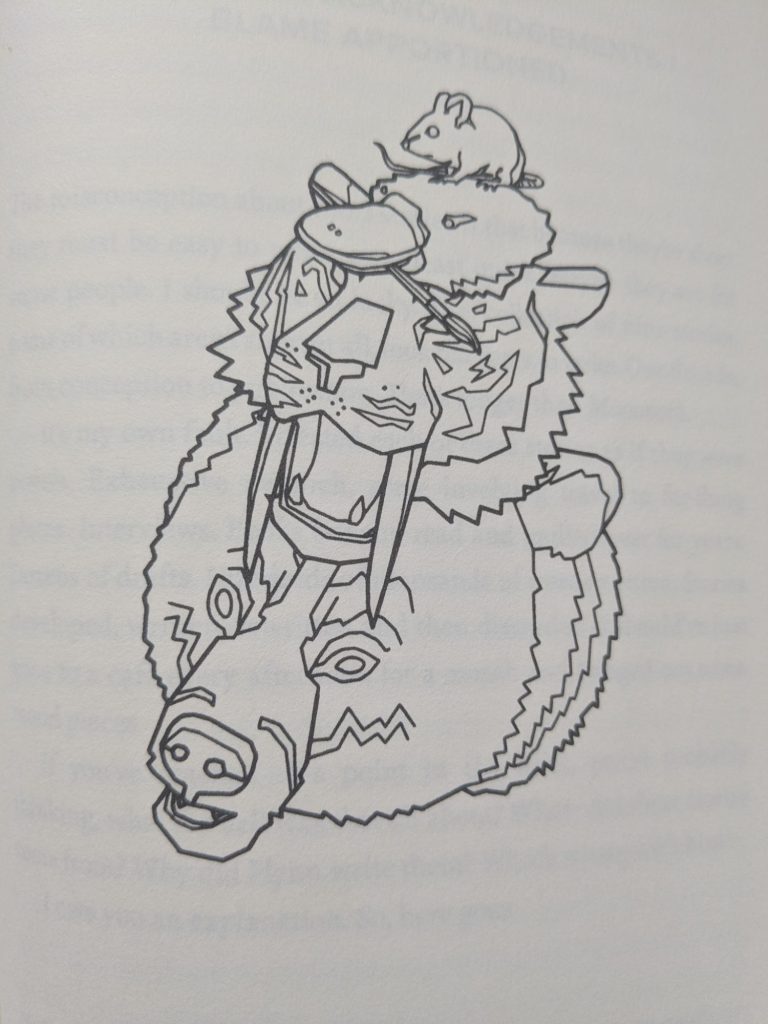
So I loved two stories and disliked two stories and the rest were fine. That’s not a screaming “recommend” by any measure. What tipped me over the edge was the authorial touches after the stories. The page after the final story is a drawing of some of the more memorable characters layered on top of one another. And then after that, is a section labelled “Afterword/Acknowledgements/Blame Apportioned”. In this section, Flynn reflects on collection as a whole and then goes through each story individually to discuss its inspiration and, sometimes, its purpose. I loved this section and the picture preceding it. Sure, Flynn’s short stories are not all amazing, but these addendums show an author that cares about the form. They elevated this collection to something structurally memorable.
“Short stories are misleadingly named,” Flynn finishes with.
“They take ages.”


Leave a Reply