
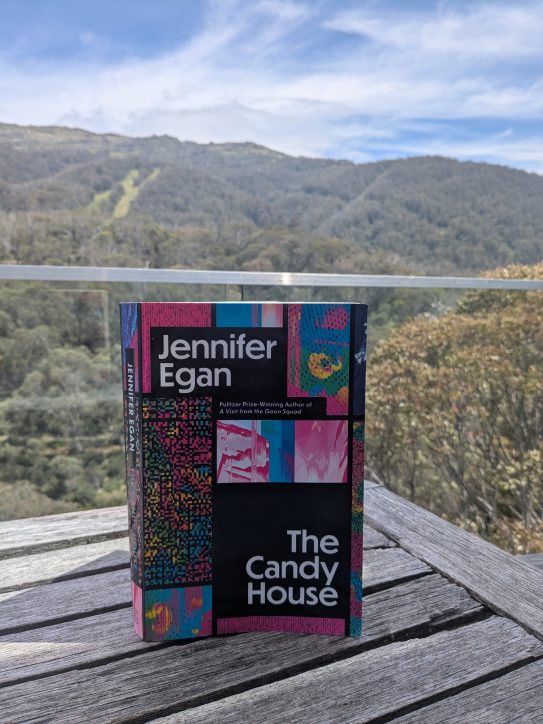
Recommend: No.
The first Jennifer Egan novel I read, A Visit From the Goon Squad, has haunted me. I’ve re-listened to chapters on the New Yorker Fiction hour and been amazed anew at her ability to make each chapter standalone in its own right. Most recently, I rediscovered the chapter Safari, and was shocked at how engrossing it was, years after I first read it. A Visit From the Goon Squad was a tiramisu of a novel: layer upon layer of delicious story and, when eaten as a whole, highly satisfactory.
The Candy House repeats much of what made A Visit From the Goon Squad structurally successful. Each chapter is from a different character’s perspective, with timelines being repeated across chapters. There are also occasional novelty chapters here, as there were in Goon Squad. This time there are no PowerPoint presentations, but there is a chapter all narrated in second person in the style of a ‘how to spy’ guide (more on that plot point later).
While the form remains similar to its Pulitzer Prize winning predecessor, sadly the heart of the novel is lacking in Candy House. What made Goon Squad so captivating was the way Egan captured relationships so crisply in so many different ways. Characters, seen briefly, and usually unfavourably, in one chapter, would emerge the protagonist and win our empathy in another. A feat of story telling, yes, but also a feat of compassion. Candy House focuses more on the former, at the loss of the latter.
The plot in Candy House reigns supreme. To be honest, it spirals out of control. Like a dictator with notions of grandeur, Egan runs us around this choppy narrative, but each vision is too vague for us to ascribe greatness. In Goon Squad, different perspectives, when pieced together, showed how complicated and evolving our relationships are. In Candy House, switching between narrators is rarely for emotional effect, rather its purpose is to claim more land in the urban sprawl of a plot.
Most of the novel is situated in the not too distant future, where social media has evolved to become more experiential. There are no posts online and no relationship status indicators. Instead, at a particular age, you can opt in to ‘uploading’ your consciousness. Like privacy settings on Facebook, you can choose how public this information is. The more access you grant society to your memories and feelings, the more you in turn can access from the general populace. But wait, there’s also mind control weevils. But wait, there’s also algorithms to predict trust between humans. But wait, there’s also Citizen Agent spies that would put James Bond to shame. But wait…
If that felt like too much exposition in a small space, then it’s accurately mimicking my memories of this book. Here’s a paragraph I found particularly grating:
Who could resist the chance to revisit our memories, the majority of which we’d forgotten so completely that they seemed to belong to someone else? And having done that, who could resist gaining access to the Collective Consciousness for the small price of making our own anonymously searchable? We all went for it on our twenty first birthday, Mandala’s age of consent, just as prior tech generations went for music sharing and DNA analysis, never fully reckoning, in our excitement over our revelatory new freedoms, with what we surrendered by sharing the entirety of our perceptions to the Internet – and thereby to counters, like me. Strict rules govern the use of grey grabs by data gathers, but there are occasions when I;m obliged, in my professional capacity, to search the psyches of strangers.
I’ll admit, I’ve chosen the worst example of exposition dump. The set up of the plot is usually not as tedious as the above. But that brings me to my next gripe: the book is only set up. This sci-fi premise about information overload and degrading privacy has the potential to be interesting. Egan can’t pull it off though. Over the hefty 340 page novel, key themes are left barely untouched. For example, there are these workers called Counters (data analysts) that sell findings to companies, but the plot goes no further, just suggests this is generically ‘bad’. We have a whole chapter from the perspective of one of these Couters, but it’s largely interested in his autism, and completely misses the chance to think more deeply about the impacts of collating and selling this data. There’s also a subplot about those who abstain from having their consciousness uploaded. Gee, it’d be nice to hear why they might not want to do that. Egan must be saving that for the sequel.
When explaining this lack of depth despite the huge volume of plot, Declan said, “is it like the Circle?”. The Candy House is a superior novel to Dave Egger’s (although I’ve long maintained The Circle was ghost written) but, devastatingly, there are similarities in quality of plot development.
Thankfully, there are two themes that are more fleshed out, neither of which are specific to the sci-fi genre. And really, the second is really just an offshoot of the first. Firstly, authenticity is of concern to many of the characters. There’s an interesting chapter where the narrator screams in public just to see an authentic, unguarded reaction to the scream. Another character can’t relax because (as a former spy) she thinks that there is no natural reality around her. The theme of authenticity arises in many other ways in the novel. The second theme is around the endings, and challenging whether anything truely ends.
According to Mom, you have to be careful or the forces of doom will line up against you. Things are more connected than they seem. The world is cruel and irrational, the strong thrive at the expense of the weak, and happy endings are purely a matter of framing.
“In the real world there’s only one ending, and it isn’t happy,” Mom has been telling us for as long as I can remember.
The above quote was taken from my favourite chapter of the book, “The Perimeter: Before”. This chapter has absolutely nothing to do with futuristic tech. It is about two neighbours who have a fierce hatred of each other, and a bit about their respective families and lives. It is beautifully, sentimentally written. At the conclusion of the chapter, the two neighbours are inspecting a fence, which one neighbour claims the other has moved to extend her garden, during a bougy garden party hosted by a sister. The uneasy truce after years of fighting is beautifully depicted from the perspective of a daughter of one of the warring parties:
I keep going to the window to check on Mom, but the garden is so far down that I have to stand on a footstool to see her. “What’s Hannah looking at?” someone asks.
“My mother,” I say, and they all laugh.
The first time I check, Mom and Jules are squatting in the dirt with the tape measure extended.
The second time, they’re both standing up, holding glasses of seltzer.
The third time, they’re leaning against the fence side by side, looking up at the sky. It’s electric with twilight.
The secret to a happy ending, Mom used to tell us, is knowing when to walk away.
Once I’ve seen Mom leaning against the fence with Jules, I force myself not to look again.
What a breath taking callback to the earlier theme of ‘endings’. What a well crafted scene, where it’s like a movie it’s that crisp. And, masterfully, what fantastic irony, to have such a complete ending to a chapter.
Egan is clearly at her best when her plot is character driven. She should have left all the sci-fi premise on the floor of her writer’s group. There are many (too many) meta ideas in the novel. The sci-fi ones (eg. information overload brought about by social media prevents an empathetic story, in a novel crammed with different perspectives) fail due to lack of detail. The more timeless ones (eg. where to end a story, in a novel where characters endlessly reappear from different perspectives) succeed thanks to their graceful humanity.
The title of the novel – The Candy House – is a reference to the Hansel and Gretel fable. In that story, entering the Candy House, and eating it out of greed and delight, brings untold horrors to the two children. Egan spends 80% of her novel trying to appropriate that motif in the context of futuristic ‘big tech’. She shouldn’t have bothered. She could have made an incredible, moving novel with ten regular, current day humans and a few iPhones.
I’ve entered the Candy House and eaten its walls. I feel lightly nauseous, and look for a fresher, simpler snack next.


Leave a Reply