Recommend: No
On a hot day in Blackheath, the fog finally burnt away, I walk through the bush. I brush past browning ferns and eat lunch in the shade. I linger by the water in Pope’s Glen. I stretch my limbs, feeling loosened by the heat. I feel like a snake thawing out of its Winter crypsis.
The animal world can seem tantalisingly languorous at these times. But Pig Tales is not a novel interested in such calm communion between species. It’s light on peaceful, heavy on frenzy.
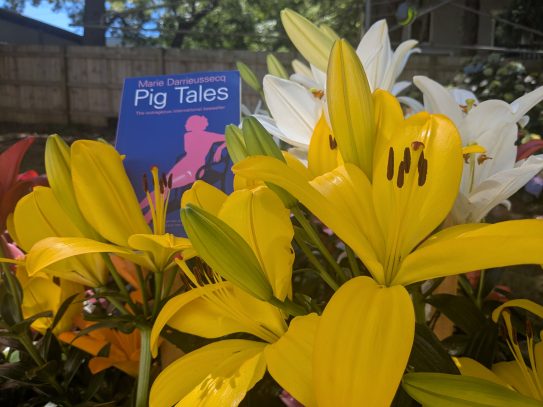
Pig Tales is an allegorical tale of a prostitute who (d)evolves into a pig as her human life becomes increasingly debauched. This little novel was fun, and pleasingly well written, and only failed because the larger allegorical meaning was unable to take root.
There are a few metaphorical worms that are being unearthed here but they are all tangled together and the narrator’s piggy snout doesn’t care to unpick them, rather swallows them joyfully all at once.
To start, the narrator’s transition from human to pig seemed to happen when she was exposed to particularly brutal or base interactions with men. I thought Darrieussecq was conveying that if we are treated like animals by others then the animalistic urges we all have (and delight in from time to time) will overwhelm the human. But life as a sow is not the treacherous banishment we initially assume it to be. It is only humiliating and uncomfortable when in the presence of other judgemental humans. When alone as a pig, or in the company of other animals, our narrator seems the most at ease with herself. So are the perpetrators, those unhinged men lurking at the brothel, whose lack of respect drive her from human to sow, actually our narrator’s liberators?
Pig Tales is a very engaging story. I was especially taken by the language around the simple pleasures the narrator finds when in her animalian form. Darrieussecq, unlike any other author, has made a muddy puddle playfully enticing.
And then, beneath the bench, I spied a puddle. A lovely puddle with nice sun-warmed mud and freshly fallen rain-water. I lay down in the puddle and stretched out my limbs, which eased my joints to no end. Then I rolled in it a few times. It was delightful, refreshingly cool on my irritated skin and relaxing for my muscles, like a massage for my back and hips. I half dozed off.
At no point during being a human is the narrator so gleefully sated. Being a human sucks in this novel. It’s all sexual exploitation, zero respect, and patronising pimp-like figures. The best our narrator gets as a human is free perfume and skin care for when she is a good little whore.
And then as the story goes on, and I try and form the ‘bigger picture’ in my head, I think: it’s probably about how, when balancing base pleasures with responsibility, men are allowed far less restrictions than women. Society turns our narrator turns into a pig because she is a female having a lot of sex – the men, equally (and arguably more) involved in sex, get to spend their days as respectable businessmen and politicians. But then towards the end of the book I have to discard that notion too because our narrator falls in love with a werewolf-esque man. Despite what I earlier theorised, men are not immune to this disease either.
Gender is a key theme, even if I struggled to piece together what the book was trying to say about it. It could be as simple as men are simple animals searching endlessly for power and women unfortunately must serve at the helm of this desire. The satire is positioned that way because men in this novel are portrayed the same whether they are literal pigs or prime ministers. In either form, at their best, they provide the narrator physical comfort. At their worst, they seek to physically harm her. It’s quite unsettling that as the narrator shifts to a more porcine form, the men in the novel appear to lust after her more intensely. In contrast, female characters have much more diverse, weird and nuanced relationships. There is jealousy sparked when a higher ranking prostitute at the brothel absorbs attention that was previously devoted to the narrator. And then there is an admittedly confusing substory about the narrator’s mother, who is whoring herself out in her own way to the media. Women are given layered emotion and complicated motivations, while it’s implied all men secretly just want to fuck a pig.
By the end, the animal dominates the human, and our narrator lives her life the opposite to her werewolf lover. It’s only as a rare full moon treat that she becomes human again. The rest of her days are spent in the mentally reduced (but physically more pleasing) pig form. She is now a sow that occasionally becomes a human, not the other way around. During her increasingly brief stints as a human, the narrator is nostalgic and pensive, but heavily reluctant in her own body. Again, I was left questioning: what does this all mean? Is it that the pleasures of life are greater when experienced simply, as a pig would, at a remove from societal pressures? Is it that unhealthy and disrespectful relationships revert people back to the animals they were before civilisation?
Sadly, there were too many ideas in Pig Tales, and those ideas were poorly developed. While it was a vibrant escapade of a novella, it wasn’t built on solid enough foundations. It is pitched like an allegory, but the underlying allegorical meaning was too varied and unclear. The plot is pushed along by a current of political unease and corruption but that is also disorientatingly unexplained. I think it’s alluded that there is a famine, and humans are being turned into animals for the purpose of slaughter and meat. Christ. Maybe none of it was about gender politics afterall?
Or maybe this is the human in me, overcomplicating.
Maybe animals just have more fun.


Leave a Reply