
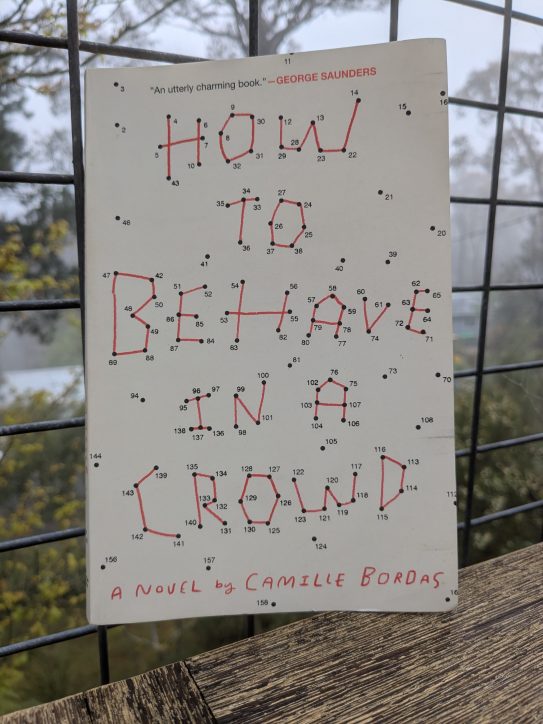
Recommend: Yes.
Whimsical. Twee. Touching. Charming. Do you have the ick yet?
In general, books described this way are a cause for concern. This sad word salad realistically will be poorly written, lazily constructed and mass marketed with Big W stock buyers in the cross hairs. But my cynicism was misguided with Camille Bordas’ How to Behave in a Crowd. This book is whimsical, twee, touching and charming. And good.
How to Behave in a Crowd is a simple, funny (and yes, even heartwarming) novel set in a family home in France. The narrator, Dory, is a self conscious, reserved twelve year old. His life is nearly entirely contained within the family unit and this insular focus universal to any pre-teen is artistically rendered by Bordas. The first chapter is called the “The Stain” in reference to an age-old stain on the family couch that’s satisfying to cover by smoothing the fabric in one direction, and then re-expose by ruffling the fabric the other way. Dory goes to school, comes home, spends time with his mum, struggles to get the attention of his disaffected older brothers, fiddles with the fabric on the couch. Rinse and repeat.
When my brother, Leonard, had begged my parents to let him go spend the tenth and following grades in boarding school, my mother hadn’t thought it qualified as adventure, even though Leonard had tried to sell it as such. He’d said boarding school was actually the ultimate adventure, that Flaubert and Bourdieu had gone to boarding school, and Flaubert and Bourdieu were the two smartest men who ever lived. I was four when Leonard made that speech, and the reason I remember is because I hadn’t really been aware that anyone existed outside of our family before that, and hearing that there not only were other names than ours (Flaubert, Bourdieu) but that they belonged to smarter people than my parents, that no one around the table – not even my parents – objected to it, made me panic and I started crying. My mother took advantage of my tears to seal her refusal.
“See,” she’d told Leonard. “You’re upsetting your little brother. Dory doesn’t want you to leave us.”
In the hands of others, this would be tedious and underbaked. But Bordas treats the mundane with such care that when tragedies do emerge (some small, some large), it is affecting.
At dinnertime, while we waited for everyone to come down to the table, Rose inquired about the blue plate my mother was always eating off and asked her if she was on a diet, because she sure didn’t need to be.
“Oh, how nice of you to say that,” my mother said.
Then my mother asked me to make sure Aurore came down to sit with us tonight because she really wanted to have us all around the table. Once we were all gathered, my mother said, “The father won’t be coming home tonight,” and this time it was because he was dead.
The father – initially a ghostly presence due to extensive business travel – haunts the rest of story, in an intriguingly light way. His death coincides with Dory’s coming of age, and the abrupt change to the family unit actually opens Dory up to the world. The changes to his small life after the death of his father are disorientating, and, for a twelve year old, monumental. His older sisters, older brothers and mother, having lived in the old family structure for much longer than Dory, find it difficult to talk directly about the passing away of the patriarch. So Dory has to find support elsewhere. He finds a best friend at school. He runs away from home and yarns with homeless people at the train station before they persuade him to go back home. He presents himself to his German teacher as a candidate to be mentored. Dory is putting himself out there. It’s sweet.
Dory grows older as the story progresses. We follow him from the age of twelve until about fourteen. As he grows, so too does the poignancy of the novel. We are watching Dory’s sense of identity emerge. He forms independent views and values. He begins to stand up for people he loves. He makes relationships that have no link back to his family.
There are also funny side characters too that pop in and out of the family’s sphere and Bordas allows these people just as much space as the narrator. At one point they get a fairly dim witted exchange student visit them, and the mother shows her hospitality by purchasing a cheap mug printed with Brad Pitt’s face stretching across it (“Didn’t you tell me Rose was a Brad Pitt fan?” my mother asked, now unsure). This only makes the sister, Aurore, hate her exchange student more. The poor exchange student. I think Aurore was threatened by the intrusion of a new person into their family, and the exchange student certainly bears the brunt of this frustration without being a deserving target.
How to Behave in a Crowd is a coming of age story. It shows a young boy, growing older, slowly getting used to his role in his family just as that family dynamic shifts forever. There’s an undercurrent of sadness, sure, but there’s also charm and whimsy. The twee is taken seriously. I was touched by this book.
At any other time, she was fine being in the middle, but she demanded a window seat for the ride back. She said looking at the seashore fade away through the window was a good way to get a grasp on her melancholy, and that being able to pull from a store of melancholy was what made great artists. “Car trips make great artists?” I asked, making sure I understood what my sister had said. “Car trips back,” Simone specified.

Leave a Reply