
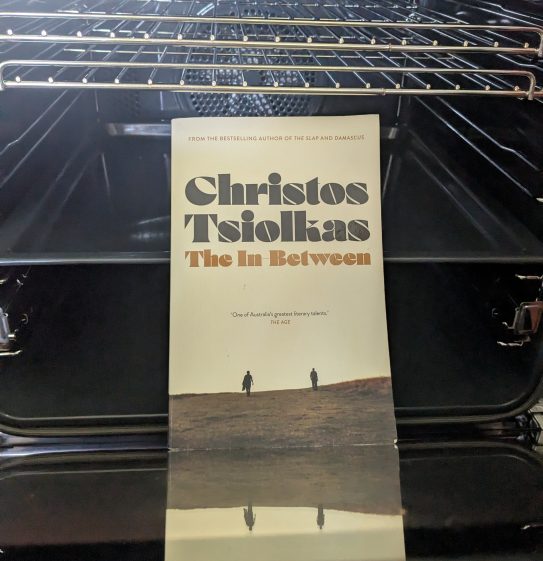
Recommend: No.
Certain periods of life are haunted by the great existential questions: Why am I doing this? What is this all for? If I was to stop, life goes on, so why do I persist? The weight of these questions are often unequal to the scenarios that give birth to them. They invade while waiting around the untended office cafe for seven minutes staring at a sign that says “back in five minutes”. They taunt while scrolling the sale section of a linen website, looking for an extra item to jump the hurdle to free shipping. And they settle solidly, indubitably, in-between the covers of the In-Between.
Tsiolkas’ first novel, Loaded, had fiery appeal. It was brimming with physicality – of both place and youth – that gave the short sentences a commanding presence. I remember being hurtled around Melbourne with the narrator, a listless gay young adult who wouldn’t be out of place in a Bret Easton Elis short story. I really liked Loaded. It was gritty and cold, a combination that Australian authors seem to really struggle with.
The In-Between reads as a tedious challenge the author has taken: now that he is older, he will write the total opposite of chaotic and youthful Loaded. The first indication of this is the title. It’s hard to think of a worse title than the In-Between. It’s a reference to the undefined space children of migrants and gay people and older single people inhabit in Australia. Actually, it’s worse than that, it’s all of the above, all of the time, all at once – older, single, gay children of migrants. You pick up a book named Loaded and you’re excited: there’s a fast, violent story to be discovered. You pick up a book called The In-Between and your mind wanders, thinking of the Woolworth’s Online order you should place in the next few days.
So I come back to what I consider the most important question: why did I finish this book? Why did I even buy it to begin with? If I knew from the title that it was going to be a moralising bore why am I wasting my time with it?
The plot revolves around two older men, Perry and Ivan, who have struggled throughout their life with their homosexuality. In their old age, they are finally finding peace with themselves, and their emerging relationship is playing a part in that journey towards serenity and self-acceptance. Yawn.
The boring plot is barely the worst thing about the In-Between though. If I had to choose what I disliked the most it would be a toss up between the endless moralising and the stupidity of the character Ivan.
Let’s start with the moralising. The novel is split into five chapters, and each is essentially just one long (long) scene. The third was probably the most bearable. In it, Perry and Ivan attend a dinner party with some old friends of Perry’s that he’s drifted away from. That’s a pretty awkward set up: a new lover intimately meeting friends you’ve long outgrown. But the chapter is dragged down by long discursions on gender politics and climate change. Tsiolkas tries to make the dynamic interesting by forcing the characters into arguments and showing them vacillate between old and new loyalties. Sadly, he is not a good enough author anymore to pull this off. Instead the pacing just feels off. His characters move in and out of support for each other randomly, so instead of the intended complexity he was aiming for, Tsiolkas just gives us characters that we don’t care about. It’s a bit like in Survivor when a tribe just totally implodes: alliances disintegrate and reform according to no discernible logic, and as viewers we are cheering the complete ruin of that tribe and the end to an unpredictable, pointless storyline.
I went a bit off topic there. I was trying to talk about the dull moralising and meandered into the unrealistic character relationships. Back to the moralising. Here’s an exemplary snippet from page 246:
“It as a different time, Troy. We didn’t have a washing machine when I was little. Mum had to wash everything in this tub and then there was this wringer thing.” Ivan stretches his hands out as far as he can. “It seemed enormous to me at the time but that was ‘cause I was so small. And Mum would be sweating in the middle of summer, putting the clothes through this bloody contraption.” Ivan sits up in the bed, mimicking those actions. “Raising two kids and working full-time at a factory. Thank fuck for washing machines.”
It’s pretty hard to imagine, but that is actually a conversation Ivan is having with a prostitute.
Gosh, Ivan was such a lazily constructed character. I hated so much about him. Every fifteen or so pages you get him declaring how proud he is that he is a grandfather, like he’s expecting a round of applause each time. Offering that, apparently he’s into such sordid gay sex that he’s afraid of being arrested, but we’re just forced to take this at face value. He probably just gets off sucking Perry’s toes. By the final, fifth chapter, he’s essentially a joke. Hard to take seriously a character that cries in the face of ancient Greece’s architecture.
Ivan turns around. There are tears in his eyes. “You know, when we first saw it from the road, coming around the bend, it looked so…” He falters, grasping for words. “It looked so fragile, so small.” He smiles wanly. “And then you come close and the sea is just beyond and the sky is so low.” He stops, heaves, and is quietly sobbing.
Tsiolkas’ writing is no saving grace for this novel. There were a lot of words I didn’t know and had to look up the definition, but then they didn’t seem to fit the sentence. Church bells emit a “bellicose” ringing. Definition: demonstrating aggression and willingness to fight. Church bells willing to fight?
In general, Tsiolkas’ writing is way too extreme. Given the structure of the novel being five long scenes, a lot of the background occurs in flashbacks. Tsiolkas, aware of his publisher’s requirement to have this book spawn over 300 pages, pads them out with dramatic prose (“The memory is always like a shard of glass slicing into his throat.”). Tsolkas, another thing, why are your characters always depicted going to the toilet or farting? It’s kind of off putting. The toilet scenes must spill over into double digits, but I’ve refrained from only choosing two.
Ivan rushes to the toilet and the relief is exhilarating.
Chloe belches, and then farts, all of the night’s toxins rising. She rushes to the toilet. She will never have cause to recall that stranger again.
Cuts to strangers observing Ivan and Perry every now and then are poorly executed. For example, we are with Chloe for only 1 out of an exhausting 370 pages and the above scene of her farting is the end of her brief life as a character. Presumably these intermissions are designed to be poetic, or perhaps Tsiolkas understood the audience’s yearning to step away from Ivan and Perry for a few pages. For me, they add nothing to the book.
The final chapter is the only chapter that deviates from Ivan and Perry’s perspective. We instead are watching them from the eyes of Lena, Perry’s ex-lover’s daughter. It’s a shit end to a shit book. Lena is probably meant to be a break from the all-encompassing masculine energy of the first four chapters. She’s so poorly defined though. Her defining trait is that she too is gay, so she reads as if she is an extension of Perry and Ivan, despite the fact she’s clearly meant to be a youthful, feminine reprieve from the two men. There’s also extensive back and forth between French and English and Greek language in this chapter that is possibly more boring than the moralising.
I found this book excruciating. I despised the characters. I thought the plot was bland. The writing was inexcusably terrible. I will never read Tsiolkas again. I should have stopped at page 30 of this book.
Yet here I am still, writing about and thinking of and wasting my time on this book. Have I gotten what I deserve?


Leave a Reply