
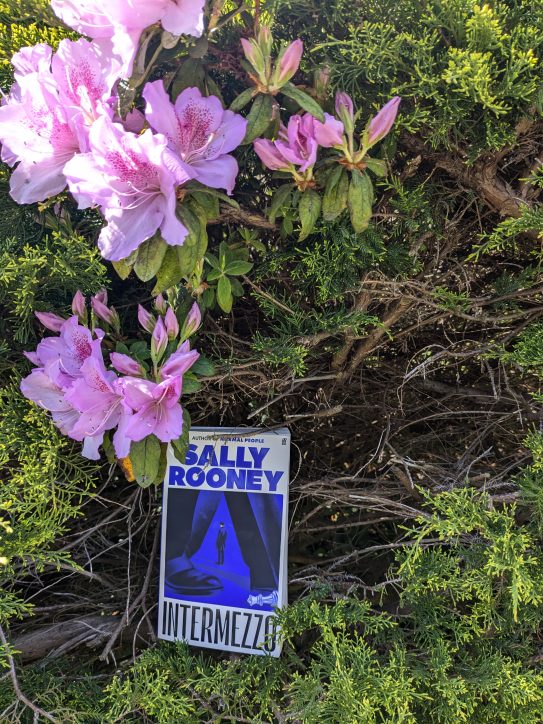
Recommend: Yes
Intermezzo is Sally Rooney’s forth novel, but only her second worth recommending. Conversations with Friends suffered from being insufferable, and Beautiful World, Where Are You was mostly forgettable. These two prior works had unlikeable, annoying characters pitched as relatable to women in their twenties. Neither were horrible books but both hid behind cynicism and trendy anxieties. Recall the unnecessary endometriosis subplot thrown in at the end of Conversations With Friends. Remember the email chains that padded out Beautiful World, Where Are You, one of which included a cringe discourse on plastic food wrapping at a supermarket.
Normal People was more balanced. It relaxed into its story about two people navigating their adolescence and looking further into a future that outgrew their relationship. Intermezzo, to me, is a maturing of Normal People. And I use that world ‘maturing’ deliberately, as age is the central theme of Intermezzo, and the plot weaves around what is lost and found with age.
Pensive reflections on growing older do not sit well with teenagers so, unlike Normal People, the youngest character is not a teenager, but twenty-two-year-old Ivan. From Ivan, hanging off the lowest branch of the family tree, to his deceased family patriarch, whose roots are now buried twenty feet under, all characters inhabit a different age demographic.
Another difference to Normal People is that Intermezzo concerns itself less with relationships developing over time, and instead focuses on how relationships, at a given snapshot in time, can bridge (and also strain) differences in age and therefore differences in context. From memory, Normal People spans around a decade. Intermezzo, however, unfolds over just a few months as Ireland plunges into Winter. This allows Rooney to probe more deeply into a relationship at a specific point of time, and Intermezzo feels more intimate as a result. Given the reduced scope, this is not a family saga, although it could easily be a long chapter pulled from one.
Very rarely do we see two characters of a similar age interacting in Intermezzo. The anchoring pair are Ivan (22) and Peter (32). Ivan and Peter are brothers, separated by a decade, who are processing the death of their father, which happened just weeks ago.
The three other main characters are the ladies romantically affiliated with the brothers. The eldest brother, Peter, is dating Naomi, a college student roughly the same age as Ivan. At the same time, Peter pines after his lost love, Sylvia. Except Sylvia is not lost in the literal sense. She is very much present in Peter’s life, but it is her youth that is lost, after an undisclosed ‘accident’ steals her very bright future away from her, leaving her with what appears to be very little joy. The third woman is Margaret, a thirty-six-year-old arts director who is seduced by Ivan. Well, by Ivan’s own way of seduction, which comprises of a lot of saying “sorry” and “thank you” – Margaret must have a subservience kink.
People of the same age are clearly designed to be foils and therefore are kept at arm’s length from each other to keep the point subtle. Naomi is bubbly and sociable and fully integrated into her social milleu (proven by her Only Fans account and disaffected text messages). Her peer in the novel, Ivan, is a sperg (proven by his chess championship obsession and stilted dialogue). They don’t meet until the final part of the book. Margaret and Peter are of the same decade, and for twenty-two-year-old Ivan, this makes them virtually the same age. Margaret is quiet and calm and tender towards Ivan, contrasting Peter’s boorish antagonism of his sperg brother. Again, these two only meet in the final part of the novel. The only two characters of the same age that spend the entirety of the novel together are Peter and Sylvia, and this feels almost incestuous. I am not rooting for Peter and Sylvia…
So what is Rooney advocating for here? It’s seems like the novel is in favour of unconventional relationships. Age gaps and throuples triumph. But the message is probably more simple than that. I think Rooney is cautioning us from judging the relationships of others, especially as we grow older and the life that we thought was full of endless romantic opportunities reduces. She shows that personal complexities are difficult enough to navigate privately and that they can quickly spiral out of control when inspected cynically by others.
There are certainly aspects of Intermezzo that fall flat. The conclusion of the novel leaves a sourness in my mouth; the plot rushes to an end too soaked in sentimentality. The characters are not always that interesting – specifically, I hated Margaret. If I am that sad and self-conscious by my late thirties, perhaps age is not something I am thrilled about for myself. Also, Sylvia’s ‘accident’ is too vague for how central it is for the plot. We never learn what happened to her and therefore don’t fully appreciate the impact it has on her current life, which is allegedly huge.
But ultimately there is much to like about Intermezzo and it’s an easy book to recommend. It is thoughtful when it comes to sibling tensions and is a touching introduction to one’s first grief: the death of a parent. I like the thematic of age, which is infinitely relatable. The writing is very beautiful at nearly all points (sadly, the exception being the conclusion). I really felt like I was watching an Irish Autumn turn into Winter. The supporting characters are drawn in an engaging manner. The mother of Peter and Ivan added considerable depth, despite being a minor subplot. The family dog, Alexi, is written with a lot of personality and becomes a character in his own right.
With Intermezzo, Rooney is aging into a new class of writers. Rooney leaves Ottessa Motesh, drunk and angry, at the party and chooses instead to dine with Ann Patchett and Anne Tyler. She looks back at the success she has found being marketed as a writer in her twenties and respectfully closes the door on that period. She will enter her thirties looking ahead, not behind.



Leave a Reply