
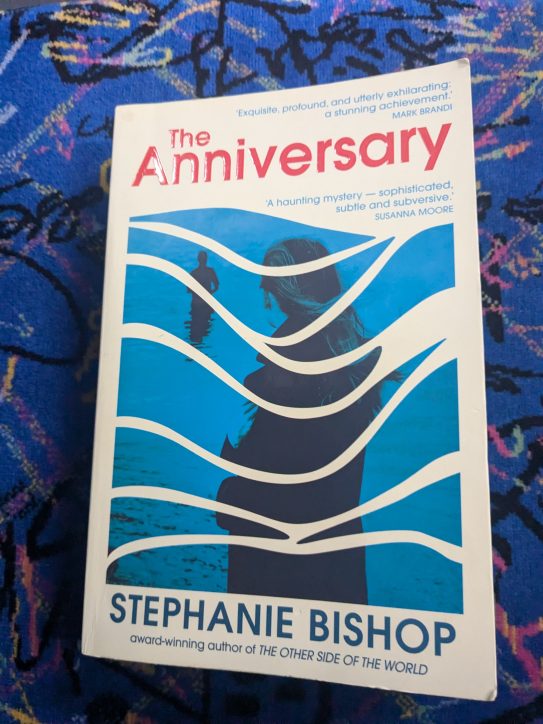
Recommend: No.
“For fans of Rachel Cusk or Siri Hustvedt” – Books + Publishing.
For fans of… Books + Publishing… I am wise to this code – this is a little lady at the publishing house telling me, with your limited funds, please, buy another book. Perhaps try Rachel Cusk. Or can I recommend Siri Hustvedt?
Life can’t all be filled with timeless works of art. I am at peace with that. I first heard about this book via the ABC Bookshelf podcast and it was pitched as a thriller set on a cruise liner, where a husband is a victim of a wild storm and finds himself overboard and drowned. At the time, Leo and Pauline were about to board a luxury cruise to Antarctica and I thought this would be a fun, pacy read that hints at the subtle stresses of holidaying in a vessel filled with strangers that are eerily familiar representations of your own class. I had also recently seen Triangle of Sadness.
The Anniversary is a more serious undertaking than I had expected. It wouldn’t be a book I would purchase as a present having now read it for myself. There are a few streams that we float along here, all of which are melancholy.
The most universal is the concept of the long-term romantic relationship and how it is the only one in life that affords space to the ugly and rotten. There are other relationships that have soured but all those disintegrate and therefore are just failures, stories that have concluded. The protagonist’s estranged mother is lamented frequently but not explored (this was a dud storyline that added nothing but bulk to the book). The husband’s child from a previous marriage, treated with distance and judgement, was a more interesting thread at the beginning of the novel but then quickly peters out – this woman completely ignores her now deceased husband’s teenage child that she previously spent most weekends with.
The time spent with the husband and the narrator is the true strength of the book. We are afforded flashbacks to their first affair that was born out of a classic power dynamic (teacher/student). The tension between the narrators’ rising success as an author and her husband’s established but stagnating career as a filmmaker is allowed to pulse throughout the backwater of their relationship. There is a true sense of love and respect and jealousy and age in their marriage. All of which are simple words but when portrayed attentively, as they are in the Anniversary, make for a satisfying read.
“But after a marriage as long as ours, the greatest of moods – the most savage accusations, the worst insults, even real hatred – can be given room and accommodated, rationalised, tolerated and perhaps forgiven, in a way. The simple feelings die off and are replaced. Surprisingly perhaps, and it is surprising when it happens, one can start to feel affection and even something like loyalty for this more nuanced state and the history it reminds you of that cannot be acquired elsewhere, or ever replaced. The meat is so densely marbled with fat that it can’t be cut off or extricated in any way.”
I feel like I am being quite harsh on The Anniversary by rating it “not recommend”. It is a novel that has been crafted – a lot more than I can say for other Australian novels I have read in the last year (Green Dot by Madeleine Gray springs to mind). It also has themes that are timeless lapping endlessly at its hull. But it was not in itself a timeless work of art.
It is infuriating that the power struggle at the centre of the book climaxes with… a book. The narrator has become a highly successful novelist, nearly eclipsing the fame of her husband. It’s frustrating – can’t the protagonist have success in any other way? She could be a partner at a law firm. A celebrated chef. Instead, uninspiringly, an author is the centrepiece of the novel. Florals? For Spring? The discourse on the limits of fiction and memory tedious and I am guilty of having skimmed through most of it.
The final issue I have with the book relates to a different thrust of the plot. One feature I was enjoying for the first three quarters of the book is that the author rejects the notion of being a mother. This fit the character well – a rather cold and focussed woman. (There of course is reference to her own childhood trauma when her mother leaves and I think at one point they think the mother has committed suicide and they drain a swamp? But then the mother appears later in the book apparently just having left the family? As I warned earlier, this is a very weak subplot.) And it’s demonstrated quite nicely in how removed she is from her husband’s teenage son from a previous marriage. But then the redemption arc at the end of the novel is that the protagonist eventually has a daughter of her own and that is now the sole purpose of her life. It’s a confused mess and it is a waste of my time.
Did she murder her husband?
There’s a lot of water to wade through before you find out.

Leave a Reply