
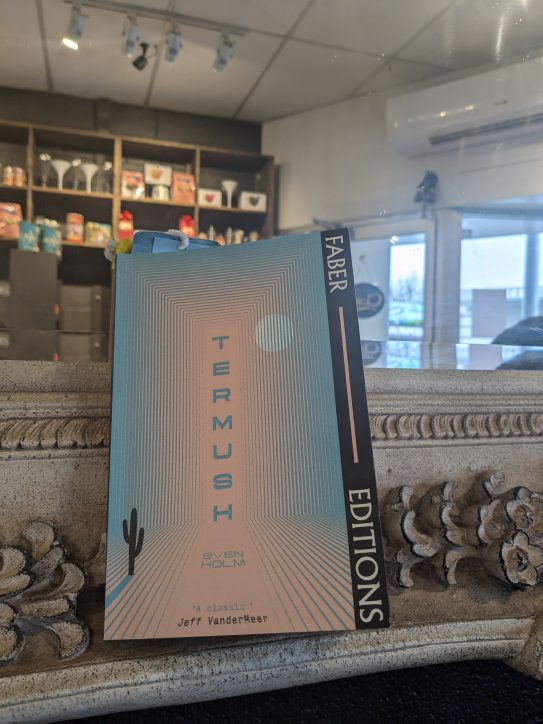
Recommend: Yes.
Walking back into the office after a ten-week holiday is disconcerting. My pass still opens doors. The relentless push and pull of the lifts in the middle of the office tower silently continues. The lunch menu has cycled back to where I left it. It’s as if even the air retains the breaths I exhaled months ago. How can this place, unchanged, hold me, changed? I have seen new things and grown. Yet nothing is different here; I must conform, and my evolution reverts.
Stasis in physical surroundings after a large societal change is the first indication of eeriness in Holm’s small novella. Our narrator wakes in the White Lotus evoking resort Termush after a nuclear event has irreversibly changed the country. The narrator is not here by chance, he has been paying for the privilege of a safe-haven for years and has visited a few times before on ‘false-alarms’. But this time is not a false alarm. The world as we know it has ended. Yet as the rich emerge from the bunker and ascend into the resort proper, they seek physical evidence of the calamity but find their rooms a parallel of their old world. There is artwork in ornate frames, mirrors intact, gardens maintained. Staff are present to cook meals and hold meetings, although as the novel progresses their titles devolve into ‘servants’. The safety of money proves resilient to absolute calamity.
“But we came back from our stay in the shelters to find a world changed less than a summer thunderstorm would have changed it. And now when we have a profound need for imagination and insight, none of us seems to have the power to satisfy it.”
With the superficial structures of class and physical comfort in place, no guest can (or is willing to) imagine what is happening outside the walls of Termush. Without a gun pressing at the temple, how can the human psyche process imminent death? It can only disassociate and hide within whatever feels familiar, choosing to respond at the very last minute, when the bullet meets the body.
“My confidence in the doctor is not unlimited. Like the other people at the hotel he is mainly concerned with his status; he is established as the chief medical officer. And the rest of us have the status of residents and therefore argue within the limitations prescribed for paying guests. Thus we each fulfil our respective roles so that the world will appear as it was before.”
But in a world devastated by nuclear fallout, this illusion cannot last. Chapter by chapter, the fortress of Termush refuses to fall, and the guests must reconcile their current (surely ephemeral) safety with the destruction that blows in and accretes within their mind.
“The illusion of complete safety so long as the margin is not reached bears the reverse implication of complete panic once the margin is exceeded.”
At first, I thought JG Ballard’s High Rise was an obvious peer but there the threat is internally generated and sustained. In Termush, it is the omnipresent outside that is constantly on the verge of punishing the guests for wilfully ignoring it.
Termush is a society, for those who can afford it, where everything is lost and nothing has changed. For now.
–
“One picture in our minds gives us constant anxiety; we see the day when the fish leave the water and push through the sand and earth to the trees, where they bite into the bark with their skinless jaws and drag themselves up into the branches to live according to new instincts. We see the trees bare of leaves, festooned with fishy skeletons, their skins rustling like a death-rattle.
We see the turtle lay eggs and burrow into the earth, where it dies of thirst; birds fall out of their nests without using their wings; the foal licks stones while the mare’s udder is bursting with milk; the goat flays its kid and tries to chew its flesh; the bee stings itself; the corn starts to grow downwards and the roots of the trees rise up to search for water from the air.
Our fear is no longer a fear of death but of change and mutilation. We have not thought this through and cannot talk about it, but in those moments when we are able to escape from our personal needs the picture becomes clear to us.”
Dek Addendum 28-Dec-2024: This books feels very modern. Jeff Van der Meer did the intro (which wasn’t actually that good and didn’t have any interesting insights) and it feels like a significant inspriation to his work. The writing has an oddly ethereal tone that feels dreamlike and very much like Van der Meer’s Annihilation trilogy. I think it worked well here to highlight the contrast of life in the hotel with the state of the world outside. It is easy to read (I must admit, I skim some of the more verbose and metaphorical descriptors, this is not the book’s fault but a failing of my tech addled brain) and very well scoped to just over 100 pages. A lot happens, but you don’t feel lost. The setting is intriguing, even for someone who has read more than their fair share of post-apocalyptic novels. Recommend = Yes definitely.


Leave a Reply