
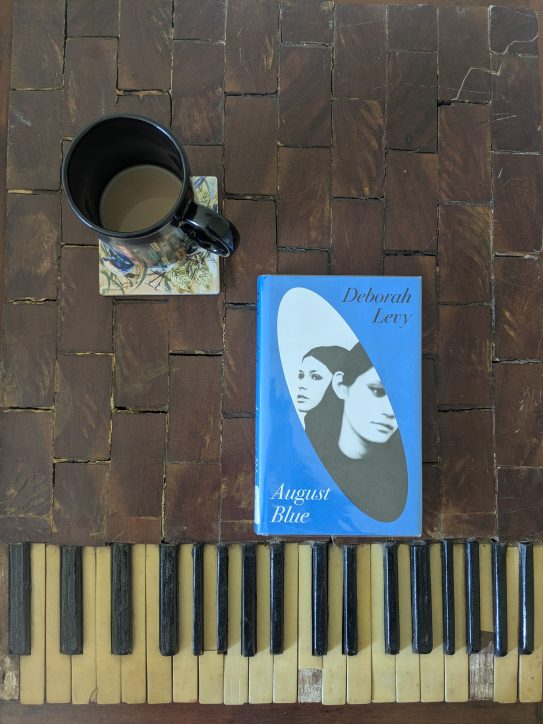
Recommend: No.
There are moments in pop culture that are all consuming and I am tricked into thinking they are timeless.
I remember being at my grandparents’ house in the boiling Coffs Harbour summer, sweating on the bed, playing Pokemon Gold, thinking that every free moment from that point onwards would be spent in service of the Game. Not that long later my attention turned to Billy Martin, my first and most potent celebrity crush. Billy Martin not a familiar name to you? Well, me neither anymore, I needed to Google’s assistance to remind me who exactly was that dreamy Good Charlotte guitarist.
So I was mentally prepared for Deborah Levy to fade away too. I’d been through this before. That heady infatuation I felt reading Swimming Home could never last forever. In the middle of a sunny Canberra Winter, I sat alone in a Manuka café, turning each page gleefully, fully absorbed in Swimming Home’s simple story of an outsider intruding on a purportedly idyllic family holiday.
But coming into August Blue the relationship between Levy and I was already stretched. Hot Milk was luxuriously but frustratingly vague. I still have absolutely no idea what was happening in Swallowing Geography. Her ‘living autobiography’ trilogy was critically acclaimed but ultimately, in my opinion, unmemorable.
Still, I never expected Levy to disappoint me like she did with August Blue.
Deborah Levy, I didn’t understand the point of this novel at all, which is sad as there clearly is a point buried deep within the saturated imagery.
The protagonist, Elsa, is a successful classic pianist who gloriously messes up a live concert performance. This reminded me of that scene in Stick It when Haley “chokes” and ruins her chance at winning Worlds. Redemption story clicking into gear. Emerging from the rubble of her career, Elsa arises a bit dumfounded and begins teaching piano to random rich kids around Europe to get by.
Off we go with Elsa to her teachings. During the first, in Athens, Elsa witnesses a woman purchasing a trinket that she herself desires. Elsa approaches the shop owner and learns that the woman has walked away with the last one. The shop owner says: don’t despair, there are similar trinkets in abundance. But alas, Elsa only wants the trinket the other lady has. Here is our second character: the mysterious woman who bought the trinket.
Our third character is Elsa’s father-figure, Arthur, who adopted her when she was around five, on the basis that he could make her a legendary pianist. Arthur is a very weird and uncomfortable character. He is almost comically unlikeable. His dialogue is often this kind of stilted alien poetry. Here is Elsa recalling this odd moment with her father-not-father when she was thirty:
A dark blue bird with golden eyes and a long tail landed on our table and positioned itself near the bread basket. Its left golden eye began to swell and expand, as if it were going to pop out of its head, and then it suddenly made off with our bread in its beak. It was as if we could literally see the planning of the bread heist in its left eye.
Yes, Arthur said, when we are possessed with inspiration, like this bird, the body alters, it changes.
Sure, that’s a totally normal thing to say…
That’s the thing with this book – on the surface things are normal (birds, bread, tomatillos) but the unsettling language and confusing scenes imply that the meaning behind these normal things is anything but normal. As the ladies on the ABC Bookshelf podcast said, “It’s all laden with meaning, but about what?”
There is an overarching purpose but I never understood it. What was leftover for me to consume had a gritty taste.
- There was the ambiguous concept of ‘doubles’ which weighed down the entire plot.
- I strongly disliked the chapter where Elsa is teaching a transgender child, which I see as quickly becoming a trope in female literary fiction (Miranda July, I am looking at you). I am finding that these segments are completely unemotional and never add any tension. It’s always an underdeveloped side plot that distracts with its focus on pronouns. Authors must think the idea of a transgender character is novel enough that they can just change a few pronouns and call it a day.
- The context of most of the novel was emerging from COVID lockdowns, though the scars of the pandemic are still easily visible. Ugh. My thoughts on this are known already. There’s nothing that slows the pacing of a novel down quite like explaining who is masked and who is not.. “My face was masked. He did not wear a mask because it hindered his breathing. I reached for his hand. Andrew was also unmasked.”
- The music jargon was exhausting. Levy’s audience are not classical musicians, we are females stuck in one place, dreaming of being in another. All this jargon was just more work at the end of a day that had enough work already stacked into it.
- The lascivious writing didn’t hit right. The metaphors were weirdly sexual when they really didn’t need to be. When Miranda July does it, it sort of works, because her books revolve around unexpected sexual encounters and are more light-hearted in general, so eccentricities don’t jar as much. Levy is a more serious writer, ala Rachel Cusk, and it just help her cause to be talking about keys and keyholes fucking.
It took a while to unlock the front door to my flat with a key that resembled a screwdriver. I had to press it into the lock and then plunge it further in again, not once but twice, as if it were a door with fathomless depths and the key was having sex with it.
The most keenly drawn sections of this novel were the parts that take place in reality. They had nothing to do with past lives or doppelgangers. An example is Elsa’s diving trip for sea urchins in one of her spare days in Athens. Elsa’s newly introduced boat-friend Tomas assists her post-dive:
My right hand was resting on his lap and I felt his erection. It was exciting, the spines being pulled from my fingers and his desire.
I felt like I could finally feel Elsa emerging when she was with these assorted male side-characters that are roughly her age. Unlike Elsa, these men are not endlessly questioning their identity, and they have full confidence that the world will accommodate their choices. When parted from them, Elsa floated off into the never-never, furtively hiding in delusions of a doppelganger
I struggled through August Blue. Can someone please explain to me what it all meant, so I can pretend it was worth it?


Leave a Reply