
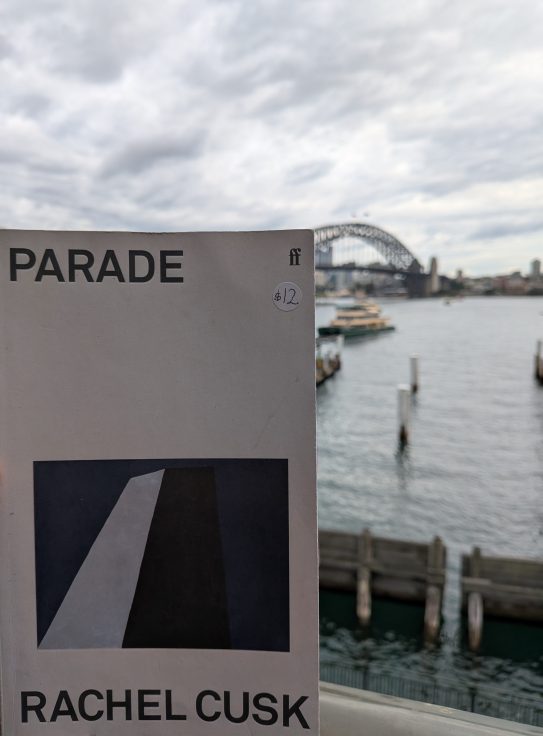
Recommend: No
There are many things an adult must endure for the prospect of bettering themselves. On a cold, rainy day in Blackheath I do not want take a three hour train trip into the city to go to work. Still, the accumulation of these mornings provides the routine and money that life is built on. The dentist drains some of the funds but in the service of improving health outcomes later in life. Constantly we have to make these accommodations, these investments, in the promise that some day later they will fruit joy and fulfilment. Reading Rachel Cusk has become one such chore of adult life. Her novels are increasingly time consuming and difficult and surely for these reasons must bring forth wisdom and richness and be endured.
I actually read the first fifteen pages of Parade on a Sunday afternoon in Blackheath. Progress stalled. Picking it up months later, I tried to read from where I left off, the crispness of the bookmark a symbol of my earlier neglect. However, it was apparent I remembered absolutely nothing about the plot. I returned reluctantly back to Page One. From here I remembered some of striking sentences – and let’s be clear, it’s her impeccable yet complex sentence structure that Cusk is famed for, not her plots – but still it was like I was reading the narrative for the first time.
Now I’ve finished the book, with the full clarity of hindsight, the absence of the plot in my memory does not surprise me. Even now I would struggle to tell you what happened in Parade and why. I can list off what it is about: art, motherhood, artists experiencing motherhood, motherhood influencing art. As to the actual lived realities of the characters, however, I am nearly clueless.
The structure of the novel is a bit of a mess. It’s ambling and confusing. This is a book where plot is non-existent, only cobbled together from stream-of-consciousness meanderings from the narrators’ engagement with the art around them. I think there are many different narrators, and that multitude does not make things any easier for the reader.
There were scenes at galleries (whose galleries I wasn’t always sure). There was an artists retreat in Europe (at least, I assumed it was Europe). And, most memorably, there was a long dinner party that was meant to be a celebration of an exhibition but ends up being more akin to a wake after a disaster befalls the preceding event. But any slices of clarity, the teasing almost-stories that are on the cusp of bloom, are deliberately obscured from the ‘point’ of the novel.
Cusk quickly jumps in and out of the perspectives of her few recurring main characters. Her attention falls instead on the interspersed ‘side stories’ of unnamed and presumably real-life artists. Cusk names them all ‘G.’, and slides promiscuously through each of their histories as though it doesn’t matter where one begins and the other ends.
Cusk takes immense care with each individual sentence. She endeavors to build her opinions about art and the artist’s prerogative with nuance. It’s just that these opinions are often boring and unrelatable. Yes, it’s clear that I have little interest in the creation of famous paintings and sculptures, and naturally I will find it hard to value Parade as a result. However, I would like to know: of those that are interested in such things, does such long winded analysis of how art fits into society, in both present and past, give pleasure? Intellectual stimulation, sure, I can easily picture Parade giving that. But shouldn’t novels as a form should also provide enjoyment, or at the very least a heightened emotional state? All of the above was present in Cusk’s Outline trilogy. But Parade, like Second Place, takes a much colder eye to the world, almost one of an academic surveying the creations of his students, with professionalism and judgement but not love.
I will admit there are some very interesting depictions of art, and for the parts that were woven into some semblance of plot I was happy to follow Cusk around the space. One of the early Gs (recall from early, there are many artist ‘subplots’, all of whom are named by the prefix G) creates inverted paintings of the world around them. The impact of these paintings on G’s wife, and the other females in G’s world, is rather exquisitely rendered by Cusk. It’s a too-rare occasion of the medium of art fitting coherently into this novel by helping unravel the depths of its characters. The paintings allow G’s wife to articulate the physical confusion she feels when trying to fit herself in with society.
When G’s wife first saw the upside-down paintings she felt as though she had been hit. The feeling of everything seeming right yet being fundamentally wrong was one she powerfully recognised: it was her condition, the condition of her sex. G made a painting she particularly loved, of slender birch trees in sunlight, and the demented calmness and innocence of these upside-down trees seemed to suggest the possibility of madness as a kind of shelter. How had he understood this nameless female unhappiness inside her that made madness such a temptation?
Later, the upside-down paintings call attention to her reluctance to integrate herself into the rules of society and suggest her detachment from her environment is deliberate.
Sometimes, at moments of crisis, she simply inverts her surroundings and instantly feels a sensation of peace. It is a habit she has got into over the years. Whatever is threatening or overwhelming in a set of circumstances is neutralised by being imagined upside down. It is the problem of perception, she understands, that has been removed – her implication in events is taken away.
In both these excerpts, art is secondary to the character of G’s wife. This is good writing. It is building something. It is when the artistic musings turn more random in scope that Cusk loses my attention. Here’s one that occurs as (a) narrator finds a painting in a gallery by a marginalised black author.
I was thinking of the virtues of difficulty and of how people who can find no reflection of themselves in their own circumstances might require proof of some boundlessness to the human soul, some distant and inaccessible goal toward which it reaches -might need to see the record of those attempts and to realise how far people have been prepared to run the risk of not being understood in making them. Not to be understood is effectively to be silenced, but not understanding can in turn legitimise that silence, can illuminate one’s own unknowability. Art is the pact of individuals denying society that last word.
It was one of many paragraphs I had to read over multiple times and, in this case, without any revelation. In this way the paragraphs accumulate without any point and can be quite difficult to follow logically. This sentence in particular sounds nice but I cannot for the life of me understand its purpose: “Not to be understood is effectively to be silenced, but not understanding can in turn legitimise that silence, can illuminate one’s own unknowability.”
There were many such occurrences where I needed to re-read paragraphs three different times to try and extract their meaning only to be saddened when I realised the whole segment – spanning pages – was not in service of the main plot and was merely an overlong aside of yet another ‘G’.
Cusk is a brilliant writer and for a select audience I assume all this mediation on art and artists is tolerable, potentially even be rewarding. For me, sadly, these types of a books are tedious. Their plots are only tenuous vehicles that have been crafted only to hold a diatribe on art that would sit more comfortably in a New York Review of Books essay. I also had this criticism of Cusk’s prior novel, Second Place. I am under the impression that Cusk, a wildly successful author, has outgrown fiction. It might be time for her to move onto other pursuits. If she doesn’t I fear that she will continue to punish her readers for her own loss of passion with the form.

Leave a Reply