
Recommend: No
Road trip movies are usually fantastic. At the same time as being incredibly specific to the physical locations, these movies appeal to a generalised yearning to be away from, and go back to, home.
Three of my favourites:
- Little Miss Sunshine
- Darjeeling Limited
- Y Tu Mamá También
Sadly, I found these pleasures of the road did not translate as well to the format of the novel. At least, not to this novel.
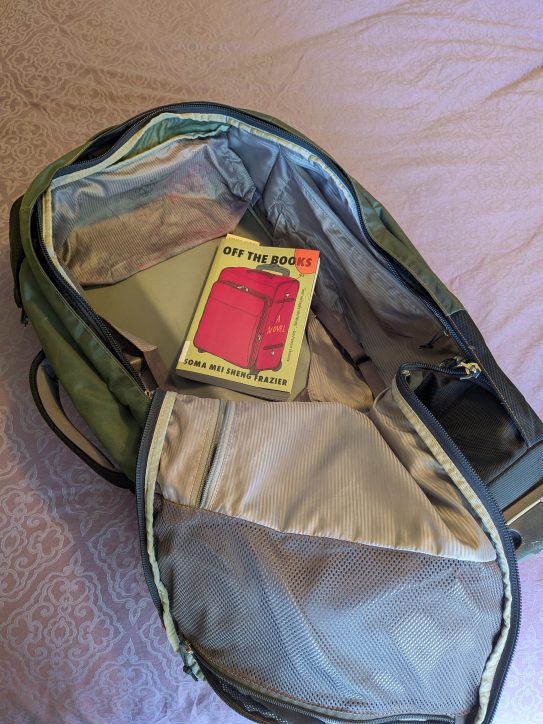
Off the Books‘ Chinese protagonist, Mei, is disgruntled with her low paying, on the books taxi driving work. Looking for more cash, she begins shuffling clients around ‘off the books’. The new clients are very well behaved prostitutes moving from one job to the next. Off the Books, however, spends next to no time on this, despite being featured heavily on the blurb.
The main plot of the book is about Mei’s latest client, Henry, who is a bit different to the whores. Henry is a suave professional, also Chinese. He has booked Mei to drive him and his ungainly suitcase from California to New York. Why does Henry need this ‘off the books’? Will him and Mei, both Chinese and both in their twenties, have things in common? And what is in that ungainly suitcase of his?
Those questions form the ‘twists’ of this novel. Answers to which consistently degraded the quality of Off the Books. Stumbling across the central conceit fifty pages in, it’s immediately obvious that the entire plot should have quite literally stayed off the books. Everything that follows, therefore, is condemned to be a waste of your time.
One of the aforementioned twists contains a political challenge to China. Theoretically this could have been interesting, but was executed so poorly that it was totally unrelatable and devoid of tension. The failures of Fraizer’s political protest are contagious. Not only has the plot suffered for it, but both Mei and Henry become quite annoying and one dimensional as they continuously belabour their (pretty boring and superficial) political view.
That’s in addition to Mei not being a well constructed character to begin with. Her dialogue in particular is weird. It’s all ‘bro-y’, as though she were an affable Paul Rudd character pinging around the back streets of America, which is completely unfitting for a Chinese-American who we are constantly told doesn’t fit in. Also, she has this gritty job where her clients are so spurned by society that they can’t get a regular taxi, yet she herself has no flaws or dark tendencies? There’s a reason Ryan Gosling is so compelling in Drive: he’s own morals, already sketchily held, are complicated by the crime he is around. If Mei was the main character in Drive she’d be played by Lisa Simpson.

That’s not to say the book is unreadable. Something works here in Freizer’s writing, I just can’t put my finger on what it is. There is an earnestness in Mei’s family relationships that is appealing. A key example is her grandfather, who is her role model, but is not a cookie cutter first generation Chinese immigrant. He smokes weed religiously (another Rudd-ism) and is the one to directly encourage Mei to take clients ‘off the books’. The plot is so unhinged that Mei’s relationships never get to unfold under believable circumstances, and therefore can’t quite be believable on their own merit. Still, there’s a glimmer. Freizer has captured something. It just wasn’t enough.
I don’t need to hop in a car and drive cross country to figure out that some adventures are best left in the planning stage.

Leave a Reply