
Recommend: No
I have read very few novels set in East Germany and have struggled with each of them. Most notable in the last few years was the interminable yet award-winning Kairos by Jenny Erpenbeck, which I really suffered through.
A year has since passed. Winter has settled in again. Morning frosts twinkle in cold greeting when we open the blinds. The electric blanket is stitched back onto the bed. Weekends are spent hiding inside. Stuck in the hardship of another Blue Mountains Winter, I succumb again to the cruelties of East German literature.
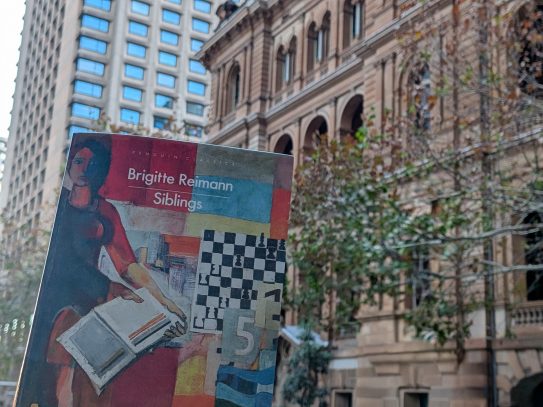
Siblings was written in 1963 by Brigette Reinmann but only translated into English in 2023. Less than a century has passed but the social structure of East Germany already feels entirely foreign to me, as though I were reading about an ancient civilisation. The novel’s protagonist, Elisabeth, is a young painter. She is at turns idealistic, petulant and passionate, marking her to be in her early twenties in my assumption.
Elisabeth is assigned to join a ‘brigade’ at a briquette factory. She is tasked with painting the proletariat as they strive in their hand-callousing endeavours. She sleeps in a dilapidated workers’ cottage and is visited by the factory workers in their rest hours to discuss art. Eliabeth overhears that the factory is prioritising (and purchasing) the inferior work of a party official over those of the artistic creations of the working class and tries to make her mark by standing up to said staid party officials. In doing so, she makes enemies and must endure the vehicle of the ‘party’ being mobilised against her. The struggle to follow is predominately ideological: to not lose sight of the benefits of communism when placed at the receiving end of its corruptions.
The plight of Elisabeth at the factory is not the most interesting thing happening in Siblings. I’d be hard pressed to call it interesting full stop. The emotional current coursing through the book wells up from the relationship that Elisabeth has with her family. In particular, her siblings.
Siblings opens with a violence between sister and brother.
As I walked to the door, everything in me was spinning.
He said, ‘I won’t forget this.’ He was standing very straight and not moving in the middle of the room. He said in a cold, dry voice, ‘I’ll never forgive you.’
I found the door handle and hung onto it for a moment out in the hallway while I waited for him to say something, or for a curse or a shoe to hit the door.
The intensity of Elisabeth’s connection to her brother, Uli, is evident from the first page. A betrayal has occurred. As is exceedingly common in this period of time in literature, there is no greater personal betrayal than a political one. Uli is disillusioned with the GDR.
The impact of this conflict amongst the two siblings is accentuated by the fact that Elisabeth’s other brother, Konrad, defected to West Germany a year ago. Elisabeth has clearly not forgiven Konrad for leaving her family, which was effectively an estrangement in her eyes. Uli’s flaws and failures are held up with excruciating judgement by Elisabeth as they reflect the ghost of Konrad’s flaws and failures too.
I am no good at analysing – my brothers often laugh at my lack of logic and insight. And I’m even less able to dissect that last conversation with Konrad to see what right or wrong things I might have said. In that half hour of wandering about, I had nothing else to do than come to terms with the idea that I’d lost my brother (and lost meant permanently, for ever); a brother who was alive and well, sitting at a table with a white tablecloth a few streets from where I was, who would fly back to Hamburg the following morning, build tankers, save up for a Mercedes, sleep with his beautiful wife, go the cinema, and carry on with his life…
It is this story of a sister and brother fighting over a three-day period that starts and ends the novel. There are long digressions, such as the chapter where Elisabeth recalls how her time in the factory challenged her faith in communism and then how she managed to come to a resolution through diplomacy. These sections of communist pride are a bit ‘holier than thou’ but they are eager and honest and do serve a purpose in the novel. Elisabeth is desperately trying to implore her older brother to remember the communist ideals she thought they had in common. Through these personal stories she is saying to Uli: I have struggled too, but I am strong and committed and as the older sibling, you should be too. She is truly heartbroken by the notion that Uli and her may no longer be a team with shared values, and she knows without this framework they will not be able to maintain the intimacy they have had up until now.
Siblings is well written. Reimann has control over the structure of the novel. The three siblings are not relatable to a Lena Dunham era girl but they are drawn solidly. I particularly liked how the conflict between Elisabeth and Uli was deepened by having the spectre of Konrad infiltrate the narrative. What could have just been a spat between a brother and a sister is heightened to the state of the tragedy of history repeating itself. Therefore the novel has enough emotional force to push through the undramatic sections about industry and party politics. It should be unsurprising that the strength of the novel – and its title – is the siblings, as Reinmann’s own brother left for the West only a few years before she wrote this novel.
Sibling’s was of interest to me intellectually. History Lesson Questions I asked Declan throughout:
- Q: How did Germany go from the end of Downfall to being broken into East and West Germany? A: Negotiations between the Soviet’s and US/UK. West Germany could have been correspondingly completely under US/UK control, if they had so desired.
- Q: Was there freedom of movement between East and West Germany, as characters seem to be able to visit each other with relative ease in this novel. A: Depends on the time period. Different political pressure was exerted at different times.
- Q: Did the East Germans hate the Nazi Party more than the West Germans? A: Keep your voice down.
Ultimately, however, the novel was too wound up in politics to be relatable to me. I can’t process how whole relationships can change, or even form, as a result of political views. I don’t know anyone who has a political view that is strong enough to exert that kind of power over their personal life.
So Reimann displays a lot of strengths in Siblings. I can imagine that, much like Hannah Horvath, she is a voice. Of a generation. Just not mine.

Leave a Reply