
Recommend: No
I picked up Cecilia second-hand on the premise that this was a South Korean novella. I was duped twice. Not only was Cecilia not second-hand – it was marked-down new Gleebooks stock (a hit-and-miss well to draw from) – it was by an American author! Scouring the book now for traces of why I assumed this was South Korean, I am coming up blank. I saw an Asian name on the cover and a photo of a cute little Asian girl on the back of the dust jacket and have clearly assumed what I wanted assume, only learning later that K-Ming Chang is from California, as American born and bred as Bret Easton Ellis.
Cecilia is a claustrophobic novella about a yearning between two high school girls and the dark places that surface when that yearning can’t be realised.
Seven, our protagonist, and her titular friend, Cecilia, play in their own bubble for many years of their childhood. Their friendship is hard to grasp. It’s intense and very physical, though not in a recognisably sexual sense. Sensual, maybe at times, but decidedly not sexy.
Seven, named by her immigrant mother after the American drink 7-Up, wants to be close to Cecilia in an almost violent way. She is infatuated with every physical aspect of Cecilia. There are common references to Cecilia’s piss and sweat. Seven didn’t seem to want to talk or listen to Cecilia as much as she wanted to inhabit and control her friend’s body. Only very few lines of dialogue are recorded between the two girls.
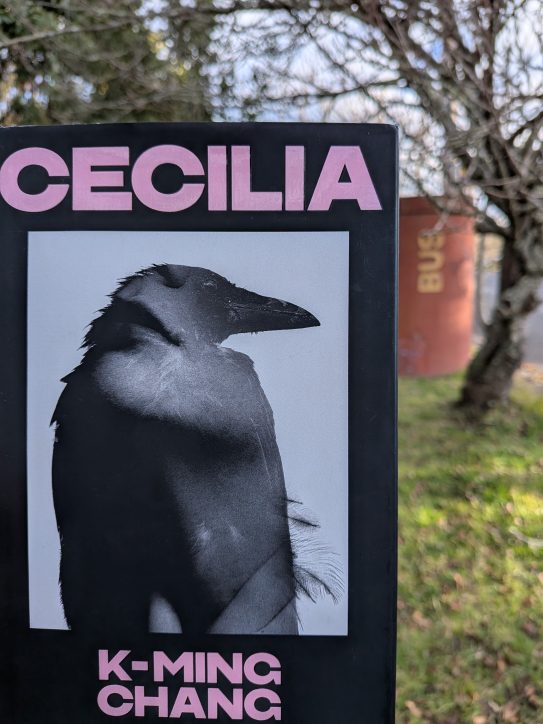
Cecilia was barely a human on the page. Cecilia was likened to animals by Seven more than she was able to speak for herself. The animal metaphorical motif is introduced at the very beginning by the cover art: a woman grasping herself superimposed on an image of a crow.
It’s an uncomfortable desire, and one that is hard to imagine a young teenage girl experiencing. I think this is also why I thought the novel was of Asian origin. It has a hostile framing of female intimacy that is foreign to me.
The memories of this past childhood friendship are unearthed when Ceclia and Seven meet again by chance in a chiropractor’s office. The two girls, now women, follow each other home, both seemingly lost in their miasma of shared memories. That is not a lead in for the reader to then unravel the rest of the plot for themselves. That is the whole plot.
K-Ming Chang has some brilliant metaphors in Cecilia. The issue is quantity rather than quality. The 130 page novella is just too laden with poetic prose. The language is soaked wet with obscenities of the body but there is no actual obscene content in the story. Just a lurking, unfulfilled desire to transgress, somehow. There is no room for plot or character or purpose when every sentence bursts at the seams with imagery and motifs. Much like the cover. A moonlight night imposed upon a woman touching her neck imposed upon a crow with a few feathers plucked out. It’s alluring but without a clear vision, and therefore without meaning.
Cecilia was a dollar bin CD special of a book. A cheap thrill to pick up. A cheaper one to discard.

Leave a Reply