
Recommend: No
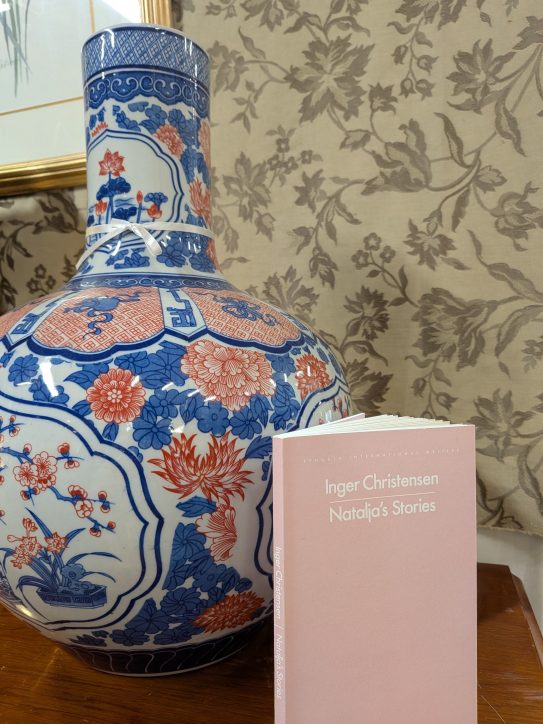
Natalja’s Stories could equally have been titled Nataljas’ Stories.
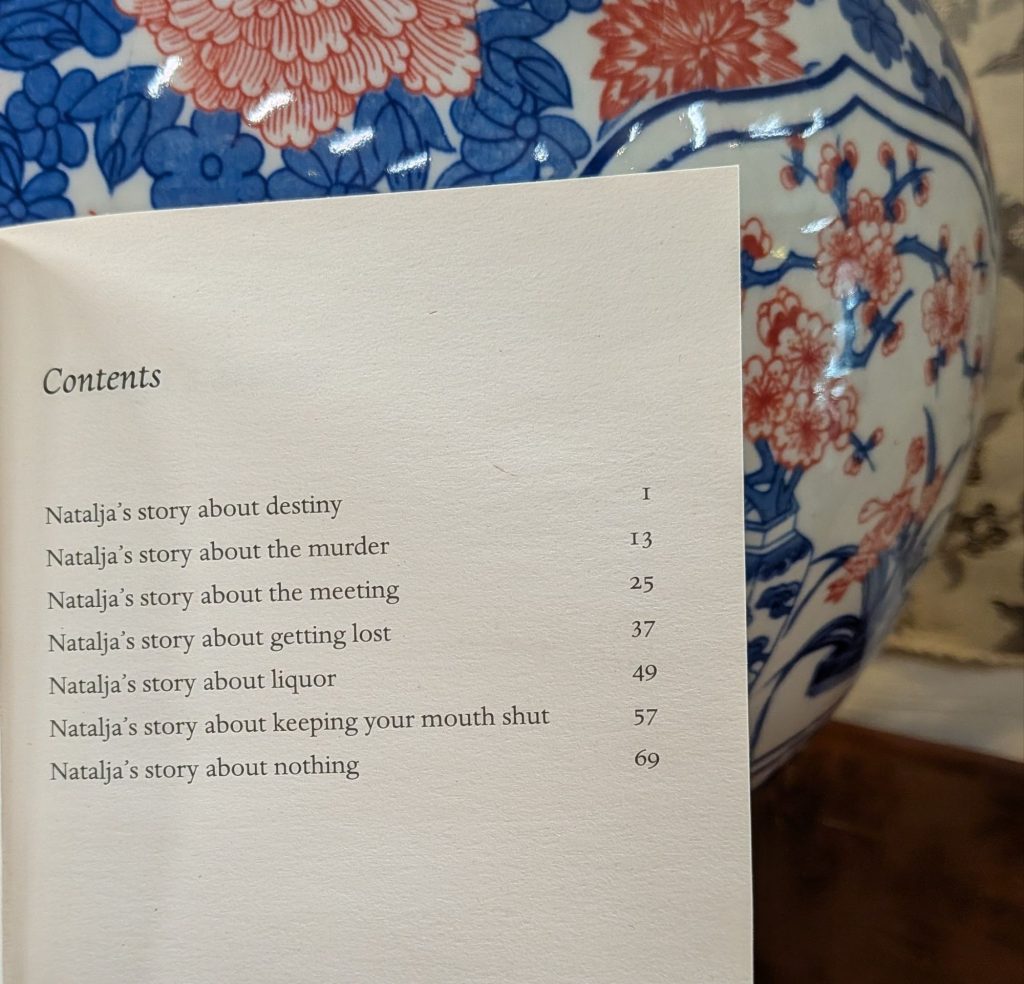
There are seven chapters that unfold in less than 100 pages. All follow a Natalja. But the question of who exactly is Natalja is a challenging one and gnaws constantly at each of the chapters.
In the first, a young unnamed woman listens to her grandmother, Natalja, recount her tumultuous personal history. Natalja was born in Russia “in 1887 on the outskirts of St Petersburg in a large wooden house with a veranda painted blue, and a garden leading straight down to the river to a small pier with a white pavilion”. Her mother, Marie, came to be here, on the outskirts of St Petersburg, because she was “abducted” by the travelling businessman Alexander Firenko. Not much later in Natalja’s retelling does this word “abduct” take on a more benign connotation.
The fact that the abduction took place was the result of circumstances that my grandmother always called lucky, happy, and fruitful.
The reframing of life’s key events occurs continuously throughout this small novel, beginning in this very first chapter.
Gradually, as time went on, my grandmother embellished the story, and every time it was told, new details were added.
I imagine the past was becoming clearer for her because she was done thinking about the future. I also think that she finally gave up hiding things from me because she’d rather divulge them than take them to the grave.
Basically, it was as if she was trying to make her entire life disappear into the story. As if she thought it would be best to get it all out of her body before she died. But new riddles, new people and incidents, continued to surface, and so she had to keep beginning the story over again.
The attempt to understand one’s life, when that life has been scarred by political and personal upheaval, is a near-unsurmountable challenge. Memories are nothing but stories, and stories can shapeshift easily around facts.
In the second chapter a women writes tales about her grandmother while she hides from the rain in a cafe. She writes about her grandmother’s “small Chinese crock with a lid, now being used as her mother’s urn, which she promised to bring all the way from Crimea to Copenhagen”. This must be Natalja’s story then, as we have heard these exact phrases being told to us in the first chapter. Though it’s disconcerting that this woman in the second chapter transcribing Natalja’s memories seems to be completely different to the Natalja’s granddaughter of the first chapter. Other than this reference to her grandmother’s “small Chinese crock” there is no overlap between the two chapters.
In fact, this second chapter quickly takes a wild turn, where the narrator recognises her ex-lover, dressed as a monk, walking down the street. She runs out of the café, abandoning her writing, yelling to the monk. Unable to move him, she follows him until the monk enters a house, only to not come out alive. The ex-lover monk killed her father (! where did he come from !), but was killed himself by a brand-new character, Badinot. Then Badinot, alive, convinces the narrator to act as his wife, even as he gets shipped off to prison for murder.
How did I fall in love with a man who could dress as a monk and kill my father? Why did I do everything he asked? And why do I align my destiny with the man who killed him even if it was only by mistake?
Honestly, WTF. Bring back the small Chinese crock.
In the third chapter that monk (recall: the narrator’s ex-lover who shot her father only to end up dead himself) is revealed to an everlasting demon that Natalja herself had a love affair with back in the day.
The fourth chapter has the narrator reliving scenes from Natalja’s stories: “a journey to bring my mother’s ashes from Paris to Copenhagen when the train I was on suddenly crashed.” But is reliving the right word? It turns our that the narrator is herself called Natalja. So has the narrator now switched to be the grandmother from the first three chapters? It can’t be because the narrator’s mother and father in this chapter are not the same as the Natalja from the first few chapters.
And so on the book goes, giving us scenes and actions and characters that are instantly recognisable from previous chapters, yet nothing fits logically together. Over and over and over again the same imagery and dialogue repeats, never once making sense.
Natalja’s Stories is a puzzle that I couldn’t piece together, no matter how long I stared at it, trying to cram each part into a cohesive whole.
Is the point to say that any story is arbitrary and therefore in its retelling it changes form from its beginning? Is it to say that we are only what we tell ourselves we are, and that we must make that legend anew every day, the result always slightly different from before? That this reinvention of self is simultaneously a gift and a force to be feared?
Are we meant to understand that life awash with chaos and the simplicity of fiction is wholly unable to reflect this truth the universe? Or are each of these Natalja’s simply all distinct, their similarities mere coincidence, and it’s the doomed fate of the reader to overinterpret a pattern that has no larger meaning?
I really couldn’t say.
Natalja’s Stories was a baffling creation, no better understood now in English than it would have been in the 1980s when in it was first published in Denmark. It was well written, but its narrative structure was utterly bizarre.
Although I would love to study this story – there surely must be something to learn in all that complexity – I would not want to read it again. It was painful without enough pleasure.
There once was a cat called Mirage. That’s more or less how I thought I would begin my story. Now of course you can say it’s already begun as I thought it would – there once was a cat named Mirage and so on – whatever I can come up with now doesn’t matter because it would be just one of countless but similar false beginnings. And if it had been a true beginning I would not have noticed it, would not have mistrusted it, I would not have ceased its development, and so on.
But why hide the fact that only Mirage the cat holds the big picture of this story and thereby knows its correct imperceptible beginning, while I am obliged to pick and choose between random sentences that say nothing to me because I am unable to see where in the story they belong?
Therefore, I might as well use my original false beginning, which is as good as any other. there once was a cat named Mirage and so on, whatever I can come up with now.

Leave a Reply