
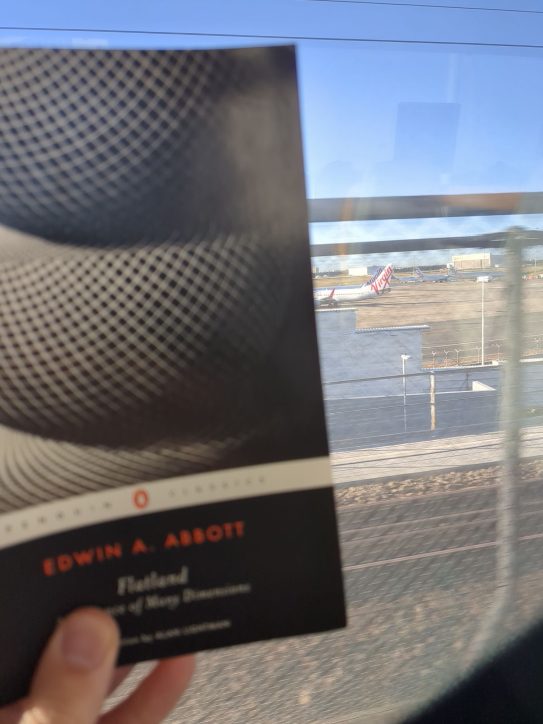
Recommended: Yes, if the idea of a 2D world intrigues you.
This may surprise the reader, but as a 14 year old my identity was in no small part defined by thinking I was smarter than most adults. As a result, when we watched the Flatland animation in Mr Martin’s Year 9 maths class I latched onto the concept of the fourth dimension, vaguely pretending I understood what it implied. Revisiting the book now, many years later, is a fun exercise. It has more layers than I was expecting (even if none are particularly subtle) and is short enough not to outstay its welcome.
Like all good science fiction writers, Edwin Abbott understands that all the fun is in world building. He goes for a surprisingly modern 60:30:10 split of world building:actual plot:wrapping everything up in a few pages. This means you get to enjoy the details you bought the book for: how does rain work, what do Flatlander houses look like and how we should forcibly rework the lower classes and if they fail to adapt, then consume (a very Victorian feeling euphemism) them and bury them in a pit?
The Victorian quaintness, underpinned by a sometimes brutal practicality and all sorts of -isms (not any of the good ones), has some of the same charm that Neal Stephenson captured in The Diamond Age. Flatland is very readable despite its heritage (over 100 years old!) and reads like a contemporary parody of Victorian society.
Despite exploring a plausible 2D world, do not expect Flatland to be consistent, correct or complete in itself. The more you think about certain issues, the more questions you have. Edwin sneakily acknowledges this: “for this reason I must omit many matters of which the explanation would, I flatter myself, be without interest for my Readers” and then goes on to list the items that we obviously crave insight to. It answers enough to keep you engaged, but leaves wide open holes. You can only assume they are operating under a different set of physical laws than us, but alas, this is not explored.
A more modern approach towards dimensional curiosities can be found in Cixin Liu’s Three Body Problem trilogy. In a memorable scene a dimensional folding weapon is launched and a solar system collapses into two dimensions. The sun’s fusion process start to slow and stop, unable to maintain its reaction without a third dimension, but carried on by inertia for a painful death. This is the good stuff, but admittedly, would have been prophetic beyond measure in the 19th century.
This is a good book for a long flight or train ride. You can tackle it in its totality and if you stop paying attention for a bit, it doesn’t really lose anything.

Leave a Reply