
Recommend: No
If you hold in your hands a small Japanese novella from the twentieth century translated into English, with high likelihood you hold the words of a person long dead from suicide. In the last few years, I have read and enjoyed many of such novels. Hit Parade of Tears by Izumi Suzuki kicked off this morbid trend, followed by Yukio Mishma’s Star and quite recently the enigmatic Kappa by Ryunosuke Akutagawa.
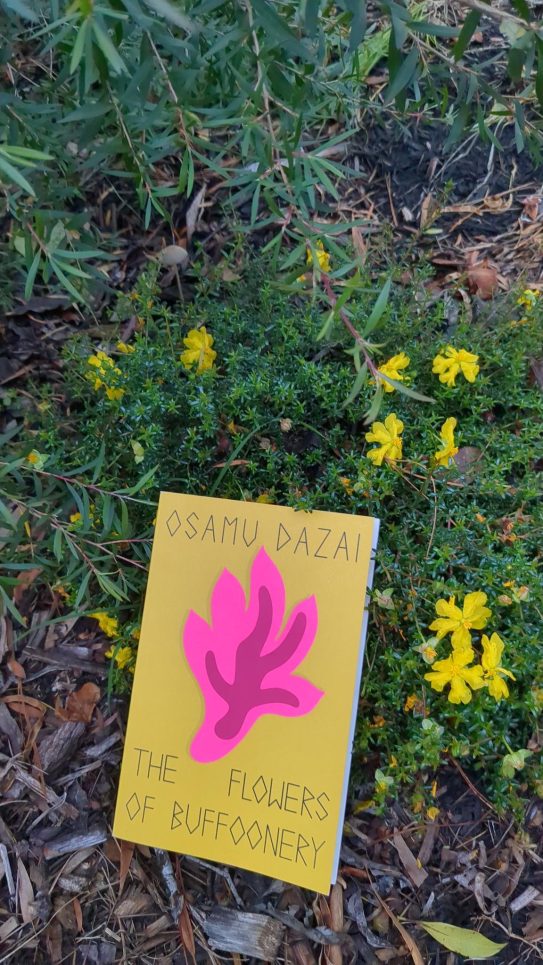
I knew I was doomed to continue the reading pattern when I picked up Osamu Dazai’s Flowers of Buffoonery. I’d already read about the tragedy indirectly in Yuko Tsushima’s eerily named short story The Watery Realm. Tsushima was the daughter of Dazai and was only a one-year-old when he committed suicide. Dazai drowned himself and his mistress in an aqueduct outside of Tokyo. The Watery Realm shows a destructive obsession with water that runs down a family lineage, the matriarch of which recounts how her husband was ‘taken’ by a water spirit.
It’s all pretty dark and it’s all very sad.
What of this hundred-page novella then, The Flowers of Buffoonery?
The titular buffoons of the story are a group of three male friends who convene at a coastal sanatorium in support of one of their members, Yozo Oba, who is accused of committing suicide. This is a particularly grievous charge given it is a lover’s suicide. The lover, a waitress named Sono that Yozo had met only a handful of times, is now dead. Yozo, garnished with a frightening head wound from jumping off a cliff to his supposed death, is convalescing in the small sanatorium near the incident before he will need to talk to the police. It’s not the first time I have met the tragedy of a lovers suicide in Japanese literature, and specifically not the first time it happened by the ocean, having formed the entire plot of Seichō Matsumoto’s Tokyo Express.
So far, my description of the plot hasn’t sounded like the breeding ground for buffoonery. The word buffoonery is defined as “foolish, clownish behaviour or absurd antics intended to make others laugh, often perceived as immature or undignified”.
The extremely serious events (attempted suicide, grievous injury, death) that have taken place before the opening of the novel are deliberately contrasted with how Yozo and his friends interact. The three men trace their friendship back to their early twenties and have never learned to communicate emotionally with each other. They can only provide support through agreement or humour. There is a constant struggle between the three men to say something more meaningful – to talk openly about what has happened and what it says about the past and what it means for the future – but all three cannot overcome the non-confrontational social structure that has always kept the trio close.
These boys never really argue. Ever so careful with each other’s feelings, they tiptoe from one comment to the next, taking great pains to shelter their own feelings in the process. They’ll do anything to avoid being ridiculed. Truly, they’re convinced that if they ever did do something hurtful, they’d either have to kill the other guy or die themselves. It’s why they avoid conflict as a rule. These friends know all kinds of expressions that could smooth things over. At least ten different gradations for conveying what essentially means “no”. Long before any type of conflict can emerge, they’re exchanging gestures of diplomacy.
Dazai has no sympathy for these three men. He treats them with derision. There are small interludes where Dazai comes into the novel via authorial first person and literally tells us he is sick of cowardly characters.
Excuse me, but I have to intervene. Otherwise I wont be able to continue. This novel is a total mess. I’m making myself dizzy. Yozo is too much for me, and Kosuge is too much for me, and Hida is too much for me as well.
The interjections of the author are brilliantly fresh. At times they frustrated me – it’s only a small novel and I was unsure what they were adding to the story at hand – but when looked at holistically at the end I understood they added a necessary cynicism that forces the reader not to attach to the group of friends. It’s as though the Dazai was worried the insult of the title was not clear enough. These men are buffoons and not to be admired, and just in case we lazily forget that, Dazai himself pops up to explicitly tell us this.
The most egregious example of the friends refusing to acknowledge reality is planted on the first page. The novel begins with the sinister implication that Yozo has murdered his lover, delivered in a monologue only the reader witnesses.
Speak up, friends. Ask away. I’ll tell you anything. It was me – these are the hands that pulled Sono underwater. In my satanic insolence, I prayed for my salvation in the same breath that I prayed Sono would die.
Not once is this discussed amongst the men, despite Yozo clearly burning inside to confess his sins. The friends instead play cards. They wander the beach ogling the female patients sunning themselves. They discuss the merits and flaws of art. They relay exaggerated comical stories accumulated in the times they do not spend together. But amongst all the laughter and backslapping and good cheer, not once do they mention Sono. They barely mention the interview with police that will happen in the days to come, and when they do it’s only to relay a generic platitude that “it’ll work itself out”.
As I was reading The Flowers of Buffoonery I don’t think I appreciated the darkness of its content. It is so easy to read, and there are so many scenes of unusual frivolity, that I think the truth slipped right by me. I thought I was reading a novel of friendship, which at the time felt bizarre given the treacherous events that brought us to this ominous setting of the sanitorium. After a few days of reflection, I can see this was novel was in fact about the failings of friendship.
Buffoonery here is forced ignorance, a sloppy protection from pain and uncertainty.


Leave a Reply