
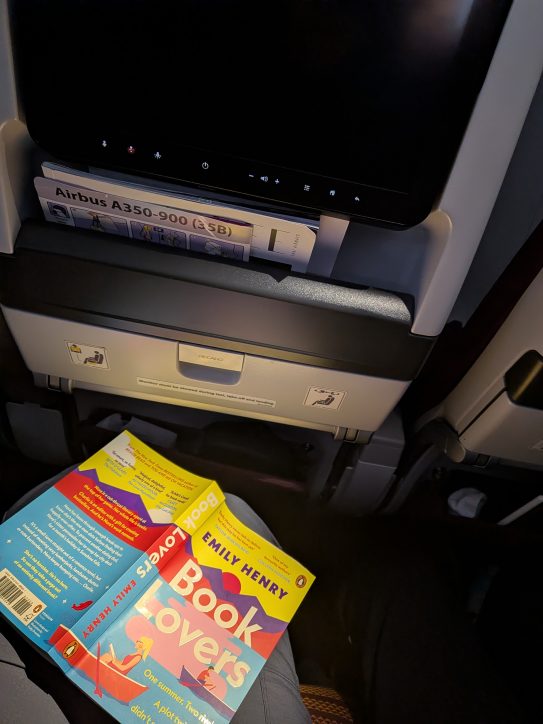
Recommend: No
Most of the time our lives are defined by rules. Work weeks are five days. Beer is cooler than cider. Holidays are for fun. You must know how to hold a baby. If these basic rules are disobeyed there’s discomfort from all around. A tension crackles in the background like a fallen wire, hot and dangerous.
The best of genre fiction leans into the comfort of rules without feeling bound by them. Genre fiction is able to thrill you through small fissures to the shroud of expectation in which it lives. A glitch in the Matrix.
What happens when a genre fiction author doesn’t transgress though? When they take the structures created by those who came before them and refuse to add anything new? You end up with a book like Book Lovers, filled with the meaningless fulfillments of our own lame expectations and nothing more.
Let’s be clear: Emily Henry, after a five day work week, orders a beer, expresses excitement for an upcoming Japanese holiday and, with correctly assumed maternal instinct, holds a friend’s baby to her chest. She is a carbon copy of what worked for others, and shamelessly so.
If genre is a grand old manor built and maintained to protect its authors, then Emily Henry is a nightmare of a house guest who slinks in the door, unpacks her bags, stretches out on the couch and plays on her phone – as though she’s always been there, as though she owned the place – sapping the energy of the place without offering it improvements or respect, or even offering to pay rent. If you’re going to profit off a genre without challenging any of its boundaries it’s hard to argue you’ve done anything more than copy someone else’s novel.
If it wasn’t clear from the garish and irrelevant cover (not one lake features in this story, let alone a boat), Book Lovers is a romance novel. Main Character has a sister who she is sickly in love with. Main Character and sister go on holidays to a cutesy small town for an extended holiday. They are American, of course. Main Character just cannot stop working – gosh, what a successful woman. Who should turn up in this small town but Main Character’s male Work Nemesis? That’s right. Work Nemesis was rude to Main Character once. But he’s so cute though…
Henry couldn’t care less about her book. She must have been paid by the word for this book. Why else would it go on for nearly 400 pages?
Halfway through the book the love interests (yes, that’s right, in a shock to all Main Character and Work Nemesis end up hooking up, eventually, after about two hundred pages of tedious repetitions of ‘will they, won’t they’) accidently merge into the same character. The two have the exact same dialogue (‘I fucking love New York’, ‘You fucking love New york’). They have the same career aspirations, although I seriously doubt Henry has ever once worked in an office.
The most unforgivable: the writing sucks.
Every second page uses the word ‘fucking’ as a point of emphasis.
If I were normal, I might’ve cried. Instead I’d sit there, and just fucking shake.
I felt physical shivers of revulsion every time the sisters refer to each other in dialogue as “Sissy”.
Then there’s a heavy handed ‘meta’ subplot where Main Character is a main character in one of her client’s books, where she is described as a ‘shark’. I wish I had tallied how many times the reference to Main Character as a ‘shark’ comes up – I think easily double digits.
So the writing is poor. Does Book Lovers redeem itself through its interaction with its genre? No, no, no. It does not.
Genre should be a home where you can safely spread out and pick through your specific life. The true self should be able to push up against the protections of the generic until there’s an understanding of where the two cannot coexist.
Book Lovers instead uses the romance genre to disguise laziness. It uses all the tropes of chick lit but seemingly deliberately eschewed its hallmark humour and hope. The stakes are outrageously low. The Main Character yearns for the career she really wanted, book editing. She’s a book publisher. That’s like me being heartbroken that I am an interest rate swaps trader and not a government bond trader. Time wasted on a background of a dead mother is so stretched that even Main Character’s sister seems to have lost interest. The romantic conflict, the purported center of the book, is overwrought and anticlimactic, much like the heavily foreshadowed sex scenes. I’ve seen G-rated movies that are sexier than this pulped wood. If all sex offered in real life was this bland there’d be less wars but also the real threat that art wouldn’t exist and that the population wouldn’t perpetuate itself to the next generation.
I’ve never seen Charlie [Work Nemesis] so uninhibited and I’m drunk on the power.
“God,” he says, “I need to be inside you.”
Everything in me pulls taut. “Okay.” I nod furiously, and he laughs again.
“No, you’re right,” he says. “Not here.”
“We don’t have many options,” I point out.
“When we finally do this, Nora,” he says, straightening away from me, his hands slipping my buttons back into the buttonholes as easily as he undid them, “it’s not going to be on a library table, and it’s not going to be on a time crunch.”
Oh, go on, fuck in the library. It’s page 246. That’s the least you can do for us.
Henry commits the greatest sin of genre fiction: she just lists out the conventions in an endless Tell Not Show.
- Main Character is hot.
- Work Nemesis is hot.
- Main Character is a business bitch.
- Work Nemesis is smart.
- Sister is schwilly.
“That was my sister, Libby,” I say. “Ignore everything she says. She’s always horny when she’s pregnant. Which is always.”
- Main Character and Work Nemesis have chemistry. They address each other by their last names in awkwardly intimate dialogue despite having only met a week ago.
“All right, Stephens,” he says finally. “Let’s hear about your family.
- A Gossip-Girl level miscommunication later and we’re at page 300 but it feels like page 3000.
Book Lovers risks nothing, circles Go and collects the money.
If it hasn’t already, AI will write this novel. AI is an emotionless pattern matching algorithm after all, and that is all that Henry is. More generally I fear that genre fiction, with all its codified repetitions, will stop being a vehicle of progress and will be the low hanging fruit for AI to slop. If we accept low-effort books like Book Lovers as genre fiction (which we do by buying it) then we’re proving to a publisher that we’ll support anything that reproduces a pattern. We’ll get what we deserve.
This could be pitched as genre fiction as a comfort. You know exactly what will happen and you don’t care and then it happens exactly as you thought and you still don’t care and not once has anything been demanded of you. I have some sympathy for this. But I refuse to think it any better than a YouTube short. It’s entertainment that hasn’t cost the author anything, while costing you $25. It’s a greasy slice of pizza when you should be eating the local food. It’s Love Island when you should be watching City of God. We should try harder. We should aim for more.
Thank you Mum for your gift for the plane. Sorry I didn’t like it.


Leave a Reply