
Recommend: Yes.
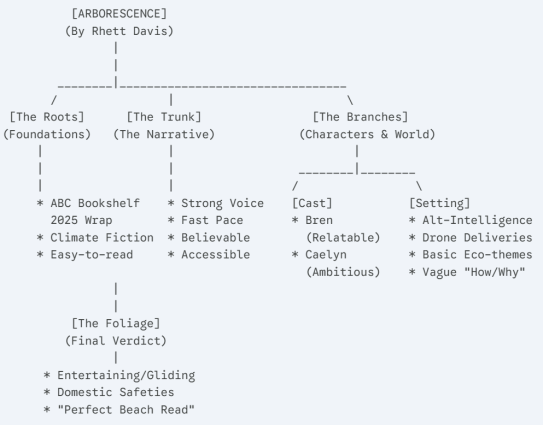
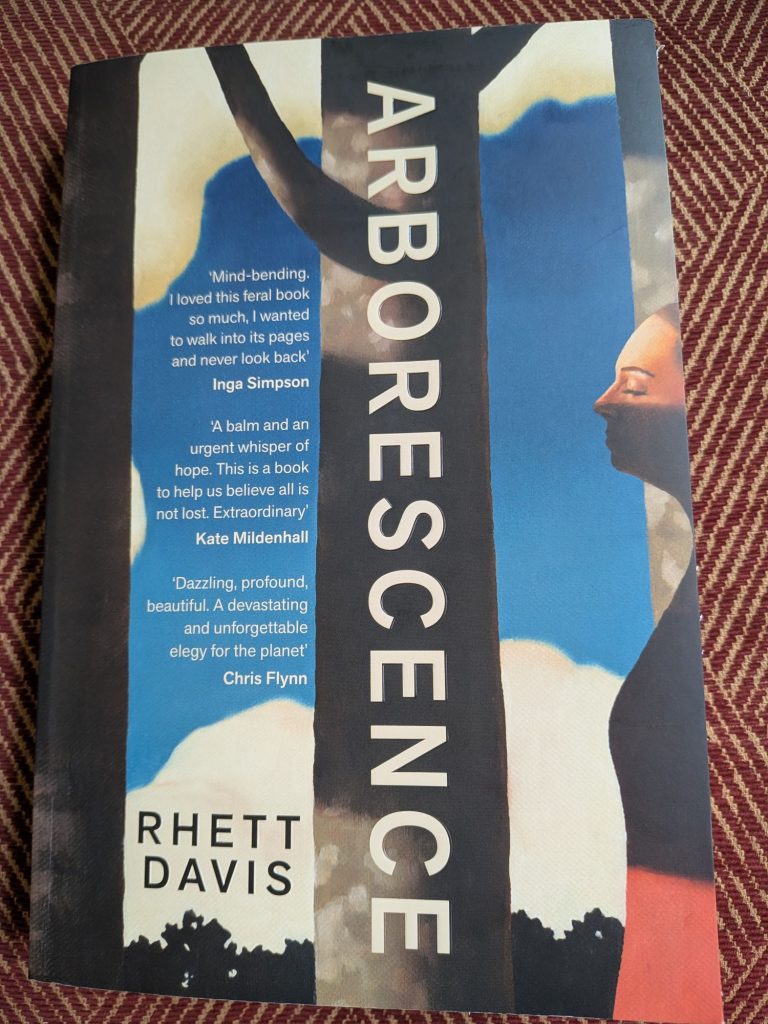
Rhett Davis’s novel Arborescence featured heavily in the ABC Bookshelf’s 2025 wrap. After reading it I can understand the appeal. The novel is an easy-to-read climate fiction tale depicting a phenomenon of people are turning into trees.
I was a little hesitant with the plot. I was worried there would be simplistic, easy emotional twists: would this actually be a basic story of grieving lost loved ones tricked up with some science fiction ideas? This wasn’t the case. For the most part the narrative voice is strong and the book glides along at an entertaining pace.
The two main characters, Bren and Caelyn, are dating. They live in a world that feels very similar to our own but there are some key technological discrepancies. In their world, the characters hang out with friends at a bar after work but that work is for companies that rely predominantly on ‘Alternative Intelligence’. They eat peanut butter and noodles, as we are want to, yet it’s insinuated that these goods are delivered via drones that bleep around the city skyline. So the setting is a near future where technology has asserted itself a little too much and achieved no great improvement in lifestyle.
Arborescence starts with Bren trying his best to support his ambitious, yet deeply confused, girlfriend as she studies small quirky groups of people in the countryside trying to become trees. To have the characters involved academically with the tree movement is a smart strategic decision by Davis. It serves as a good vantage point to watch the early developments of the plot unfold. It ensures that the main characters are observing this phenomenon from the early stages and has them doing so with unemotional distance. The readers are ‘safe’ with Bren and Caelyn. This trust means that the drama rises as the situation escalates. Having the main characters too emotionally involved in the action too early would alienate the audience. If I picked this book up in a shop and read a tree’s stream of consciousness on the first page, I would have put it back down in the pile.
The power balance of this relationship between Brett and Caelyn changes as Caelyn’s ambitions become more targeted and praised by society. It was their changing relationship that secured my investment in Arborescence, even when the less traditional plot elements weakened.
Rhett Davis is not a master world builder. The processes of people becoming trees (‘arborescence’) is not elaborated on in great detail. Davis falls back on an age old safenet: if the characters in the book don’t understand what is happening, then there’s no need to flesh out details for the readers. Why this is happening now is also hand waved away – superficial allusions to biowarfare, ancient genetics and the ‘earth fighting back’ are touched in the space of a sentence.
The environmental considerations are also pretty basic: we’re consuming too many resources as humans, and wouldn’t it be better if the burden of humanity was lightened? And what of the gross irony that Rhett Davis is making his living from the pulping of trees to produce his book…
But what Davis doesn’t gloss over is the voice of his narrator, Bren. His perspective is rooted in believability. Bren is not an extremist and does not react to this new world of humans transitioning to trees in an alarmist, overbearing way. Nearly all of his focus is actually given to Caelyn and supporting her as she discovers her purpose in this new, increasingly tree lined landscape. There’s a comfort here to me; no matter how weird and dystopian the world there are still domestic safeties to retreat to.
Arborescence
is interesting and
quite well written. The
characters are fairly relat-
able. The dialogue is fine. It’s
got that charisma of a well developed
narrator and a hefty helping of page turning
gusto that makes it a ‘recommend: yes’ book.
| |
| |
A perfect
Summer beach
read. Or
mountain
read.
| |
| |
To tree or not to tree, that is the question.

Leave a Reply