
Recommend: Yes
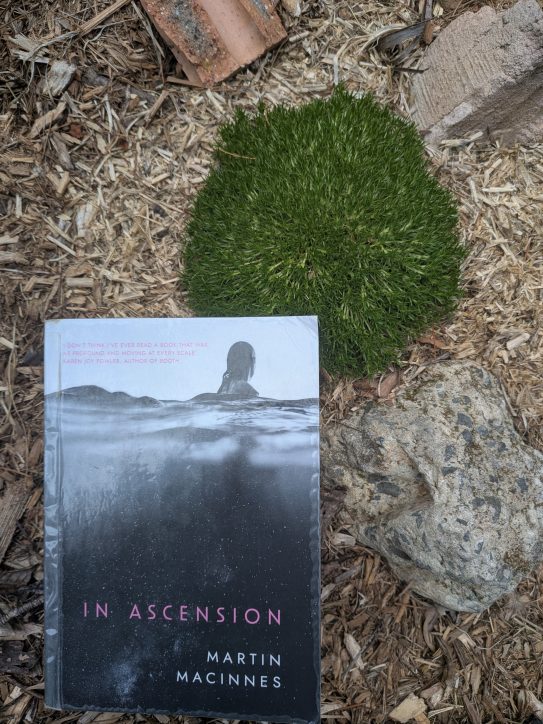
When climate fiction hits, it hits hard. Straight off the back of Arborescence, I dived straight into Martin MacInnes In Ascension. While the two reads are thematically consistent – the world as a system that humans impact but do not control – reading them sequentially was not intentional on my part. In Ascension loomed at me from my (admittedly dwindling) pile of overdue library books. I was about to go away on holidays for five weeks. I wanted a clean slate at the library when I am back. It was time to tackle the Big One.
Coming in at 500 pages and bearing a library-ordained sci-fi stamp on its hefty spine, In Ascension is daunting but only superficially so.
Leigh is the protagonist of In Ascension and is a driven scientist, obsessed with marine algae. The novel follows Leigh in various milestones of her career, beginning with deep sea research and culminating in her Big One: interstellar travel.
There is not much dialogue here. Macinnes is nearly always writing from the perspective of Leigh’s inner monologue. This shows her to be a tenacious, emotionally bereft woman who dedicates her life to the search for the Something Greater. Or, unkindly, ‘on the spectrum’.
The writing is not exquisite and not page-turnery, but simple and clear. MacInnes thrives when he is describing his set pieces and the forces they are designed to impose or counteract. Exposition comes organically through these settings: an ocean liner where crew must maintain a strict containment zone to house unknown discoveries; a temperature controlled biology lab with rows upon rows of algae specimens; a training gym with the lights cut off to focus all of the body on building physical endurance; the spaceship prototype waiting for its successor to launch faster than previously thought possible. Leigh is in each of these spaces for a deliberate reason and she engages with her environments accordingly, which makes for a purposeful read.
It is not, however, a perfect read. The main plot, which I am taking pains not to spoil, has watery areas and left me wanting at times, particularly in the fifth and final chapter. Also, there’s a trauma backstory that runs throughout the novel and that does ultimately fall flat. But the pacing is really good. The scope is huge and is fleshed out enough. There’s the addition of new storylines in each chapter that means the tone is changing subtly throughout. It’s not 500 pages when it should have been 300. This is an epic story that starts in the depths of the ocean and ends in the outer realm of space. It is a mind-bending adventure that has its own natural ebbs and flows of drama.
The otherworldly lingers in the background always but never becomes the focus, as if to suggest that if we want to find something extraordinary, we don’t need to look as far as we think. A new strain of algae is treated with the same reverence as potential contact from an alien force. This lends a softness to the sci-fi. In Ascension is an ambitious work rendered approachable by the endless awe that is found seemingly at every turn in the universe, not just in the outer reaches.
If I wasn’t being posted a bill for this book by Randwick Council Library I’d put it in Declan’s pile.

Leave a Reply