
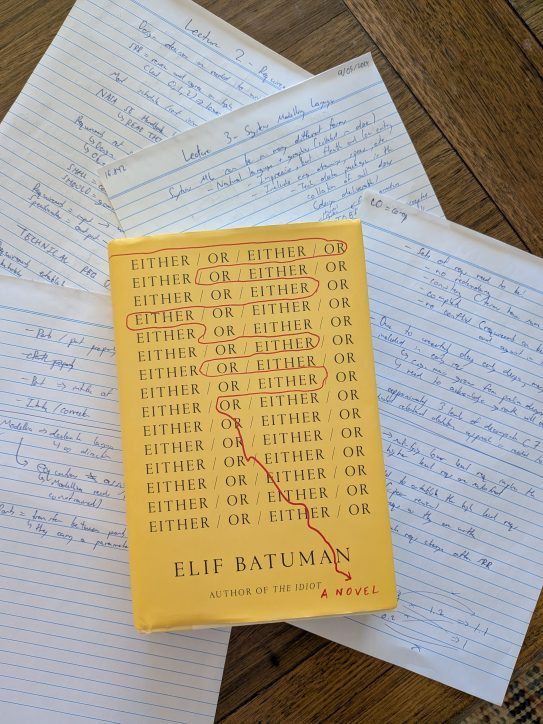
Recommend: No
Sometimes sequels come as a surprise.
I recently watched a clip of Zac Efron recalling how haphazardly and quickly the first High School Musical was filmed. Get’cha Head In The Game, a training montage that captured the athletic and musical abilities of the East High School basketball team, was caught using minimal takes so as to spend as little resources as possible.

No one expected the franchise to be successful. Of course, it wasn’t even a ‘franchise’ at that stage. I can imagine the vibe on set of the first movie: it’s fun to make a movie, I’d like to make a movie, this is the movie we are making, now it is done.
It’s that same creative whimsy that I attributed to Elif Batuman’s The Idiot: I spend all my day reading books, thinking about books, I shall write a book, this is my book, now it is done. Surely Batuman could not have had a masterplan for a sequel up her sleeve at the time of writing The Idiot.
The Idiot was a great book that was often funny, always charming and reasonably exciting. It followed the protagonist, Selin, throughout her first year of Havard. It was set in the 1990s at the cusp of the technology we so happily take for granted today. Although that context is a bit irrelevant. The Idiot was really just about Selin’s first year at Harvard.
My amazement that The Idiot was able to sustain a sequel is easy to understand. Either/Or follows the protagonist, Selin, throughout her second year of Harvard. It is set while the technology we take for granted today was still new and thrilling. Again, the context is a bit irrelevant. Either/Or is really just about Selin’s second year at Harvard.
High School Musical 2 was totally fine.
Either/Or is totally fine.
But neither are as fun as their predecessors. I don’t believe it is because they are no longer ‘new’ in concept. They just don’t have the same vision that propelled their ancestors.
For a large part of Either/Or – the whole first half – nothing happens. It is arguable nothing happened in the whole of The Idiot but nothing happened there in the same way nothing happens in life. In Either/Or nothing is happening in the same way nothing happens on the XPT from Sydney to Coffs Harbour. Time slows and distorts in not necessarily an unpleasant way. Your only entertainment are your thoughts. And indeed, all we really get in the first half of Either/Or are Selin’s thoughts. There is a stream of consciousness reflection of the events that transpired in The Idiot. Selin’s rehashing of the events that have already happened in a previous book felt too much like “recently on…” and instead of the montage going for a minute, with tense melodic music in the background, it goes for half of the book in overpowering silence. It’s as though this first half is the saggy exposition that got cut from The Idiot.
Setting-wise, Either/Or is bland as well. 99% of the first half of Either/Or takes place in Selin’s student accommodation or the halls of Harvard. This is a static setting that feels generically ‘academic’. It’s not fun to explore. It made me appreciate how important place was to my enjoyment of The Idiot. Different environments, even ones as banal as the side of a motorway, put Selin and her friends in different headspaces. There was room for them to examine their surroundings and each other. It gave the sense that these were just young people, similar in essence to all young people, trying to find their way in the world and it just so happens they were using academia to achieve this universal plight. Having Either/Or set only in Harvard is exhausting – every conversation comes back to some principle of ethics, strand of philosophy or relationship in Russian literature. Take me back to the motorway! I can relate to the motorway! Diversity in setting allows characters new space to dynamically react and adapt to the world. A ‘real world’ book needs the real world.
The Idiot brought to life Selin’s academic experiences by weaving them intricately throughout the entire novel. There was a short story being read in her Introduction to Russian language class that wound its way into her whole semester and we got to read it as she did, class by class. Batuman fantastically revealed a joy for learning and, simultaneously, showed how applicable higher education is to everyday life. Either/Or doesn’t achieve this. Even the titular text is at most mentioned in passing a few times. I think the key issue is there are too many texts referenced. The book tends to a listicle about what texts Selin’s read without demonstrating her engagement with them outside of the class room. Name game is rarely fun for those on the receiving end.
Selin comes from a very middle class family. Her parents immigrated from Turkey to America and although they divorced they both retain professional careers and are very supportive of Selin. There’s a reference to how their household income is too high for Selin to qualify for financial assistance at Harvard so her parents pay her tuition in full. In other words, Selin has been encouraged to speak her mind since childhood and has been provided the platform to do so. Another, related, reason that this sequel was less successful than the original is that much of the charm of the original was Selin’s subsequently mildly whacky way of interacting with her cohort at Harvard. Selin would say something observant and honest that could be taken to offend or offput, yet nearly always her fellow characters would treat her with respect and engage in good faith in the conversation. This gave The Idiot a sweetness that was not predicated cheaply on innocence but rather on the belief that life is more enriching when we try and understand people than when we ignore them.
Ivan, the love interest in The Idiot, pointed out these strange interactions that Selin instigated. Giving voice to Ivan’s perception of Selin meant that The Idiot was less reliant on inner monologues to convey her as a character, which ultimately made her feel well realised and whole. But Ivan also served as a reserve of poignancy. Ivan didn’t accuse Selin of being ‘anti social’. He supported her and developed her thoughts through well meaning discussion. He was very much a friend to Selin – a safe space – and thus opened her up for the reader. Ivan is physically absent from Either/Or and the emotion is all the weaker for it.
I was disappointed with Batuman’s Either/Or in the same way I would be disappointed with myself for not getting 100% on a math test in high school. I’d done it before. Everyone knew I was capable – there was proof. But in this attempt, I had fallen short. I couldn’t recapture the focus I previously had.

Leave a Reply