
Recommend: No
Caitlin has said several times that she believes I am moving into the business phase of my life. This appears to be based entirely on a handful of books I have read over the past few years (e.g. American Icon). I feel like it is not the business aspects themselves that interest me, but rather instead wanting to understand how hard things happen in different organisations. Corporations are very complex, dynamic systems that vary hugely in scope, approach and success and we all often have to engage with them to varying degrees. Thankfully, there is a whole market of entrepreneur gurus, business champions and LinkedIn influencers who have figured it all out and are chomping at the bit to help you start your journey for the low low price of $39.95.
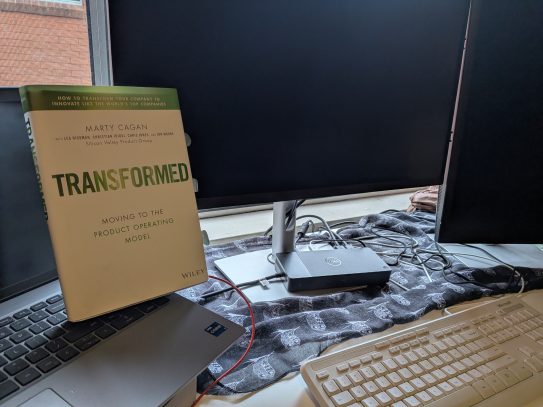
TRANSFORMED (always referred to in all capitals in text, presumably because it is an otherwise very forgettable title) is one of these holy tomes. Marty Cagan has descended from the mount to speak the good word of the Product Operating Model and transform your organisation.
Here would be a good time to tell you what the Product Operating Model actually is. Unfortunately I am unable to. Despite the second chapter being explicitly titled “What Is a Product Operating Model?” I could not find a clear definition throughout the whole book and it seems like more of a loose vibe than anything else. At one point it is defined as “the way of operating that we find the best product companies consistently use” which is an infuriating circular reference. This is a key problem with this and similar books: they are insanely vague and high-level to the point of being meaningless.
This book is somehow part of a quadrilogy. You should also purchase INSPIRED, EMPOWERED and LOVED to fully realise that you need to pay for at least $30k worth of training before you should even think of claiming to truly understand product. This is another problem with these books, they are normally also ads for other things. TRANSFORMED is particularly egregious in this regard when Chapter 34, Tranformation Help has 20 pages of product coach bios (complete with headshots) for you to peruse. I skipped over this (and several other sections).
There are sections that resonate. These books always have elements the reader can relate to because all organisations are partially dysfunctional. It’s intrinsic to a complex system in a changing world, there is no equilibrium and there shouldn’t be. We all waste time doing work that no one cares about and following some weird process. We all know (or think we know) how these issues could be a lot better with a few changes. The Product Operating Model promises fixes, but is somewhat light on the detail. Concepts like “Outcomes over Output” and “Principles over Process” sound great, but get a page at most. Instead, merely by following the Product Operating Model the fixes should be expected to emerge out of the primordial soup of hot-desking.
Unfortunately all of the examples are excessively IT based. Whenever they want to convince you that someone knows what they are doing they will namedrop Google or Facebook. Maybe this is because these companies have more money to spend on frivolous training or Silicon Valley based authors are in a software bubble. Either way it is difficult to visualise extending this wholesale to a very mature, heavily regulated and long lead time industry like aerospace.
The book is definitely bulked up by Part X, Overcoming Objections. This is 50 pages of expected concerns from various parties and pre-prepared rebuttal to convince them to adopt it. It doesn’t feel right to spend more time covering how to explain to people why they are wrong and the Product Operating Model is right than what it actually is. It seems like a majority of your time being a great Product Leader should be telling people how good the Product Operating Model is. From an evolutionary perspective I can see why dogmatic evangelism is essential to the survival of an idea. The primary goal seems to be to convince people to adopt the Product Operating Model. It having a benefit to business is secondary. Sort of like a virus spreading rapidly before it can kill its host.
The most interesting parts (and I use the term interesting at a stretch) were the innovation stories. At least there was some human connection and tangibility to understanding how Adobe was so proud of leading the market with subscription services and the insane returns this has delivered them. It’s not mentioned that this made them nearly universally hated by the graphics design industry, but maybe LOVED deals with that topic.
When you get down to it, these types of books normally have the same advice just dressed up in different outfits. Actively engage with and take ownership of your product, critically review how you are doing your work and embrace that there is no steady state. I am confident you could distill this down into a 10 page pamphlet more effectively, but you can’t really sell that for $40 can you?


Leave a Reply