
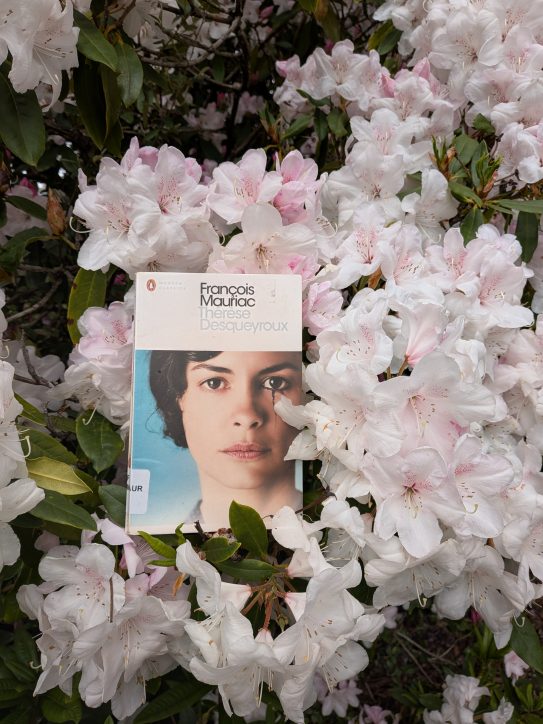
Recommend: Yes
Therese is the eponymous main character of Therese Desqueyroux but Desqueyroux is not her maiden name. She was born into the small-time empire of Larroques, initially built from timber and resin farming, but spanning now into politics. Her father, Jerome Larroque, is the major of the local town. It was this local fame and fortune that made her marriage to neighbouring estate owner Bernard Desqueyroux a harmonious union, on paper.
It takes some time to learn all this about Therese, despite the novel barely reaching 100 pages.
Instead of tedious exposition, the novel opens cinematically outside a courthouse. Therese is walking out of the building. Her father and her father’s lawyer are awaiting her but with no pleasure.
Her father did not kiss her. He did not even look at her, but addressed a question to the barrister Duros, who answered in a low voice, as though he were afraid of being overheard. The words they spoke came to her, but not plainly.
‘Tomorrow I shall be officially notified that the case has been dismissed.’
‘No danger of any last-minute surprises?’
‘Not the least in the world. We got it, as they say, served up on a plate.’
‘Hardly that – one can never be quite certain.’
‘Once they’d got him to admit that he never countered his drops…’
‘But in cases of this kind, you know, Larroque, the evidence of the victim…’
Therese spoke in a loud voice:
‘There was no victim.’
Just preceding the first page of the novel, Therese has been dismissed of allegations that she attempted to murder her husband by means of poison. This is an arresting start. Therese Desqueyroux is no police procedural. There are no courtroom ‘gotchas’ to be revealed. All that has happened off-page, already. Our first meeting with Therese is as she walks free, down those courthouse entrance stairs, and begins her journey home to her husband, who is convalescing at home in the French countryside.
The novel’s tension comes from exploring what freedom this woman, free now of serious legal accusations, has left when she returns home. Indeed, upon reflecting on how she got here, accused of murder, Therese questions what freedom she ever did own.
This is a novel of two sections. The first takes place on the long journey home to her husband after her case has been dismissed. The reader is on shaky ground as they travel, very closely, with Therese. At this stage, Therese is a stranger to us, yet we are placed so intimately next to her, in the small confines her transport home, as she tries to make sense of all that has happened, and as she confronts the imminent disaster of her return home. She was found not guilty by the courts of murder but the Therese we see evades direct memories of what transpired with her husband. In these hours of distraught reflection, Therese instead turns to her childhood, to the beginnings of her marriage – all the roads that lead to her dark soul.
‘Ah!’ thought Therese: ‘he won’t have understood. I shall have to begin again from the beginning…’ But what is the beginning where our actions are concerned? Our destiny, once we begin to try and isolate it, is like those plants we can never dig up with all their roots intact. Would she find it necessary to go back to her childhood? But even our childhood is, in a sense, an end, a completion.
It is a testament to Francois Mauriac’s prose that this is not a suspense novel around whether Therese murdered her husband or not. From the very first page, the private discussions between her father and the family lawyer are damning. Those closest to her believe she holds an evilness in her heart that would make her capable of such deviant actions. It is this evilness that Mauriac examines. How did it get there? How did it thrive? How to best live with it now it has taken intractable root?
It is insane to me that Therese is a character written by a man born in the 1880s. She is perfectly drawn. In the second half of the novel, once Therese has returned home, a madness grows in her but only because of the horrid way she is treated. That evilness alluded to earlier is largely her independence festering, which her small family and friend group have taken upon themselves to squash.
She stared before her, seeing in imagination the cage with its innumerable bars, each of which was a living person, a cage full of eyes and ears, in which she would have to spend the whole of her life, squatting motionless, her chin on her knees, her arms clasped about her legs, waiting for death.
This is a story of a woman having dutifully followed her allotted path into the trappings of domestic life only to find herself literally trapped.
Never had Therese known such peace – or what seemed to hear like peace, though it was but a half-sleep, the torpor of the snake within her breast.
The depictions of the marriage between Therese and Bernard are impeccable. Therese’s claustrophobia strangled me. This following scene at the altar of their marriage, recalled by Therese on the train home, is as bitter as any Taylor Swift divorce album could hope to be.
Therese, very soon, would be one of the herd of those who have served their purpose. She remembered how, in the vestry, she had bent to kiss the laughing little face lifted to her own, and how she had realised suddenly the nothingness of everything round which she had built a universe of vague joys and sorrows no less vague.
Followed quickly by what must be the most loveless and poisonous honeymoon imaginable.
Their being together no longer have him any happiness. He was bored to death away from his guns, his dogs. His wife was so cold, so mocking. She never showed pleasure even if she felt any, would never talk about what really interested him. … As to Therese, she longed to be back in Saint-Claire. She was like a transported criminal, sick to her soul of transit prisons, and anxious only to see Convict Island where she would have to spend the rest of her life.
The honeymoon as transit prison! And the longing just to get on with it – marriage as prison itself; let the pain begin so that she could at least get used to it. The best she can hope for now the endless monotony and entrapment of home – Convict Island! A more dire picture of newlyweds on their honeymoon would be hard to paint.
This pedestrian disdain for each other does not relent as Bernard and Therese move through the motions of married life. Watching them perform normal life events is like listening to nails on a chalkboard.
The smell of chocolate made Therese feel sick. This vague bodily discomfort served to confirm her other symptoms: she was already pregnant. ‘Better get it over early,’ said Bernard; ‘and then one needn’t bother any more about it.’ He gazed with respect at the woman who bore within her the future master of unnumbered trees.
Written in the 1920s, I was nervous that Therese Desqueyroux would feel as antiquated and irrelevant as much of Mansfield’s A Dill Pickle was. That proved to be an unwarranted prejudice I had against the decade. From the first page the prose is entirely fresh. The structure – the first scene being just after the main action; the domestic tensions that thread through Therese’s memories as she travels back home; the absolutely satisfying ending – is innovative even by today’s standards. This is such a clever and engrossing character story, not just of Therese but also of her husband Benard, and her childhood friend Anne. The relationships Therese holds with these two are developed in a such satisfying manner that at the end of the novel I really felt as if I had ended something. I had walked away from something physical.


Leave a Reply