
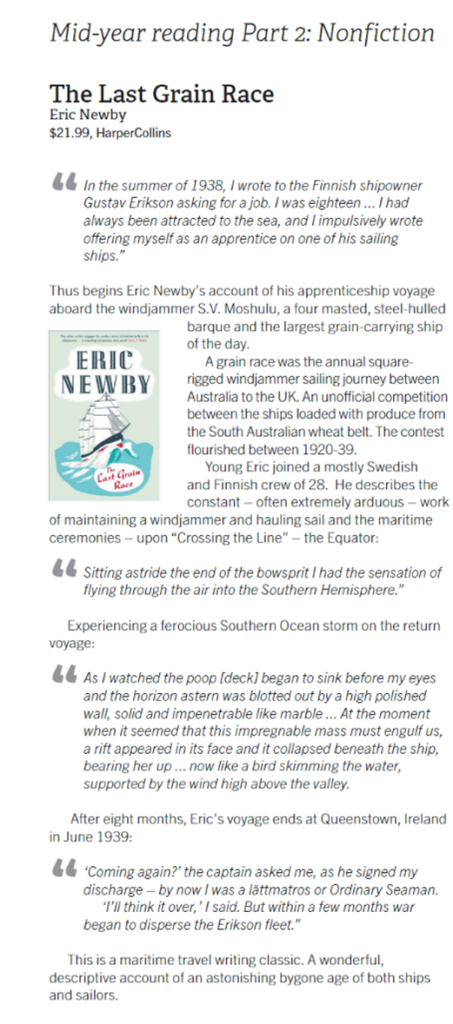
History: Stephen (Blackheath Secondhand Gleebooks) has a regular review column in the Gleebooks promotional handout. It is dubious how much revenue this review column adds, as when I tried to purchase this particular feature it was out of stock and after placing an order it took months to arrive. That copy of the Last Grain Race was gifted to Leo and currently sits unread in the Adelaide study. However, this book reappeared a few months ago in Stephen’s shop and, recalling the small saga in obtaining it the first time, it was loaned to me to enjoy for myself.
Recommend? Yes
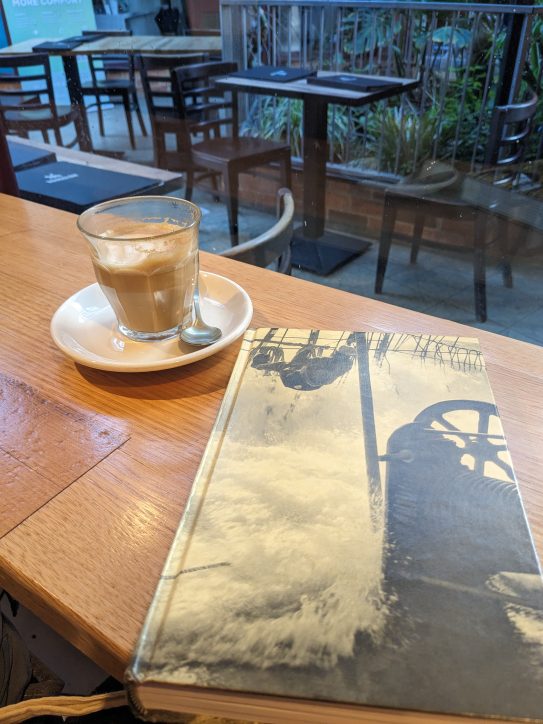
It is a beautiful edition with pleasingly thick pages. The Folio Society republishes classic books in hardcover with additional inscriptions, illustrations or (in this case) photographs for a hefty markup. Purchased new, they command prices in the hundreds. Briefly care-taking such a regal edition for free is dangerous… Like getting your first hit of heroin for free. All of the joy and enrichment, at none of the cost, leaving you with a disconcerting acceptance that this deep imprint of desire will now be a permanent in life. It is completely feasible that I have entered my Folio Editions stage of life. A slippery slope into ‘investing’ in (collecting at an absurd price) rare books.
The Last Grain Race was challenging to start. There is strong assumed nautical knowledge and jargon is rarely explained. The crew and captain are Finnish and orders are given in that native tongue and Newby’s dialogue is therefore polygot. The descriptions that are in English are so technical that even after seven seasons of Below Deck, I was confused and disorientated. In that way, I felt just as incompetent as Newby working deep in the Atlantic Ocean aboard the Baroque.
Here’s a sentence (one of countless) where I spent half an hour on Google figuring out what part of the ship Newby was referring to:
“The lower topsail yard was slung from an iron crane but the upper topsail yard above it was attached to a track on the foreside of the topmast allowing the yard to be raised by means of a halyard more than twenty-five feet almost to the level of the cross-trees”.
Google:
- Lower topsail
- Upper topsail
- Yard
- Top mast
- Halyard
- Cross-tree
Harbouring no intrinsic love of non-fiction, I would have stopped reading this book after 20 pages had it not been for Newby’s enthralling narrative gift. For every page of tiresome and difficult to follow boating manoeuvres, with equal precision Newby focuses a page on his fellow crew members.
“Yonny Valker was golden-haired and completely chinless, with two large tusk-like teeth protruding from his upper lip so that he looked exactly like a dugong, that large herbivorous mammal of the Indian Seas. He was the oldest Jungman in the watch and was completely indifferent to both to hardship and comfort. If he had been a soldier, Yonny would have slept happily in the puddle in which he had been halted.”
The work on board seems fictionally unpleasant and gruelling. There are repugnant toilets to clean; three pigs in pigsties to tend to before they end their days on dinner plates; morose watches of the wheel in hail. To go aloft, which is to climb the masts of the boat in order to wrap sails, let sails down, or adjust sails (here I am eschewing from using the 20 different words for rope, 10 different sections of the sail and the 5 different types of line), is a frightening torture that wouldn’t be out of place in Game of Thrones.
“Far below, the ship was an impressive sight. For a time the whole of the after deck would disappear, hatches, winches, everything, as the solid water hit it, and then, like an animal pulled down by hounds, she would rise and shake them from her, would come lifting out of the sea with her freeing ports spouting.”
This book is an adventure, and adventures rarely come without grit. I’ll never do a day’s manual labour in my life, so this adventure is well placed to be experienced vicariously in a book. Read in the comfort of a gas-fire warmed Blackheath house, there is a small melancholy that I will never see the world from a boat. Looking over the bulwarks and onto shore lends human life an otherness that verges on spiritual. This must be a stark beauty hard to rediscover on land.
“At that moment the little town was outlined against the early redness of the sun, the tin roofs and the spire of the tiny church breaking the hard, dark line of the coast. The sea was cold-looking with the sun not yet on it, and across it a ketch, the same grey colour as the sea, was sidling out deep-loaded towards the ship.”


Leave a Reply