Recommend: Only if you enjoyed the first two.
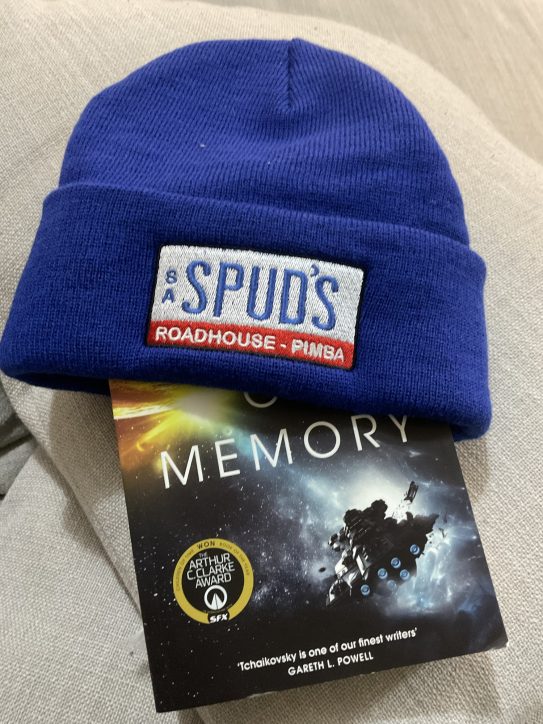
Children of Memories is the third in a series and to fully understand how I feel, I think we need to go back.
Children of Time (the first book) was recommended to me secondhand. Someone Caitlin deals with at work found out I like sci-fi and stated this as a must-read. I am often skeptical of sci-fi recommendations from others. My ego goes on the defensive and I have to rapidly sort out the casual chit-chat, from the hardcore sci-philes. My litmus test is the Martian. If they liked that, the conservation is meaningless.
Children of Time was delightful. An unexpected story of which I had no background that introduced interesting concepts about life and intelligence, but managed to maintain a coherent and engaging narrative on top of it. On a distant planet, ants and spiders became intelligent and developed societies. The interesting part is how these intrinsically differ from a human society and why. Layered on top of this is the arrival of humans into the planet to introduce some conflict.
The second book, Children of Ruin, follows these themes. This time focussing on a society of octopuses and an alien organism. The question around intelligence is again key with the octopuses having an obviously intriguing set of questions to be answered (how do their spaceships work, how do they communicate, etc.). However, the alien lifeform is novel too. It is not a society as such, but an organism that evolved out of bacteria in a small puddle and is physiologically unlike anything conventional.
That brings me on to the final book and nominal subject of this review, Children of Memories. Again, to no surprise, the questions of intelligence and life are key. Intelligent (although this is debatable) crows that operate in pairs (one observes and records and the other processes) are the tractable half of this. The other half is more complex and not easily presented here. The spiders and octopuses are still around, but their novel characteristics are sadly removed and they may as well just be people for all intents and purposes.
Most of the book takes place on a remote human settlement on a barely habitable world that appears to be on the way-out. The problems are mostly human, and less exciting than the first books.
The novel also starts to get a bit too philosophical at points. Can a simulation ever be alive? And the inevitable follow-on, does it matter if we are in a simulation? There’s been a trend in each of the books to build out topics around life and intelligence. It’s admirable that each books brings in new approaches around this. But as the topics become more obtuse, the readability does drop off in this last book.
It’s not short either. There are 300 pages of faffing about in the middle with a lot of repetition. A lot of this is deliberate and conveys a story in its own right, but it doesn’t make for engaging reading. Confusion is deliberately introduced, which all (mostly) makes sense at the end, but doesn’t make for an easy journey there.
I’m glad I read the book in a single two week stint and had the time and impetus to finish it. If I had let it drag on or had an extended break (a common weakness of mine) it would not have been easy to come back to and would have suffered for it. If Adrian Tchaikovsky writes another book in the series, I’m not convinced I’ll read it (maybe it would wait for a good secondhand), but I thank him for his work so far.
Also, it’s always a concern when the praise on the cover is for the author and earlier books in the series instead of the one you’re reading.

Leave a Reply