
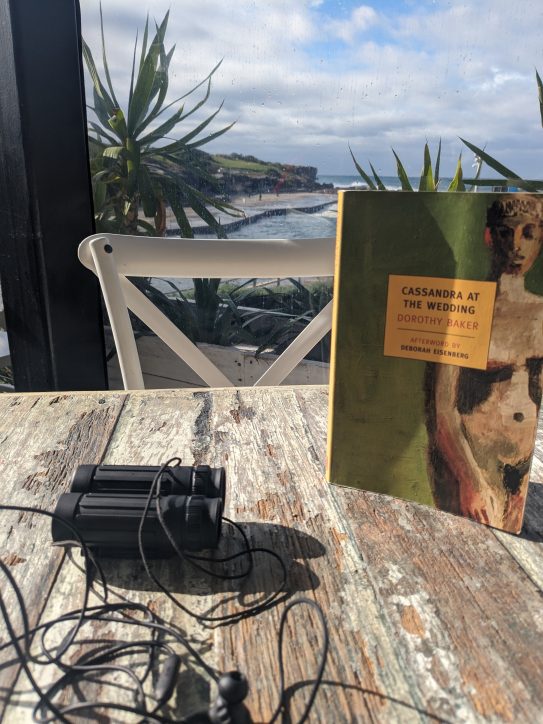
Allure: Water-damaged copy from the public library near A Man and His Monkey. 90% probability also purchased recently from Steven at the Blackheath second-hand Gleebooks outlet. Double-ups are a hazard of the book buying game, and these duplicated attainments end up donated back with Steven with a rapid turnaround time.
Recommend: Strongly.
“The bridge looked good again. The sun was on it, and it took on something of the appeal of a bright exit sign in an auditorium that is crowded and airless and where you are listening to a lecture, as I so often do, that is in no way brilliant. But lectures can’t all be brilliant, of course; they can be sat through and listened to for what there is in them, and if the exit sign is dazzling it can still be ignored.”
Cassandra at the Wedding. It’s an authoritative and bold title that doesn’t lack irony, as the novel is solely concerned with Cassandra trying to thwart her identical twin sister Judith’s wedding. From the title to the closing page this authority persists from Dorothy Baker. We are in her orbit and it’s an orbit where the ordinary laws of physics won’t apply.
We begin on the first page being told “Cassandra Speaks”. Yes, there are three sections to the novel: “Cassandra Speaks” for the beginning and end, and in-between we are briefly sedated by “Judith Speaks”. While Judith’s section comes in the physical middle, it is Cassandra at the centre of the system and all characters (of which there are very few) collapse inwards on that system as Cassandra implodes. Cassandra – like her namesake novel – is frantic, manic and unhinged.
This book is strangely modern, despite having been born in the early 1960s. It is more relatable than any of the recently published books I’ve read in the last three months. The plot is sublimely simple. There are two identical twins, Cassandra and Judith, who have lived up until their early twenties very closely together. Judith then leaves Cassandra behind in Berkley for New York, and while in New York Judith finds a bland doctor with whom she embarks upon a suburban epiphany. Judith wants to be married to Bland Man at the family ranch, and that’s where we open the book – Cassandra on a chaotic road trip home to the ranch, already teetering on the edge of sanity and presentability and not even through the front door. Cassandra despises Judith deserting her for a lesser life, one that could belong to anyone, and for which she despises everyone else for living.
“Same thing everywhere I’d ever looked. Large amounts of safety; very few risks. Let nothing endanger the proper marriage, the fashionable career, the non-irritating thesis that says nothing new and nothing true. They go along.”
Baker inputs intensity into all of Cassandra’s scenes but the prose is so clear and crisp that you feel you yourself are hurtling along a bridge, unsure if the path is connected to land on the other side but at all times being very sure that you are on that bridge and you are travelling fast and you cannot slow down. Had this have been a modern day 300-page book, it would be cheapened by ‘experimental’ breaks in consciousness. Instead, with not a hint of dust from her 80+ years on the shelf, Baker gives us an unreliable narrator whose thoughts are corrupt and dangerous but are also lucid and thoroughly entertaining. Yellowface also has an unreliable narrator at its core. But it is laughable to compare them. Cassandra at the Wedding is a novel with immense care and talent and perspicacity. Every page shines with a fresh colour and catches the eye and what you see through the glare dazzles.
The characters outside of Cassandra and Judith are brilliantly rendered too – the dottery and self-absorbed Grandmother is entirely believable, the widowed eccentric father enters just enough to give a sense of how isolating childhood at the ranch would have been and then there is the cleansing late arrival of Cassandra’s analyst.
The family gathering at the ranch has a heady Deborah Levy style. The heat and the moths and swimming pool and the small group of people, too close together. As a great lover of Swimming Home by Levy, I am shocked to find myself saying Cassandra at the Wedding executes the tight family drama (the limits of which are pushed by the entrance of an outsider) even better than Levy.
“I was working hard to think of something besides people, something besides clothes and weddings, and I ended up thinking about bats and how they used to whip over the pool at twilight, weightless and on a fast slant, and scare us, but not much. I stood on the coping at the edge of the pool and wished that a bat would skim across this very minute and get right into my hair, which is what granny really believes bats do. It would be very nice, I thought, to have a bat in my hair, and not just to prove that gran was right, after all, about bats, but simply to have something real, something tangible, to deal with.”
Cassandra fears stasis. Judith’s upcoming marriage is emblematic of Judith diving into a deep, stagnant pond where she will be motionless as she drowns. When those you love and respect the most wander from safety into enemy ground with their wrists together, waiting to be bound and taken, how can you really love and respect them from that moment forwards, and what are you left with, defending your empty land?
I love this book. I am in love with this book. I will love this book for the rest of my life.
“Same thing everywhere I’d ever looked. Large amounts of safety; very few risks. Let nothing endanger the proper marriage, the fashionable career, the non-irritating thesis that says nothing new and nothing true. They go along. All but papa, who prefers the skeptics and Five-star Hennesy. And me who what. Who nothing. Who less than nothing. Who tried, but didn’t.”


Leave a Reply