
Recommend: Yes.
As I get older, I am told with increasing frequency that I ask difficult questions. The implication, buried not too deep underneath, is that I am a difficult person. On occasion it is meant as a compliment, a way of highlighting curiosity and insight. Mostly, though, the statement is delivered in a defensive tone with intense eye contact, as if to say, “your intentions here are unclear but surely nefarious”.
If I am being generous with myself the apparent break from social norms is nothing more sinister than just having different interests to the masses. Instead of asking about how you found your ski resort in Hokkaido, I am simply more interested in how Japanese culture, as depicted in Western media, influenced your preconceptions of Japan.
If I am being critical with myself, the ‘unusual’ questions I labour my guests with reveal that I do not prioritise their comfort. I refuse to let them drift into the same story they’ve retold already ten times this week. I dislike and distrust the ease of their rehearsed narrative.
The narrator of Happy Hour Isa. Isa is constantly being told that her conversation is surprising, sometimes to the pleasure and sometimes to the discontent of her audience. I can relate to this.
Isa is 21, of deliberately vague Ethnic origins and has recently moved to New York. That, I must admit, is all harder to relate to.
What happens in Happy Hour? Really not all that much. The novel has a tight focus on Isa and her best friend, Gala. The two girls are illegally residing in New York and struggling to make ends meet. To slide through the cracks, they exploit the generosity of their loose acquaintances. Isa and Gala always seem able to find someone to take them to dinner in exchange for their youth, beauty and quick quips.
Happy Hour just covers a New York Summer. The novel is sectioned into three months, each one fairly indistinguishable from the last, with only the natural subtle progressions of Summer to guide us. The first month is hot and lively. The second month is listless and social. The third month, as the heat peaks but the end of the season nears, alternates between stuffy aggression and mournful reflection. And then Summer is over and so is the book.
There’s no plot here but the writing bounces off the page. Isa and Gala are characters that are easy to read. The two girls have a nuanced friendship that has developed in the decade prior to this Summer. They are sympathetic without being achingly sentimental. They go with the flow and find their own pockets of fun in a city that only shows them ambivalence. It’s all pointless and it’s all believable.
I think Happy Hour is a descendent of Elaine Dundy’s The Dud Avocado. There’s the strong female narrator in a new city with none of her family. She has an extremely small set of friends from her past history (at most two) who keep her company amongst an everchanging roster of side-characters. We watch our narrator try and make ends meet through exploitation of her wit and charms. And we suffer with her through innumerable snarky dinner parties. Admittedly The Dud Avocado reigns supreme in this comparison because of its stronger plot but it’s not to worry because there are ample humour lines to keep my hours happy here.
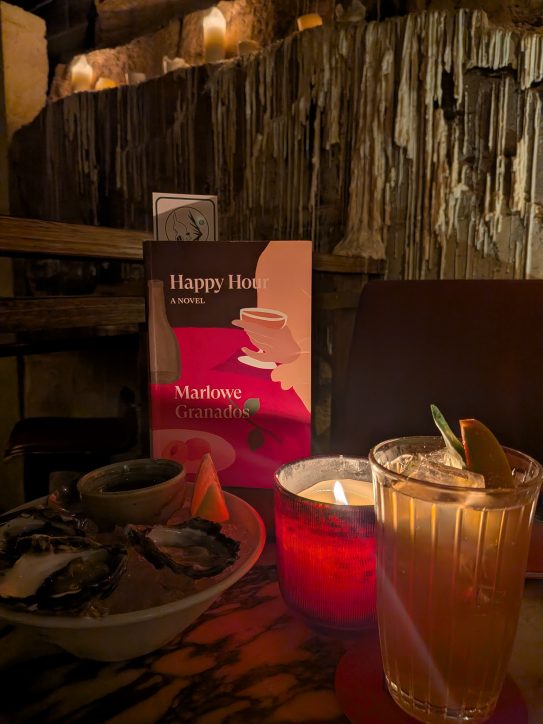
Grab a copy of this book, order a cocktail, hunt down some oysters and relax into an evening you won’t remember in a few years but will undeniably enjoy tonight.


Leave a Reply