
Recommend: Yes
To those in the know, Caitlin obviously has a favourite bookseller. I suspect Caitlin may also be one of the favourite customers, because she is often bestowed with gifts of recommended novella, classics and modern literature. I have observed this mutual relationship over several years from the aisles of the store, while I sheepishly browse the SciFi section. However something has changed. While I may not yet be in the general’s staff, I have been deigned entry to the command bunker. A few months ago Steven gave Caitlin a book that he thought I might be interested in. While I suspect Stephen hasn’t honed in on my interests to the same degree he has with Caitlin (at one point he thought I had ordered a golf self-help book that appeared on his counter), this pick was well-executed and appreciated.
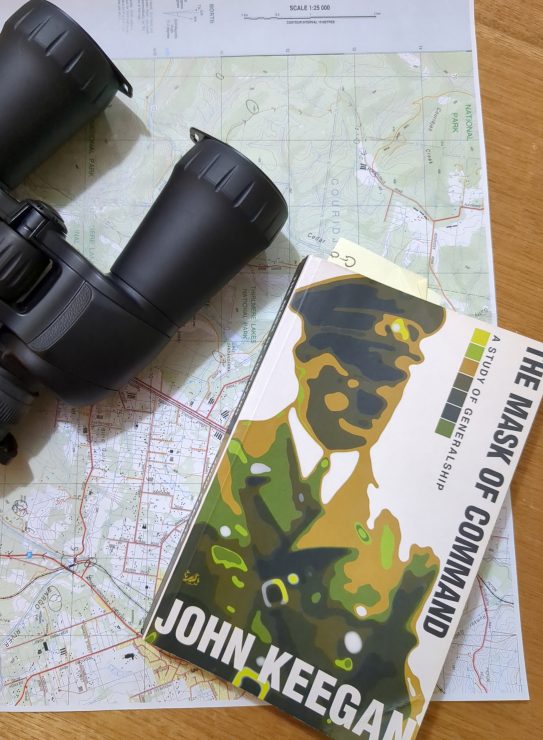
The Mask of Command (with the appropriate subtitle A Study of Generalship) is an exploration of what it is to command an army and how the personal traits of the leaders impact command. It explores four different military leaders throughout history and performs an engaging compare and contrast on them. Alexander (the Great), Wellington (the Formal), Grant (the Pragmatic) and Hitler (the Interferer). The leaders were well selected as they were all people I was aware of. Each analysis felt novel and not something I had read before, though I am far from an avid historian.
There is a combination of biography (Wellington’s time in India, Grant’s time at West Point and Mexico) and analysis (Grant’s understanding of his Southern contemporaries from their mutual experiences helping him to fight them) that makes it very readable. There were definitely sections that I tuned out on, but that is more likely an outcome of reading at night rather than an indictment on the book. When a new leader came up I wanted to keep reading and was excited to learn about them.
The most interesting part of each analysis was the role of the general in response to the society around it. Alexander leading from the front lines because his society demanded it and he would not be leader if he did not. Wellington being the last generation to command from the front lines, with Grant being pushed further back as weapons became more deadly and warfare industrialised. Hitler operating as a chateau general with a false sense of the battlefield through modern “real-time” communications. This approach avoided the book being a mere recounting of exploits or ranking of Top Military Leaders of all Time (although Wellington and Grant are Keegan’s obvious favourites).
One aspect I noted was that the analyses reference only the leaders who have already been discussed. This is useful as it enables you to understand the evolution of command without assuming reader knowledge. I could comfortably come into this book with barely any understanding of the four generals and the world they lived in and still obtain the same value from reading the book.
In the conclusion Keegan breaks effective command down into five distinct elements: kinship (inward and outward access from command to the soldier), prescription (exhortation of the army), sanction (coercion through decoration or punishment), action (selecting and performing the correct movements) and example (present in person). Looking at these more broadly, they are definitely characteristics of effective leadership and management in general. The out-of-touch manager in his panelled office is derisively disrespected on the shop floor. As compared to Elon Musk wandering the factory floor firing those who can’t explain why they are doing something and don’t believe in his mission (for all his faults, he is definitely executing some of the above elements – people didn’t really find Grant personable either).
I worry that because I enjoyed this book, Stephen may respond positively and find more interesting and engaging books to lend me. The shelves full of books awaiting their time loom menacingly over me. However, there could be worse problems to have.


Leave a Reply