
Recommend: No (but do read Tirra Lirra by the River).
It must be hard being a successful artist. Not everything you do will match the heights of your career. After the meteoric pump-up of the Reputation Tour, Taylor Swift returns with the cloying, cringeworthy, monosyllabic single Me. Dave Eggers becomes a finalist for the Pulitzer Prize for A Heartbreaking Work of Staggering Genius and founds McSweenys and then publishes the unforgivably generic The Circle (which I still assume was ghost written). Even the OC had Season Four.
I get it. Art is hard.
But it is still so disappointing when an artist that you know is capable of such grandeur puts out something that is lesser than their peak.
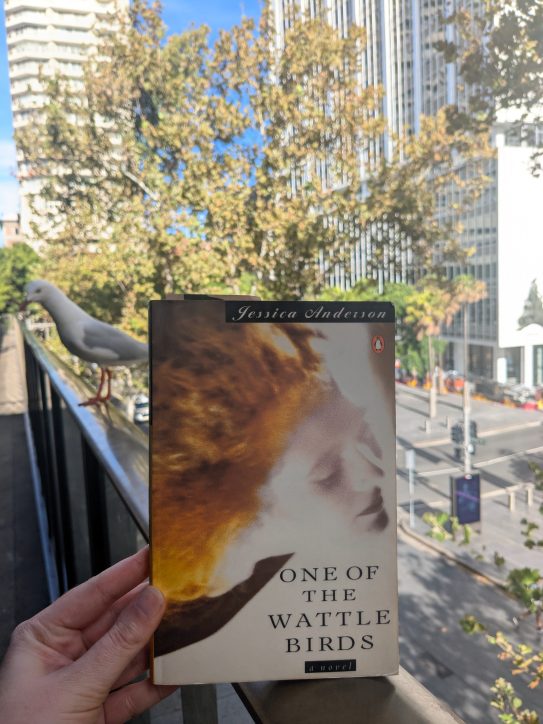
One of the Wattlebirds is a fine book. Arguably, better than average. But it is a bit of a nothing story, with not enough of Anderson’s talent as a writer to hold it all together.
The title is a giveaway. Although it was released thirty years ago, One for the Wattlebirds was as bad a title then as it is now. I know that because on the cover there’s a little box that clarifies ‘A novel’. The title comes from a rather poor analogy about grief being a baby wattlebird that is always hungry and never satisfied.
The narrator is nineteen-year-old Cecily. Her mother, secretly terminally ill, has recently died while her and her friends were on a European tour. Cecily has since come back home to Sydney and her and her medium-term boyfriend are studying for her university exams, but she’s distracted both by her mother’s death and the recent relocation of her estranged father to Coogee. This is not really a novel about grief (although it is literally referenced a lot in the plot), it is not really a novel about family (even though the dead mother and the reintroduction of the father figure is a catalyst for Cecily’s lack of focus), nor is it really a novel about friendship (but there is an abrasive and elusive best friend Katie, who I really enjoyed as a secondary character). It’s more accurately a coming-of-age novel that unfolds over a three-day period.
It’s really the tone of the story that prevents this being a novel about grief, family or friendship. Cecily narrates very uncharacteristically for a nineteen-year-old. She doesn’t linger in emotions long, preferring to stick to critical assessments of herself and those around her.
It would make me see myself, reflected I the mirror of Wil’s principles, as disgracefully self-indulgent in view of the various deprivations around me, to say nothing of the sorrow, terror, famine, and the clash of ignorant armies in the terrible world outside. Wil wants to live his life in full consciousness of that world, he genuinely does, and so would I, perhaps, but whatever I do, my concerns remain narrow, and I often forget all about it.
So it ends up being a novel all about Cecily. She’s not a realistic character as she is far too emotionally uninvolved in the dramas that should be all-consuming, particularly to a teenager. But Anderson is a good writer, so it doesn’t really matter. The plot of this novel could have easily been cooked up by Cutis Sittenfeld but the difference in writing abilities is keenly felt when reading the two authors side-by-side. One of the Wattle Birds has enough interesting phrasing and grammar in the writing (I like the use of capitals in Aunt Gail’s dialogue that really make her seem A LITTLE EXTRA) and sidenotes in the plot (what did happen to that ex-best-friend Katie?) that it is an enjoyable read. Just not a perfect one.
Ultimately, it was the tone not fitting the plot that made this less successful than Tirra Lirra by the River. The airy, unconcerned lilt of Cecily works perfectly when she is reflecting on her medium-term relationship with Wil. It was humorous how Cecily describes Wil’s attachment to his studies. Here’s a small scene where she is looking at him from the other end of a library table:
“So now there Wil is, over there, impaled to his work.”
I could see Wil in my imagination, hunched over textbook tomes, as though a stake is holding him. Is there anything more beautiful in young love than leaving the library together, heading out into the afternoon after a few hours of study?
I hate it in here. Not only because of the wrong noises and the glassy spaces, but because it smells of plastic.
Also, I am hungry. I keep thinking of anchovies.
I just looked across at Wil in a very concentrated way. I kept looking, and concentrating, and after about thirty seconds, he began stacking his books.
Yes. I know it is only coincidence.
However (as Mum would say), I know that when I look up again, he will have finished his stack, and will be looking across at me.
He will catch my eye, smile, nod towards the door.
And I will nod back Yes.
It’s a lightly mocking, perceptive narration, which benefits from a plot that stays with few characters, all of which are interlinked. But here, the mother is a separate character to the estranged father, who are altogether separate from Wil, so it just ends up feeling like each chapter is its own distinct character assassination. All of which is good, as I say she is a talented author, but not exceptional, because the strands don’t come together as cleanly as they do in Tirra Lirra by the River.
The relationship that worked the best here was Cecily and her boyfriend Wil and that was mainly because of Wil’s consistency throughout the plot. Unlike the other characters that flirt around the edges, albeit for a chapter or two where they are central to a scene, Wil is always around, looking for a quiet place to study and a well-priced takeout meal to end a tiring day of thought.
I think Anderson felt the same attachment to Wil. The very end of the book has a touching memory from Cecily. She’s recalls having just gotten home from the rather clinical meeting with her estranged father, which was an event that she had hyped up in her head for days prior. With that done, and now at home with Wil, it’s really the only moment that I felt Cecily relax. She chooses her final recollection of the novel to be domestic and honest. Her relationship with Wil gave her stability at a time in life where the rest was in a state of upheaval. And it is calming to end this three day journey with Cecil in a safe harbour.
Wil and I probably didn’t sit there for as long as it now suits me to conceive. He had bought food, too (in case, he said, I had been too busy to shop) and I see us now as sitting there for a long time, peaceful and tired, too lazy to move, each naming what we had bought, then concocting a meal from the named items, while the windows clicked in their loose frames, and the traffic went by outside.


Leave a Reply