
Recommend: No.
“Last week on the ‘Staff Recommends’ shelf was a copy of a book that Bert C. reviewed. He said everyone had to read it. It’s no longer there so I was hoping you could let me know what that book was.”
“Do you remember any other details,” the fair-haired Town Hall Dymocks elf says, politely, if not a little tiredly. She eyes the clock on the service desk computer. It is nearly 7pm.
“It was around 300-pages. It was quite a wide book. I am usually dubious of 300-page books these days. But he did say on the flash card that everyone should read it.”
“Bert C. says that about a lot of books.”
I pause. The Town Hall Dymocks elf is trying to tell me something. Without telling me not to buy a book. It’s not something I am ready to hear though.
A few days later, an email from Bert C.
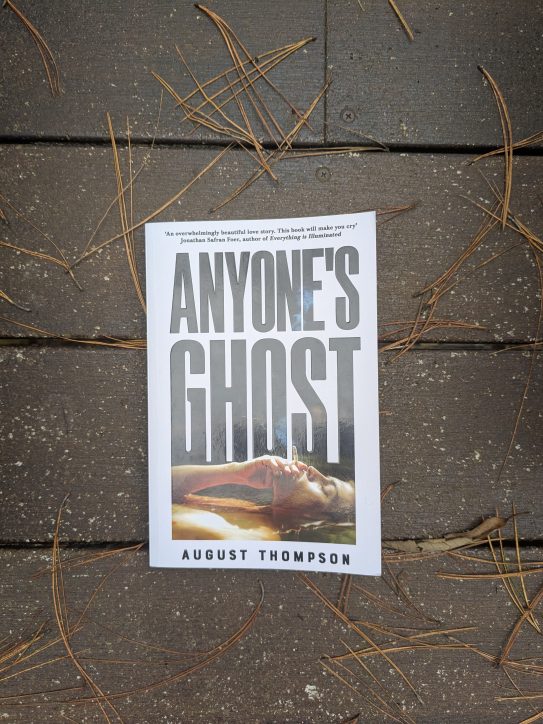
“Anyone’s Ghost by August Thompson.”
I’ll start this review in an unconventional place: the acknowledgements, which drone over four pages. August Thompson begins with thanks to his high school teachers, “who made several hours a day of high school a time of grace and charisma instead of emo angst”. It’s all a bit cringe. And yet as the acknowledgments drag on, I am dumbfounded. The names that appear here are incredible: Jonathan Safran Foer, Joyce Carol Oates, Jeffery Eugenides, Katie Kitamura, Brandon Taylor. How insane to thank the high school teacher Mr. Denis and Katie Kitamura in the same breath. All these world-renowned writers (and Mr. Denis) gave feedback on this novel and all we ended up with was this overwrought, self-conscious, sprawling mess of a love story?
The plot of Anyone’s Ghost is exceptionally simple, seemingly made more complex by the splitting of the novel into three parts:
- Teenage (male) narrator meets cute guy in down-and-out American regional town. Cute guy has a girlfriend. Unlikely cute guy gay. 142 pages.
- Post-college narrator lives in New York. Ex-teenage crush turns up for a few days in New York. Ex-teenage crush now married to his high school girlfriend. Oh well, there’s a big storm in which all of New York loses power for days and the two men hook up. But “we didn’t end up having penetrative sex, which felt right, even romantic, in the moment”. Oookay. Ex-teenage crush leaves New York and goes back to his wife. 104 pages.
- Ex-teenage crush dies. 50 pages.
I am furious at this novel because if you are going to write such a simple plot over 300 pages, you must be skilled at writing. You must introduce tension somehow, or at the very least have the characters be vaguely empathetic. Instead, we just get 300 pages of drivel. The narrator’s most interesting property is that his name, Theron, reminds me of the Game of Thrones character Theon. The love-interest, Jake, is the dullest depressive I’ve ever met in literature. I cared more about the updates to my health insurance premiums than I did whether he was gay or not.
Anyone’s Ghost suffers from the same devil-may-care American writing style as Jackie Ess’s Darryl. There’s all this “oh man” and “ah fuck” in the dialogue. There are road trips pined after and meals whittled away at crappy food chains. It’s a rush when Bret Easton Ellis references The National’s lyrics in passing in a scene in Imperial Bedrooms (“one time you were blowing young ruffians”). When August Thompson takes an entire song title (Anyone’s Ghost) from The National as his own, it is lame and uninspired. All this Americana in August Thompson’s novel just feels like filler – it’s a lazy way to try and evoke a time and place and push up the word to 300 pages. This novel is much more Dear Evan Hansen than it is BEE.
There are other major gripes I have with this book.
My primary issue is the writing. August Thompson sucks at it. He tries to be poetic and poignant throughout the whole novel and it falls flat every single time. He chucks a bunch of metaphors at the wall, hoping some stick, but none are fleshed out so they just look out of place and awkward. Take this line as an example: “The beach still clung to sunlight”. It’s sort of a nice visual and “clung” is an interesting verb choice. But there’s no deeper meaning there and no attempt to add layers to the atmosphere – the next sentence will be completely unrelated; the characters will probably be back in the car and talking shit about metal music. This is a structural problem with his writing. The metaphors he uses could be evocative in the hands of better writers (Jonathan Safran Foer, Joyce Carol Oates, Jeffery Eugenides, Katie Kitamura, Brandon Taylor) but Thompson doesn’t wrap the imagery up with a purpose, so the purple prose just sits there alone on the page, spoiling.
On a related note, the dialogue is terrible. Here’s the narrator’s father having a D&M, made for a straight-to-streaming service.
“It’s all right, Davey. It really is. I trust you. You’re not a fuck up. It’s silly – one of the worst parts of getting old is you forget what it was like being a kid. You lose your sense of empathy, even though you promise yourself you never will. Even when you spend your whole life thinking you’ll never be like your parents, you end up forgetting. I know I can be a real asshole now, but there was a time where I was fun. People loved having me around.” He sighed.
Sigh.
Some more pithy wisdom from Dad, saved up for the end of Part One.
“You don’t need to be that way. It’s OK to care. No, it’s good to care. It gets harder as you get older, so I hope you’ll do as much caring as you can now. Just giving a shit is enough sometimes.”
Oh, and here is some dialogue between the narrator and his teenage boy crush. I’ve experienced more tension during a game of monopoly with my family.
“I want to be here, right here, for a day that feels like a year.”
I thought about what to say, and it all felt cliché, but sometimes all we can turn to are cliches. “I wish you could too. But it’s good to leave a place before you get sick of it, you know? It’s good to miss things.”“Oh shit, you’re gettin’ deep on me.”
It’s less annoying but there’s also a weird tendency for the narrator to talk about how he grew up only among women, even though for 200 pages there are no prominent female characters whatsoever. It’s a strange flex, and it comes up multiple times in the book (“A life without women was a stark change. Growing up, my favourite thing was when my mother filled our house with women.”). Is August Thompson guilty about the lack of gender representation in his novel? Is he insinuating spending a lot of time with women as a child made his narrator gay? It’s off-putting, if I am being honest.
This is just so obviously a bad book. The plot is bland. The writing inexcusable. The characters are paper-thin.
Bert C. you owe me $35.


Leave a Reply