
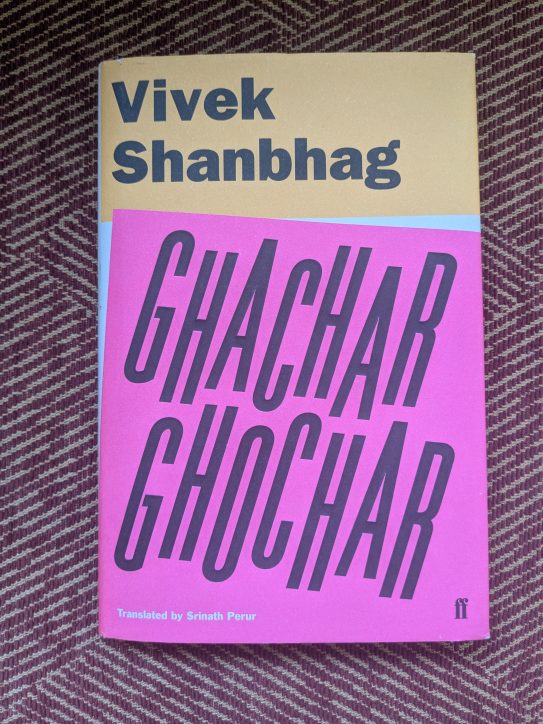
Recommend: No.
You have to be careful reading on holidays. Too good a run of books and ordinary life is put in jeopardy. Why return to work when there is a library of excellent books at home to be pillaged? Sure, money is nice, but it’s all just in service of reading isn’t it?
Ghachar Ghochar came at the perfect time. It was the final Sunday before trudging onto the early morning train back to work after a two week Christmas holiday. I was on a reading high. Murial Spark’s The Driver’s Seat was hilariously enthralling, and Horace McCoy’s They Shoot Horses, Don’t They? had the resplendent shine of a hidden gem. Work… Unappealing.
It’s really thanks to Ghachar Gochar that I caught that red-eye train. As I feebly punched my password into the turret Monday morning, all the time I was thinking: at least I am not reading Ghachar Gochar.
What a tedious read. Coming in at just over 100 pages, a book this small really has to be doing something awful to be boring.
Plot-wise the narrator is part of a big-ish Indian family living in India. There’s friction between his wife and his family, and they all live together Bear in the Big Blue house style. They are a wealthy family that came into their wealth relatively recently and are shuffling between social classes. If I wanted to learn about a family increasing in wealth, all I’d need to do is wheel down to the window end of the trading floor. A plot needs more substance than the mundanities of money.
There is one small sliver of intrigue – the narrator doesn’t work himself. It’s his cousin that is the source of the newfound wealth in the family. This adds an amount of tension between the narrator and his wife. But it’s too little too late. I couldn’t wait to close the cover on this underwhelming, unpoetic novella.
Flick to any random page of Ghachar Gochar and you’ll find yourself among such unemotional, uninteresting description that you’d be mistaken for thinking you’re back in Year 10 Geography.
Until then, eating at a restaurant had been an infrequent treat. Every fortnight or so we would all go out for tiffen on a Sunday afternoon. Appa was in the habit of taking a nap after lunch on Sundays, and on the appointed day we’d wait impatiently for him to wake up, Malati growing increasingly desperate for her masala dosa. The budget was fixed – it bought a masala dosa for each of us and a single coffee shared between Appa and Amma. Sometimes one of us would ask for another snack. Then, Appa wouldn’t feel like a coffee.
Yes. It’s all that bad.
This is the first of Shanbhag’s books to be translated into English. It’d be fine with me if it was also the last. I curse Garth Greenwell’s testimonial on the back of this book (apparently ‘exquisitely observed, wry and moving’). Greenwell, you owe me.


Leave a Reply