
Recommend: Yes.
What a title. What an opening. What a book.
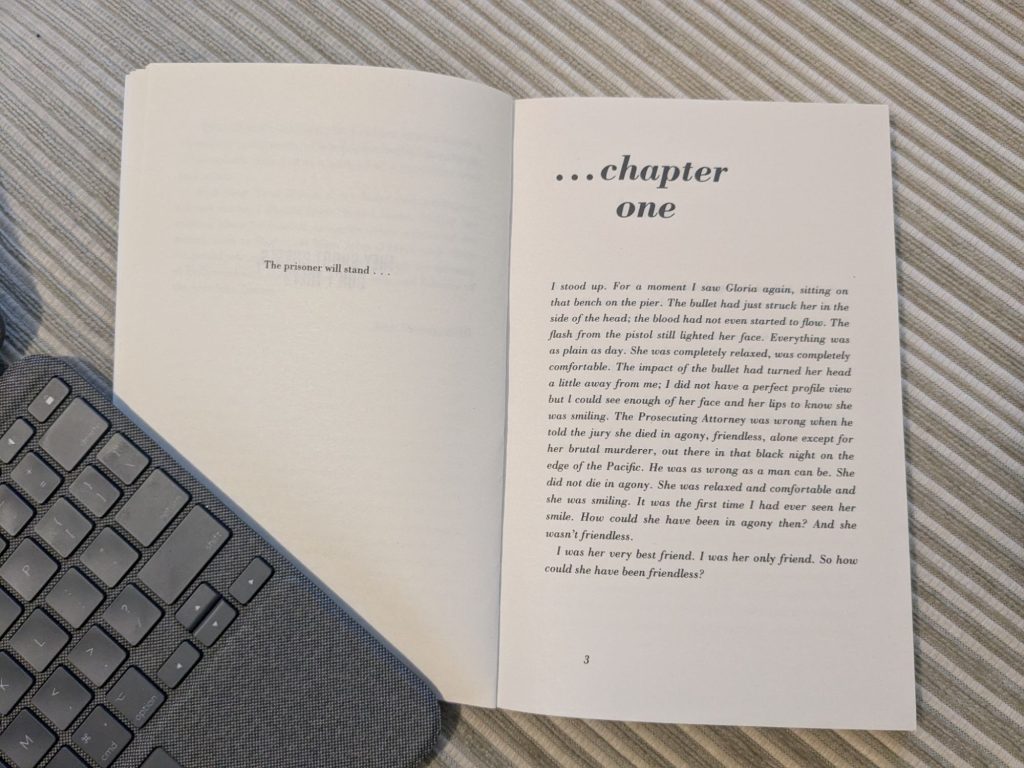
From the outset, it’s clear that this book has a striking structure. Proceeding every chapter is a phrase from the current court judgement being handed down to the protagonist, Robert (eg. “The prisoner will stand…”). Then, the chapter is 90% a reflection on how it came to be that Robert is pleading guilty to murdering his friend, Gloria, and the leftover 10% is an italicised stream of consciousness from the present day, inside the courthouse.
Oh, and the bulk of They Shoot Horses, Don’t They? takes place in a 24/7 dance competition.
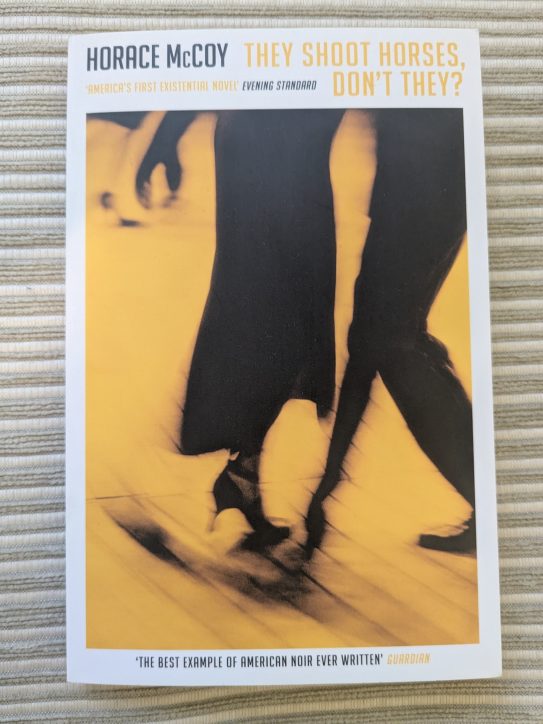
This is a cool novel. The font is cool. The setting is cool. The characters are cool. The quote on the front cover (“America’s first existential novel”) is cool.
A small biography of Horace McCoy included at the conclusion of the They Shoot Horses, Don’t They? makes McCoy out to be a tragic character who had one good novel.
Europeans began to rank him beside Faulkner, Steinbeck and Hemingway. McCoy, however, was broke, depressed, and “fat from too much food and booze”.
But.. At least he had that one good novel. And it’s a cracker.
Narratively, McCoy succeeds in balancing the anachronistic unease that creeps into the flashbacks of the dance competitions, and the tension that cracks like a whip in the tiny segments from the courtroom as Robert is being sentenced for murder. Structurally, McCoy is experimental – the font size of that courtroom judgement that proceeds each chapter gets bigger and bigger as the chapters tick over, mirroring how a judge would build into drama in his theater (the courtroom). So not only is the writing cinematic, the font is too.
There is also humour. Take, for example, this scene between Robert and (existentially challenged) Gloria, our two main characters, who are taking on more than 200 other couples in a 24/7 dance competition in Hollywood during the Great Depression, hoping to win the elusive $1500:
‘We’ve got a chance to win haven’t we?’ I said.
‘Have we?’
‘Well, you don’t seem to think so,’ I said.
She shook her head, not saying anything to that. ‘More and more and more I wish I was dead,’ she said.
There it was again. No matter what I talked about she always got back to that. ‘Isn’t there something I can talk about that won’t remind you that you wish you were dead?’ I asked.
‘No,’ she said.
‘I give up,’ I said.
There are beautiful, quiet scenes where Robert’s appreciation for the simple pleasure for life has increased by an order of magnitude now that he can’t access them. There is a strong sadness in these scenes. They are recounted in the context of the 24/7 dance competition taking away his freedom, as the only breaks that the contestants get must be used for rest indoors. But they also constitute a more poignant foreshadowing, because these freedoms are to be taken away from Robert again, and with permeance, as he is sentenced for murder.
Gloria and I walked down by the master of ceremonies platform. It was nice down there about this time of the afternoon. There was a big triangle of sunshine that came through the double window above the bar in the Palm Garden. It only lasted ten minutes but during those ten minutes I moved slowly about in it (I had to move to keep from being disqualified) letting it cover me completely. It was the first time I had ever appreciated the sun. ‘When this marathon is over,’ I told myself, ‘I’m going to spend the rest of my life in the sun. I can’t wait to go to the Sarah Desert and make a picture.’ Of course, that won’t ever happen now.
I watched the triangle on the floor get smaller and smaller.
Finally it closed altogether and started up my legs. It crawled up my body like a living thing. When it got to my chin I stood on my toes, to keep my head in it as long as possible. I did not close my eyes. I kept them wide open, looking straight into the sun. It did not blind me at all. In a moment it was gone.
Obviously, this is a great book. Thank you to Imprints on Hindley Street in Adelaide for stocking it, as I had never heard of it before that, and will think about it fondly for years to come.


Leave a Reply