
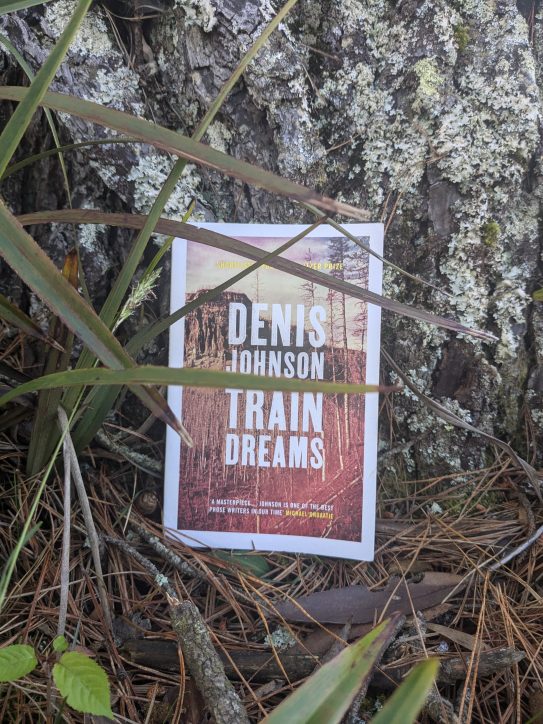
Recommend: No.
“He was all alone in his cabin in the woods, talking to himself, startled at his own voice. Even his dog was off wandering and hadn’t come back for the night. He stared at the firelight flickering from the gaps in the stove and at the enclosing shifting curtain of utter dark.”
Train Dreams falls into the same batch of novels as Cormac McCarthy and John Steinbeck. These authors all present gruff pictures of a life that ages without grace. They show America as a lonesome country where nature is bountiful but cruel.
He was standing on a cliff. He’d found a back way into a kind of arena enclosing a body of water called Spruce Lake . . . its flat surface as still and black as obsidian, engulfed in the shadow of the surrounding cliffs, ringed with a double ring of evergreens and reflected evergreens. Beyond, he saw the Canadian Rockies still sunlit, snow-peaked, a hundred miles away, as if the earth were in the midst of its creation, the mountains taking their substance out of the clouds.
Train Dreams is the story of Robert Grainer. Grainer is a labourer outside on the land and is rewarded for his toils with a patch of land in which he can build a modest house and take comfort in his modest wife. He has no ties to his immediate family. He arrives to distant relatives as a child, alone, by train and with no clear memories of his parents. The train motif of the title sounds itself throughout the small novel. Grainer hears trains in his dreams, in the background of his life, and on his journeys across the countryside. The train is a melancholic symbol of the emotional connections he yearns for but are constantly out of reach, falling away in the background as the train pulls away into the distance.
Grainer makes for himself a life that is padded with solitude. This at first brings him peace. He can balance the quiet of his life with the friendship of his wife and the exertion of his physical labour in the logging industry. The complications of the book occur when tragedies of nature and age befall Grainer. He loses much in a bushfire. His body falls apart and he can no longer continue as a logger. From here, Train Dreams becomes a mediation on how to sit with oneself day after day, as the mind fogs over with loneliness.
Train Dreams, for me, couldn’t punch with the same emotional weight as The Road or Of Mice and Men. The writing is sparse, and at times very lovely, yet I find it hard to relate to Grainer. He is held at arms-length from us, and his whole life’s story is covered in just over 100 pages. Such brevity also makes it difficult to connect with any of the auxiliary characters. All that is likely intentional, given this is a small novel about a small, and isolated, life. Still, the effect is distancing. I felt more connected to the story of Grainer’s patch of land – newly acquired, burnt to the ground, and then slowly rebuilt over decades – than I did to Grainer himself.
It didn’t help that I read this 100 page novel over three weekends, interspersed with Hit Parade of Tears, a campy collection of sci-fi short stories that couldn’t be more opposite in tone or style.
Had I given Train Dreams the focus it deserved, maybe it would have been a Recommend. It is, after all, a good book. Train Dreams finds solace in the journey of life, promising little, expecting less and all the while moving forward, through the seasons, towards an uncertain horizon.


Leave a Reply