
Recommend: No.
Deciding whether to buy a book new or wait to find it second hand is a decision I make mostly based on whim. Intentional purchases occur when I’ve never heard of a novel before or when a bookseller recommends a book that clearly is not a best seller. Outside of this, factors that determine whether I purchase a book new include but are not limited to: did I get paid that week? Is it raining and miserable? Do I like my life at this moment or would I prefer to accrete books in the delusion my circumstances will change and I will have time to read them?
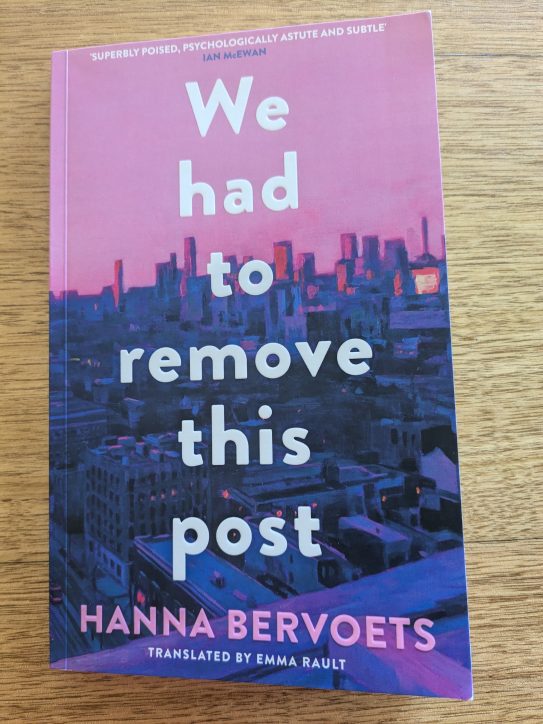
At one point I considered buying we had to remove this post new. Slim size and fuchsia sunset cover. A testimonial from Ian McEwan on the front. Kudos to the marketing department, I’m butter melting in their copper saucepan. But there was a glitch in the matrix that day. Perhaps the sun was shining alluringly outside the cafe next door. Maybe I’d bought too many possum jumpers already that week. Declan was likely stalking outside the bookstore, a frown brewing as he considers literally everything else he could be doing if he wasn’t waiting for me. I didn’t buy the book.
Eventually it turns up secondhand, I buy it and it was a disappointment. The writing is fine. The story is almost okay. The epistolary structure is cloying. The ending is abrupt and anticlimactic. I am $20 richer for waiting but I still feel empty. The world is no better off for this novel existing. I ponder the pine trees forests in Mexico that have been plundered for us to end up here. If I give it back to the secondhand store, what am I adding to the community? I am just permitting the next person to also waste their money and time. But then if I don’t, if I instead leave this at a roadside public library, would that person spend even more money and fell even more pine forests by purchasing this book new?
Out of this existential spiral a realisation emerges: is this why people prefer sports?
EDIT: Declan requested information on the book itself, which is absent from the initial review. This novella is just so inconsequential that it felt fruitless to recap. But infuriatingly, it was a more pleasing reading experience than Crash. And the reason I wanted to review it (I don’t review every book) was to think about what distinguishes a ‘good’ book from a ‘bad’ book. I liked this book more than Crash, but Crash will stay with me forever, unlike this one, which will not be remembered and will contribute nothing to my life.
We had to remove this post follows a small group of content moderators that work as subcontractors for an unnamed firm that is presumably Facebook. It’s written as a recollection from the main character in the form of a series of long winded essays to a lawyer launching a class action on behalf of the employees. Much of that is irrelevant because the author does not exploit the different timelines, nor does she leverage that the audience of the letters is an outsider with a different perspective and a vested interest in the grimey realities of content moderation. The book could have equally have been written in present tense.
We had to remove this post gestures towards the atrocities the employees must ‘moderate’ and the resulting densentisation they have to the most obscene behaviours of fellow mankind. Moreover, after watching countless hours of internet filth, the employees begin to softly emulate these behaviours: one threatens to taser his boss, another spills racial slurs loudly and publically, and our narrator is suggested to rape her girlfriend. The writing is twee and offhand so it sends mixed messages. We’re clearly not meant to pass judgement on these employees, given how sympathetically they are rendered. It’s as though we’re instead meant to pity what they’ve become through osmosis in their workplace. But they are not inherently likeable characters so we, the readers, are left quickly flicking through the book hoping for more guidance on why we are reading it.
The end of the novel is particularly jarring. The narrator visits the house of a girl whose video the company has suppressed and has a moment like “I have crossed the line” and then the book ends. Not only is this unsatisfactory in terms of wrapping up the themes of the book (so she crossed the line being a stalker but not a rapist?) it is also incorrect structurally. It is a personal, confessional memory that would have no relevance for the lawyer. The author just forgot we are meant to be in a letter to this lawyer, like she got bored of her own conceit. And that’s it. The book is over.


Leave a Reply