
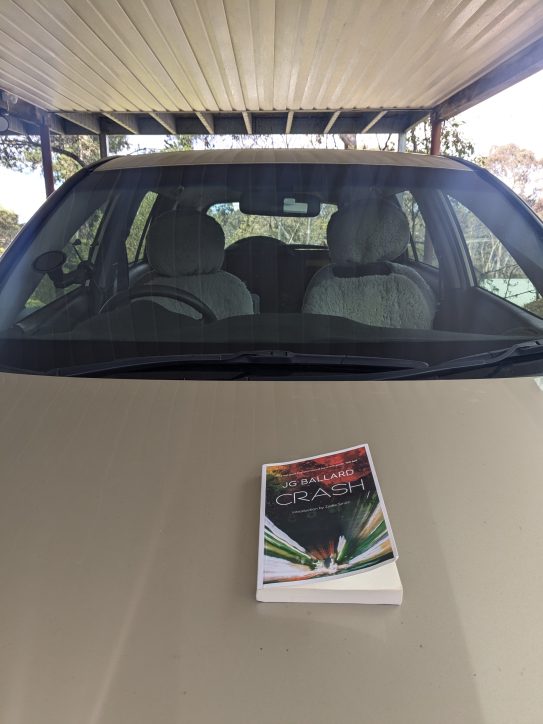
Recommend: No.
It’s an unfairness that the one socially acceptable non-work-related topic of chatter on a trading floor is sports. No one has ever asked on Monday morning what I’ve been reading over the weekend. Not once has a Friday lunchtime lull been filled with a sly joke about the state of the Australian Sad Girl Novel. There was that time Lee asked me what I was listening to walking into work and I informed him it was the Bookshelf podcast. But I’m still waiting for his follow up questions.
So how I dread the Olympics. In ordinary times sports talk floats above me, from the male on one side of me to the male on the other. I physically hunch myself over my desk to avoid inclusion in the conversation. The Olympics, however, are an ‘event’ and it’s assumed anew that I have at least a passing curiosity in the games. I am forced to feign interest where before I was permitted to sit on the sidelines. It’s so tiresome. Did a man compete as a woman? How cute is the skateboarder girl that won a duck? These matters feel so inconsequential and purposeless, like they have been generated by an AI to encourage mass human engagement without causing emotional stress. My eyes glaze over, struggling to focus. My brain on standby to nod at appropriate pauses.
After upholding this taxing charade, I then come home only to have to feign interest all over again with JG Ballard’s Crash.
Crash is repetitive and rudderless. We follow our narrator, James Ballard, who in turn follows Robert Vaughan (this random guy that is now the frame of the story) into his obsession with automobile centred ‘sexual acts’ that evoke the pulse quickening, stress inducing panic of a car crash.
It takes the first third of the novel to become accustomed with the fact there is no plot holding this novel together. The characters are propelled by visions of violence and disfigurement and take actions to force these fantasies into reality. The narrator is entirely complicit in Vaughan’s lust to see technology overpower humans, and destroy itself in the process, so there is no complication. People have sex in cars, people in cars are stalked by other people in cars, people wear cars down to their skeletons and in turn cars break the skeletons on the humans in them. Every chapter is another wave of traffic cruising towards a roundabout, in no way distinguishable from the last.
All characters appear totally aware of the danger and maliciousness of the road and readily invite it. Such uniformity means that Vaughan, meant to be the deranged central character, is more like a disassociated cult leader, which in turn means that Ballard (the author, not the narrator) can’t raise the stakes. If Vaughan kills one of his followers in a car crash, it is meaningless because they themselves submitted to the death. By the time Vaughan and Ballard (the narrator, not the author) have sex, it’s rendered trivial because we’ve already endured Vaughan fucking literally every other cast member and Vaughan’s semen on Ballard’s binnacles shines the same way it did on Ballard’s wife.
The car (and the violence made possible by the car) becomes more sexually alluring than the human counterpart, and outside of the confines of the car there is an absence of pleasure. Crash forms a warning about what we extract from technology. We expect technology to enhance humanity, and implicit in that desire for transcendence is the assumption that to improve upon our current state we require better machines, not better humans. Sex is just a very visceral example of a human experience that, once taken to the next level by technology, cannot revert back to its primitive form. I could extend this message to countless other human interactions marked by technology, both personal and societal: attention spans, communication, politics.
It was a struggle to finish this book. I was particularly infuriated by how Ballard reused phrasing. Bodies were continuously conforming to metal. The concrete overpass to the airport loomed over every page. Airplanes lifted out of the sky again and again and again. A motif is a vital tool for the novelist but to use the exact same language each time to present the motif is ineffective and boring. I was tempted to pull over the the curb and walk home as I clearly was not enjoying Crash and it did become clear there wasn’t going to be an exceptional plot twist to reward me at the end of the drive.
Yet irony imbues Crash. The incessant repetition of language was so numbing that in order to feel something new, I was driven to push hard against the accelerator, anticipating the pain, and finish the book.


Leave a Reply