
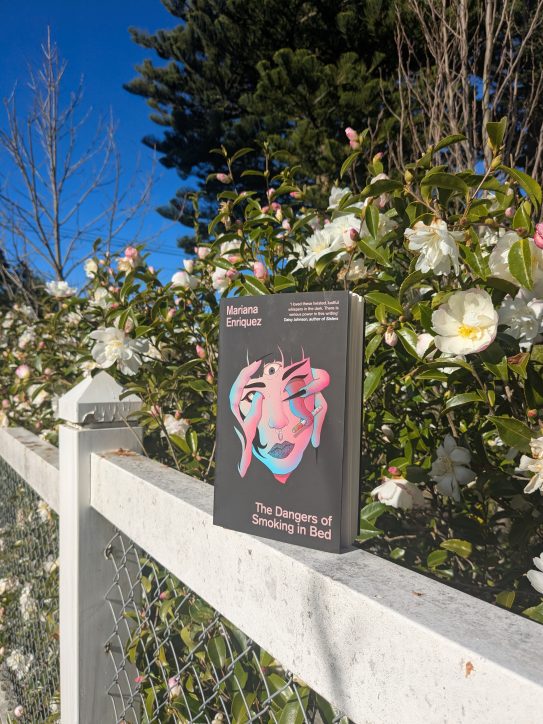
Recommend: No
Arthur: So, once we’ve made the plant, how do we go out? Hope you have something more elegant in mind than shooting me in the head?
Cobb: A kick.
Ariadne: What’s a kick?
I started reading The Dangers of Smoking in Bed while I was reading Wild Abandon while I was reading Kairos. Real life-Inception.
I was struggling with the stoic, academic prose of Booker Prize Winner Kairos. So I took a little break during the intermezzo and plunged into the swampy depths of Wild Abandon, written by Australian author Emily Bitto. Instead of being scrubbed fresh and new with grit, I found that I was merely mucking about, slimy and directionless in Bitto’s quagmire. I distracted myself by starting yet another book, The Dangers of Smoking in Bed, and, with great relief, finishing it. And so now I pull myself up through the layers, going on to complete the levels Wild Abandon and finally the finale of Kairos. Only then may I break the curse of average novels.
The Dangers of Smoking in Bed isn’t actually a novel; it’s a collection of short stories by Argentinean author Mariana Enriquez. Most are quite small – less than 20 pages. These smaller stories rarely engaging. All have a ‘horror’ bent designed to highlight the nastiness of crime in Argintina, though many lack the suspense and the satisfying endings I expect of the genre.
There’s usually just one pretty fucked up thing happening (ghosts/curses/cannibalism). The anomaly is announced early in the story. The plot fleshes out a little bit about how the ‘normal’ characters react to this event. And then the story will wrap up pretty abruptly with the resolution being ‘we just let the weird shit alone and moved away’.
It’s not terrible writing but there’s often a distinct lack. Short stories are meant to feel surprisingly expansive – where what is unsaid should speak as strongly as what is said – and part of that expansiveness will come from the unexpected turns the stories take. Where you think you are reading one thing and then in only a few pages you realise you are reading something altogether different and more meaningful. Enriquez couldn’t construct those moments of surprise in these smaller stories. The journeys she took you on were typically on a straight road without much in the way sightseeing.
There are pleasant exceptions.
Our Lady of the Quarry is narrated in the past tense, first person plural of a gaggle of women recalling an event that occurred when they were fervid teenagers. The narration is demented. It is warped by the way it sounds as if they are all one entity (“But we wanted her ruined, helpless, destroyed”) and warped further still by time that has elapsed (“The details came soon enough, and they were nothing spectacular”). All this adds the depth and intrigue which is missing from some of the other stories.
Despite the experimental title of the collection and its bizarre cover art, The Dangers of Smoking in Bed only features a few interesting plots. The weakest story is actually the first, Angelita Unearthed. Here an ancestral specter appears and haunts the protagonist for no great reason and to no great effect. Later on, the plots do improve. Meat was a standout. It was so unique it ironically reminded me of Izumi Suzuki’s Hit Parade of Tears. In Meat, a weirdo pop musician attracts a weirdo fanbase and he commits suicide in a weird way and his fans’ reaction to his suicide is weird.
The longest story is Kids Who Come Back. This was much better than the average shorter story. The roughness of South America strengthens all the stories in the collection but it’s most satisfying in Kids Who Come Back. An employee of a muesem-like organisation preserving oral histories of the missing children of an Argintinean city finds all the missing children chilling in a park, nevermind if they had previously been recorded alive or dead. Enriquez invests more time in the world of this story. We get to have beers in the park before it is defiled. We meet side characters and watch love interests fizzle into friendships. There is an ooze of disquiet that pervades without dominating. The plot, again, is not incredible and the ending feels underdeveloped, but the care taken in the rest of the aspects elevates this to be nearly the best work of the collection.
The best, I argue, is No Birthday’s or Baptisms, a tiny ten page story. It opens confidently.
He was always around, the kind of acquaintance who turned up at parties although no one knew him, but I only became friends with him that summer when all my other friends decided to become assholes – otherwise known as the summer when I decided to hate all my friends.
I love openings to short stories that deliberately misdirect. They emphasise one small aspect of the plot, as though that were going to the basis of the entire story, and then pull you into something with a grander scale, occasionally harking back to that unobtrusive opening when you knew nothing. Here I am thinking – what happened to her other friends? Why was this man at parties when he didn’t appear to be invited? What has made our narrator cold and bitter? None of that really matters, of course, because the story then weaves in a different direction. I am drawn in!
It is never unbelievably good, and sometimes it sinks below-average, but The Dangers of Smoking in Bed can be a delicious read.
I heard Enriquez speak on a recent live Bookshelf podcast and she was brilliant. On the podcast, the hosts were spruiking some event called the ‘Best 100 Books’ where the audience votes on their favourite books and they asked Enriquez why it was important to recognise modern and old classics. Enriquez, charmingly, replied, “It’s not. Lists are silly. We like them because they are silly.” She was essentially saying: this whole hour of discussion is not as serious as you are trying to convince yourself, and that’s not a bad thing at all. To reply so honestly, and with such an upbeat spin, is damn endearing.
Even though The Dangers of Smoking in Bed didn’t wow me in the way that Enriquez did on that podcast, I am going to continue reading her. This is a collection of her early work. There are definite signs of promise here. I can see a future where I read her later works and say, “ah”.


Leave a Reply