
Recommend: No
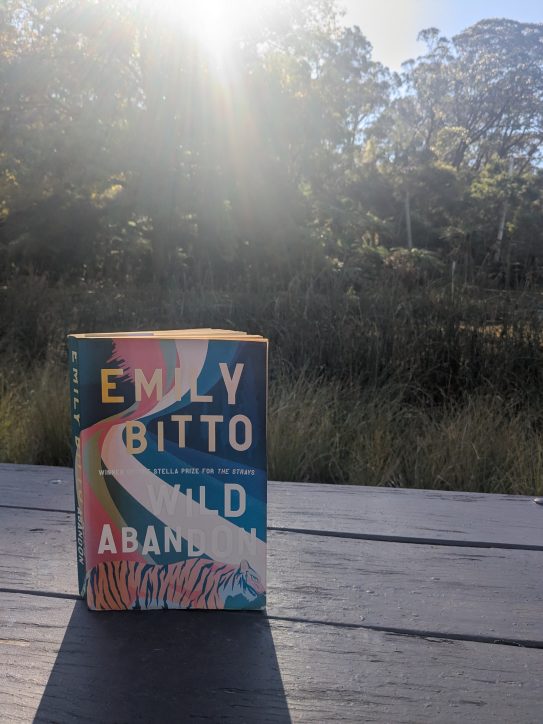
Wild Abandon is an Australian novel that had an intriguing plot but was so poorly written that I came to dread my time with it. In the Acknowledgements section Bitto reels off the series of grants that she received while writing this sludge, and only then did I feel as though I understood why this novel was 450 pages and set in the US. I suspect grant-scam.
Wild Abandon begins with, ostensibly, the break-up of all break-ups. This is bigger than each time Ryan and Marrissa broke up in The OC. This is tragedy on the scale of Dan and Serena parting ways in Gossip Girl.
This is a twenty-two-year-old Melbourne hipster (Laura) realising that she is embarrassed by her try-hard country-bumpkin boyfriend, Will. If she’s being honest, she’s finding it increasingly hard to relate to Will, given that he’s actually pretty boring, and she can’t get a word in amongst his inner monologues on RM Williams boots. She’s got Bonsoy lattes to drink and art shows to attend, anyway. Laura breaks up with Will.
Will is distraught and lonely, and thinks that if he travels to America, he might find a way to be less distraught and lonely. This is where Bitto drops us off: in New York, fresh off the plane from Melbourne, heart freshly broken.
There’s nothing wrong with the plot. The general premise of a young Australian travelling overseas with no ties back home is not reinventing the wheel but it is generically pleasing enough to the average Australian reader. Throw this woman some grant money!
It’s the writing that is the issue. Bitto cannot write. She is the definition of purple prose. I heard on the Bookshelf Podcast that Bitto teaches creative writing classes – god help the future of Australian literature.
Where to start?
Structurally, Wild Abandon is infuriating. 99% of this book is written in third person, observing Will as the central character, but the third person style is just plain wrong. It is a claustrophobic stream-of-consciousness third person narration that has zero subtly or distance to the protagonist. Frankly, the whole book should have been written in first person. Bitto just doesn’t have the talent for anything more nuanced.
I do have to also draw attention to a feature of this novel I am sure Bitto thought was ‘experimental’. Sporadically, there will be a few paragraphs from a random person’s perspective. And I mean random; like the (gay? creepy?) side character art dealer that has literally nothing to do with plot gets a whole page to weigh in on his first (and only) impressions about Will. These pages from another character’s perspective are crap. They should have been edited out. They are inconsistent and underbaked. They are meant to be giving us an alternative perspective on our protagonist but he’s so uninteresting to begin with, that the switched-perspective additions can’t add any depth and they just come off as stupid. The mundanity of the reflections on Will reveal just how little there is to say about him as a character and how inconsequential he is.
There’s also the weirdness that this is so clearly a male protagonist as written by a female. Bitto’s writing talents are too shallow to pull off any feats of gender subterfuge. Her narration is not masculine at all and it feels off. There’s these odd, too-frequent moments where Will reflects on how left out he feels when he’s in a group of females at a party, who take joy from conversation, unlike himself and his fellow neanderthal men. For god’s sake, throw that woman some more grant money!
Kim and Darla smiled and nodded and returned to that familiar multi-voiced unceasing chorus of impassioned female conversation that he would hear the world over and for the rest of his days and always be shut out of.
This is sort of like Bitto yelling into your face, “look, my protagonist is man. He have penis.” Which she kind of explicitly does in a sex scene that I am working hard to forget.
She bent over him – cradled him almost, her tits at the level of his mouth, and he wondered whether he might get to suck on them, suckle up all that feminine energy… maybe that was the formula – prick shrink away to become a hollow tube, but not a lack. Never lack, he had learned that at uni, the thorough take-down of Freud and Lacan. Oh, but these were not thoughts to sustain a hard-on…
Eeeeww… Suckle. Feminine energy. Hollow tube. Please, please Bitto, stop, the boner’s already dead.
It’s clear from the above extracts just how awkward Bitto is narrating from a male perspective. Bitto doesn’t know her characters and watching her fake it is entirely uncomfortable. It shows in the prose. Her sentences ramble and her metaphors falter.
Bitto tries to augment masculinity through metaphors heavy with jargonistic language but quite often there are specific word choices that just feel incorrect. For example, Will watches dogs at the park hungover and comes up with this pearl:
He longed to dig back for in the loamy non-linguistic past of his own life or his species’ as far as it was necessary.
As necessary for what? The sentence, as hard as it is to read, ends so abruptly after dragging on for so long. The worst crime here, in my opinion, is use of the word “loamy”. Why is it there? Loamy is a soil type. What specifically is Bitto trying to call to mind – distant ancestors writing around in mud? The language just feels wrong, and it’s a feeling I lived close with while reading Wild Abandon. I kept sensing that Bitto didn’t know what she wanted to convey in a given sentence and so just forced semi-related words together, hoping something would sound poetic enough to stick. Sure, most books are guilty of this to some extent but when it’s paragraph after paragraph of these unfocused sentences, I get so demoralised. What am I reading? There is an AI-like quality where if you really, really try to unpack her sentences, forgiving her for clunky grammar and metaphor, you might glean some meaning. But it’s impossible not to question if it’s worth the effort.
A quintessential example of Bitto going totally off the rails is the following sentence:
And so our hopeful adventurer sat at the bar and drank too many beers and chatted easy and aimless to J.T., this provident innocuous and kindly figure of easy welcome and blessed simple shallow friendship, and he marvelled at the haphazard date of the traveller, whose authentic ranks he may finally have joined.
What a travesty this sentence is. And yes, it is just a single sentence. Firstly, I cannot stand when Bitto slips into a very ham-fisted first person plural point of view (“our hopeful adventurer”). It’s that cringeworthy 1% I foreshadowed earlier. Secondly, there is the total out of control way this sentence forces upon you J.T.’s character assignations (“provident innocuous and kindly”) while also setting up the physical scene (drinks at a bar) while also drifting into some cliché at the end about ‘the traveller’. Then, finally, the sheer volume of padding words with too few commas to ease the burden (“too many beers”; “provident innocuous and kindly”; “blessed simple shallow friendship”; “authentic ranks”; “haphazard fate”). Bitto, to paraphrase yourself, this is not language to sustain a hard-on.
Gosh, I haven’t ranted about the second half of the book, which is a complete rip-off of the Netflix series Tiger King. But I am tired. Wild Abandon wore me out. I would have stopped reading this after 100 pages if it weren’t for the fact I started this book because I wanted to take a break from another book. I would have felt like a big fat failure if I gave up on this too.
I love the zoo. I am infatuated with the idea of New York. I am intrigued the notion of a clean break. I did not like this book, proving that the whole, in the hands of a bad author, can really be less than the sum of the parts.


Leave a Reply