
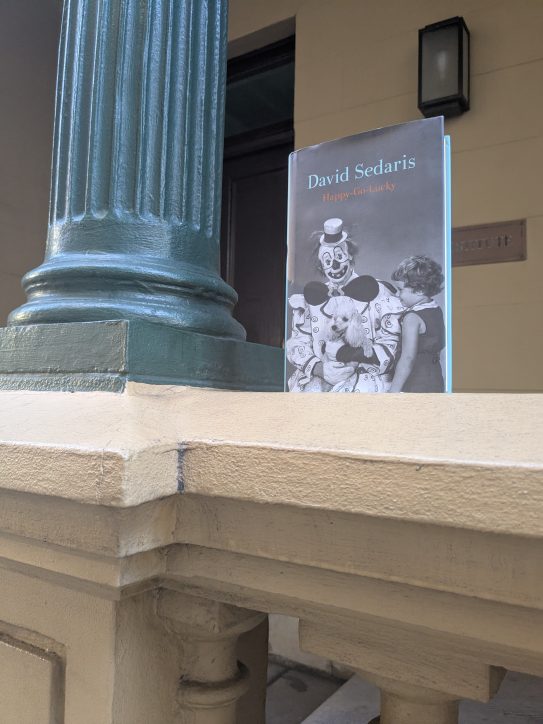
Recommend: No.
Youtube Short trends that I was exposed to instead of reading this book at night:
- TokyoTok: foreigners that live in Japan walk around Daiso pointing out quirky junk for sale.
- BookTok: a reminder that people actually do buy shit books, and read them, and recommend them.
- DanceTok: Maybe the O.G. Tok?
- GoldenRetrieverTok: woof.
David Sedaris is a stalwart of short essay collections. This is his bread and butter. But the breadcrumbs are flaking off the stale loaf and the butter’s best before was three months ago. It’s still good though, right? It’s not going to hurt me to consume it, right? You won’t get sick but you also won’t have fun.
I remember really enjoying Sedaris’ older collections. The stories were all a bit different, each a well constructed yarn that had narrative merit. This collection, Happy-Go-Lucky, has not measured up to my expectations.
My complaints begin superficially. I hate the title. And I hate the cover. Is the title simply being ironic because Sedaris is becoming an old codger who, by his own claims, is not happy-go-lucky? If so, that sucks. What’s up with the clown image on the cover holding a poodle? None of that is remotely relevant to these essays. It’s random and unesthetic.
The content doesn’t fair much better. Sedaris is in the stage of his writing career where collating his diaries for publication counts as ‘work’ and ‘art’. I am steering well clear of the diary anthology but picked up Happy-Go-Lucky with the hope that these essays would be more structured. What I got though was a collection of many repetitive essays, drawing (too) often on the following themes: Sedaris’ relationship with his now-dead father; his holiday house on a coast of America; his life touring around the world giving lectures; COVID.
God I am sick of reading about COVID. For a time in the world that felt unprecedented to me, it’s incredible how much creativity it drains from writers. With worlds reduced to suburb radii, everything feels so petty. And it is ruining the greats. Tessa Hadley, Hilma Wolitzer and now Sedaris as well. They were old and comfortable during COVID and presumably fussed over a lot. There is no tension or drama to draw upon. I was trying to figure out why this has been such a common motif in the books I have read recently, and I think it’s because all these COVID-time books are now second-hand or on sale, so they’re only entering my bookshelf now.
Sedaris is at his best when writing about his family in this collection. He writes honestly and sharply about his recently deceased father, his sister that committed suicide, and his other weird and wonderful and very much alive sisters. But the rest of the content of his life is now officially boring: putting a house up for rent on Airbnb; getting cosmetic dental surgery; staying at expensive hotels paid for by event organisers. There’s nothing poignant there to mine. I ended up flicking through a few of these essays as one would a glossy magazine, or Youtube Shorts: absent-minded and with only the loosest thread of interest.
Sedaris is a skilled writer who has already done everything of interest and now leans back into age, counting his wealth. It might be time to give fiction a go next.


Leave a Reply