
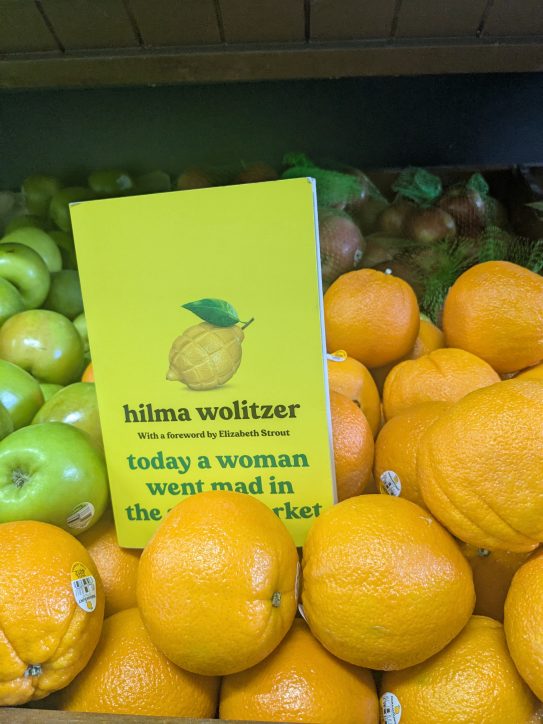
Recommend: Yes.
Books with long titles talk a big game. A recent example that couldn’t live up to its syllable-overload excitement was Nostalgia Has Ruined My Life. Today a woman went mad in the supermarket is a totally different ball game. It is sassy and in control. It is surprising and fresh. Nearly every story in this collection is worthy of note.
I’ll start with the namesake first story, Today a Woman Went Mad in the Supermarket. A killer title for both the collection and the specific story. It evokes instantly a distrust in the domestic. What could be more routine than a trip to a supermarket? If you can’t hold yourself together in a supermarket, how dire must your grip on sanity be?
The writing style is easy to read. Scenes are clearly rendered, and the plot of each story is remarkably simple. Most stories occur within a ringfenced time in a person’s life, maybe a few days, maybe an afternoon. For example, in this story, our narrator (unnamed and unimportant) has an interaction with a woman in a fragile state in an aisle of a supermarket.
Nevertheless, this woman did not go trundling her cart through the ordered chaos. She stood transfixed, as if caught in some great thought. She was blocking the aisle.
“Excuse me,” I said tentatively, hesitant and self-protective as only a woman expecting her first child can be. “Pardon me, could I just get through?”
She turned slowly, and the two small children clinging to her skirt held on and tightened the cloth across her hips. Only what she said then stopped me from clearing my throat and asking again if she would move and let me through.
She gripped the handle of her empty cart and said, “There is no end to it.” It was spoken so simply and undramatically, but with such honest conviction that for a moment I thought she was referring to the aisle of the supermarket. Perhaps it was blocked ahead of us, and she couldn’t move up farther. But then she said, “I have tried and I have tried, and there is no end to it. Ask Harold, ask anybody, ask my mother.”
I admire how Wolitzer has given us the insufferable nature of this narrator so succinctly (“hesitant and self-protective as only a woman expecting her first child can be”). We start with the narrator, pregnant and naïve. And we witness that narrator judging the lady in the aisle, becoming increasingly impatient with her (“Excuse me,”; “Pardon me, could I just get through?”; asking again if she would move and let me through). The narrator is pregnant and the woman who ‘went mad in the supermarket’ is implied to be in such a state due to her children. The parallels between the two are not a coincidence. The narrator might not realise it but we do: she is looking at a future she does not recognise but will surely, inevitably, succumb to.
There’s an added edge of interest as Howard and his ‘mad’ wife are central to many of the stories. It’s hard to explain the links in the stories though. It’s not like a Brett Easton Ellis novel where characters reappear in different contexts almost as a reference to how irrelevant they are: we spend thirty pages with one character only to have that character mentioned in passing and never again in another chapter. It’s also not like a Jennifer Egan novel where characters, often only loosely connected, are interwoven into each other’s stories as a way of building out that world. I think these really are independent stories from the life of Howard and Paulie. The stories do not build to a greater whole – they are each standalone.
Why then follow the same married couple throughout most of the collection? One benefit is that we are familiar with them. We don’t have to relearn their contexts in each new story. Sometimes I do find the constant changing of narrative disorientating in short stories where each one is totally unconnected to the last.
When I stopped trying to understand how one story influences the stories that came before, I could relax into this collection more. It felt a bit like looking through an old photo album of a married couple. Many photos have recurring settings, but they are not organised to tell a grand narrative. They are little snippets to be enjoyed individually.
There was another standout for me titled The Sex Maniac. Again, the title is a hook. And again, the story proves to be an entirely satisfactory catch. Is this not one of the greatest starts to a short story? Who wouldn’t want to read on?
Everybody said that there was a sex maniac loose in the complex and I thought – it’s about time. It had been a long asexual winter.
I loved nearly all these stories. I would happily re-read them. Their strength is just in the telling of the story. In modern short stories, often there is a big reveal at the end that changes your opinion of the story you thought you were reading. There is none of that tricksiness here, and in fact the endings fall pretty flat. Wolitzer can be tongue in cheek but it is done through her characterisation rather than any ‘meta’ narrative structure. I don’t see that as a limitation – it just has a different impact on me. Instead of enjoyable and jaw-dropping, as a Joan Didion chapter opening might be, the writing is enjoyable and familiar.
The one exception is the final story. All of the other stories were written in the 60s and 70s. This final story, The Great Escape, was written in 2020 and is based in COVID times. Is there anything more tedious than old people talking about COVID? Tessa Hadly fell into this trap too with her final story in After the Funeral. What happened in COVID times should stay there. If I have to hear once more about an investment banker’s child ‘missing out’ on their international travel year during COVID…
Supermarkets, domestic frustrations and family are commonplace in our daily life. Skilled writing, less so. How pleasing to have them all at once.


Leave a Reply