
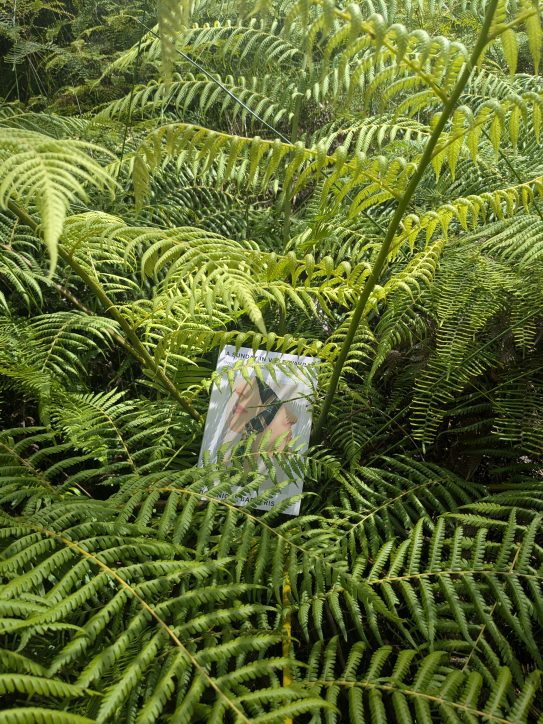
Recommend: Yes.
I am missing a category of friend in my life. I have the friend to give cool, mid-twenties literature too. I have the friend to give edgy 1970s sci-fi literature to. I have the friend that I will bequeath the occasional classic. But I do not have the friend in which to share a quieter style of novel, such as A Sunday in Ville-d’Avray. This imagined friend is likely older in age. They definitely do not have children. They play social tennis and afterwards share a bottle of local pino.
A Sunday in Ville-d’Avray is an understated gem that is enjoyable for the soft atmosphere it emits. There are no bombshell twists or moments of shock. It mostly unfolds over an afternoon shared by two sisters. The narrator, Jane, visits her sister, Claire Marie, in a suburb about half an hour from Paris. While narrated by Jane, the whole novel is about Claire Marie. It is about how she is observed by those around her and, eventually, how she observes herself.
Before their evening unfolds, Barberis sets Claire Marie as the central character of this story: a woman whose complete ordinariness stirs up distrust amongst her more ambitious peers. Jane recounts how unaffected Claire Marie was during their childhood (“She’s read a lot, but she hasn’t drawn any theories from all that reading”). There are also reflections from Jane’s partner, not in attendance on this particular Sunday afternoon, regarding Claire Marie’s inability to connect with modern Parisians.
‘I don’t trust your sister’s ability to diagnose patients; she always seems to be “elsewhere”. Your sister,’ says Luc, ‘has never had her feet on the ground. It’s a family trait.’
Then Barberis transitions into explaining the context around the afternoon. It’s suggested that certain reflections on life only occur at particular times of the year, in a particular part of the week, with a specific, accommodating weather. In this case, it is a Sunday afternoon caught between the end of Summer and the beginning of Winter (‘The season was moving on’). The evening is pleasant but the days are just starting to grow shorter.
The mood of Sunday is exquisitely evoked as Jane drives towards her sister’s house.
I passed a station, I don’t remember which one, where the people getting off a train from Paris stood out behind the railing that separated the platform from the street like figures silhouetted against a background of sky. You got the impression that they were hesitating, they didn’t know where to go. The train left again; it was typical of Sunday, all that, the degree of blankness, of slight uncertainty, of vauge apprehension (connected to uncertainty) that characterises a Sunday; I put on my sunglasses and told myself that despite the fine weather, despite what was left of summer, you could always recognise a Sunday afternoon.
I think referencing the title of the book within prose always adds poignancy. It also adds comfort because I am convinced that the author has a vision. I am at the behest of competent hands.
The sisters recline outside. Claire Marie’s husband is out. Her daughter Melanie is at a movie. They spend time within their shared nostalgia and each quietly yearn for a life they do not have but cannot picture.
‘When Melanie leaves, I don’t know what we’re going to do with the piano. I don’t play, and neither does Christian. The whole floor will be more or less closed up.’
I suggested, ‘You could learn to play too. You could. Haven’t you ever thought about taking up music?’
‘Yes,’ she admitted. ‘I’ve thought about it occasionally.’
‘You have time. You could learn. If you start now, you’ll surely get to where you can play two or three pieces – I think it takes only a few lessons before a beginner can play “Fur Elise”.’
I was getting carried away. I said, ‘Everything’s possible.’
‘Do you think so?’ my sister asked wistfully. ‘I’d love to, I’d really love to.’
Seeing that the idea appealed to her, I kept insisting. ‘Of course, everything’s possible, it’s never too late,’ I said (even though, in fact, I didn’t believe a word of it). But that was just the way it was; the more I felt bogged down in the torpor of that late afternoon, the more I insisted. ‘At least try. What have you got to lose?’
And then the conversation moves on to a confession of sorts from Claire Marie. A retelling of a past “encounter”. From here the plot of the novel evolves. But I was not very invested in this past story. I felt that it didn’t convey as much disquiet as the earlier back and forth about the missed opportunities (and missed passions) to learn piano. When Claire Marie is directly recounting, the language is not as poetic or sharp as when Jane is listening to Claire Marie recount.
I am sure there are subtleties of France embedded in this novella that I am knowingly ignorant of. There’s a lot made of the distinction between the heart of Paris and the suburbs less than an hour drive away, which was lost on me.
These are small gripes though. This is a compelling and calming read. It evokes an in-between time of week, an in-between season and an in-between age. All mellowed out by in-between feelings.

Leave a Reply