
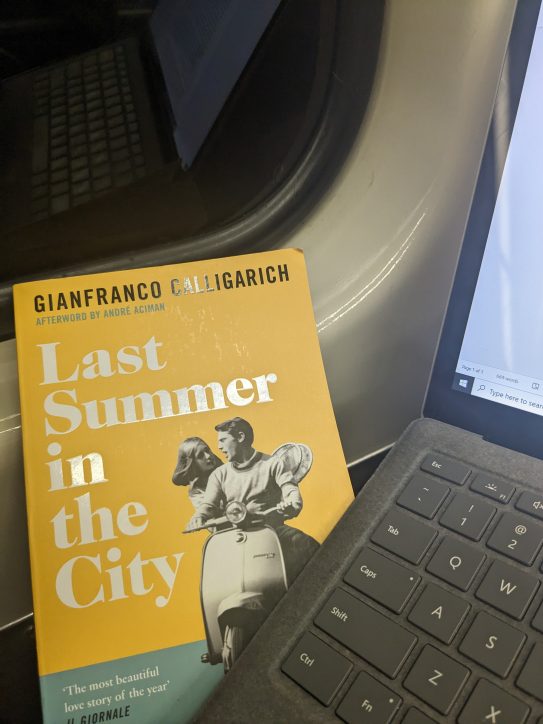
Purchased: Ariel’s, 2024.
Allure: Less than 200 pages; an Italian hidden gem; afterword by Andre Aciman
Recommend? Yes.
“Well, I’d arrived where I meant to arrive. Now all I could do was turn back.”
After a dinner with brokers in the city, where no one can relate to each other beyond their salaries being located in the same 1% of Australia’s distribution, Last Summer in the City has the alluring familiarity of a family member you see every few years. They may know as little about you as the brokers seated around a private dining room at Mr Wong’s, but when you look at them you see yourself – you see a past and future that both scares and comforts.
This is a book that reminds you of where you were when you read your first Hemmingway, the angst when you read the Great Gatsby and the luscious Italian otherness of Call Me by Your Name. It has characters that appear for a chapter (maybe two) with such intimacy that they command attention and respect. And then there is the love interest that seems to materialise and evaporate interchangeably, and you must accept that they are the love interest, despite their shady and elusive character. Why not love a girl who carries around a deck of playing cards in her jacket everywhere? I find with these ‘older’ books that it’s best to just go along with the dubious romances – if you question these connections then the story becomes patchy and confused.
What is more interesting is the protagonist and their place in a world that seems very far away, in both time and geography. The late Italian summers are beautifully rendered – Last Summer in the City convinced me that an Italian summer was a summer distinct to others in the globe. The friendships are cold and like in Fiesta: the Sun Also Rises (Hemingway) these friendships are temporal. They are relationships bound together with wine and discourse particular to an age but are not bound by feeling. I am left with the distinct impression were these people to meet as strangers on a bus, they would all turn to their paperbacks and exchange not a singe word. Their chemistry is borne of staleness – they work the same jobs; they know someone’s sister; they have had sex with each other but can’t muster the enthusiasm to recreate that original spark.
“I didn’t say anything. We were so old, it was so late, everything had gone so badly.”
There are touching scenes in this book. The quiet funereal of a friend who the protagonist was writing a film script with (but as with all the friends in this book, it’s hard to tell just how good of a friend they are) stands out as one such scene. The protagonist shares the day with the deceased’s father, a cab driver. “This was the man we’d killed in our story, an old man”. To base an entire fictional script around killing a man shown to us as so pallid is poignant – what a worthless grudge this friend must have carried through his adult life, ending with his father so helpless at his grave. Or alternatively, what a beast this old man must have been in the past, only to have time and loneliness erode him to a weathered stump, which is dire look into the future for all characters in Last Summer.
Diving into this book is like (re-)reading five other books at once. Even the novel I read most recently before this, “Bright Lights, Big City”, by Jay McInerney, sets out parallels to Last Summer in the City. The protagonist works as a quasi-journalist – in McInerney’s novel, at the New Yorker; in Last Summer in the City, at a hobbyist sports magazine. The protagonist is surrounded by people who mean him no harm but cannot reach him. There is a very faint yearning for a parent now distanced that looms over the text and is perhaps the source of aimlessness that neither protagonist can escape. This final theme is stronger (and comes as a surprise) in the concluding chapters of Bright Lights, Big City, whereas comes up in the first chapter of Last Summer in the City and then softly permeates the text that follows.
As Last Summer concludes the tone quickly shifts from urban restlessness to dramatic, existential melancholy. Last Summer quotes the final page of The Last of the Mohicans. While this means little to me, the attention paid to end of that text is attention I give to this novel too. The final paragraph is an epic, worthy of attention and re-attention.
“I think about the first fish that survived being abandoned by the waters, that struggled and gave birth to us. I think that everything leads us to the sea. The sea that welcomes everything, all the things that have never succeeded in being born and those that have died forever. I think about the day when the sky will open and, for the first time or once again, they will regain their legitimacy.”


Leave a Reply