
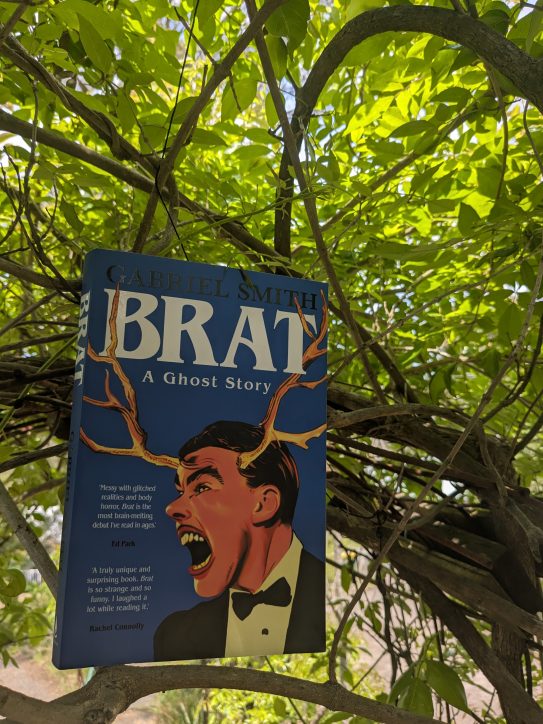
Recommend: Yes
BRAT A Ghost Story is approximately 300 pages long. It has testimonials from authors I have never heard of and they’re not even good testimonials (“A surprising book”). It costs $34.99. We’re on date night and I have BRAT in my hands, turning it over dubiously, Christmas carols chirping from the Dymocks Town Hall speakers. Declan has already found a book. He’s ready to leave. In fact, he was ready to leave the bookstore five minutes after we arrived. I put the book back on the “Staff Recommends” shelf. I turn towards the exit.
I can’t do it.
I can’t walk away.
I turn back.
On the flash-card review taped to the shelf below BRAT Bert C. has scrawled his name, and I am desperate to trust Bert C because on the top shelf, shiny in its shrink-wrap, is his other pick: BEE’s American Psycho. For a shocking moment, I am wary, as Bert is also recommending a BookTok romance book between a gay prince and his PR manager. But upon closer inspection, Bert and Bert C. appear to be distinct flash-card reviewers. I buy BRAT.
BRAT is constantly in a war with itself, hell-bent on self-destruction: on one side of the war, its terrible title, and on the other, it’s cool cover. On one side, the flimsy, disposable font, and on the other, fast paced page-paragraphs. On one side, droll repetition of “sad, bad” feelings, and on the other, humorous cuts between scenes that imply rather than show. Constantly, BRAT asks of itself: am I book to be forgotten instantly or am I to be passed, sheepishly, amongst friends? Happily, the war is won by the good guys. I really enjoyed BRAT.
Structurally, BRAT successfully executes the vignette style that many modern books stumble over, drunk in their own self-importance. Sections are rarely more than three pages long. But instead of being a chaotic mess (No One is Talking About This – Patricia Lockwood) or an unemotional bore (Weather – Jenny Offal), BRAT’s short sentences, within short sections, successfully emphasise the narrator’s mental state: tired, exasperated, confused.
The narrator (somewhat annoyingly, also named Gabriel Smith) does very little. Wakes. Drinks. Smokes. Fitfully falls back to sleep. Tries to contact his ex-girlfriend. Occasionally, and evasively, emails his agent. He’s grieving, alone in his childhood house. His dad has just died.
Interspersed heavily throughout the plot are surreal anomalies. If I was allowed to peak at Gabriel Smith’s own flash-card reviews, I imagine I’d find impassioned thoughts on Saltburn and Six Feet Under. Yet the delight of the book, for me, was that this was not speculative fiction.
As the text rockets along, the emotional weight of the surreal becomes realised primarily because of what is happening in the narrator’s real life. BRAT reads simply, and entertainingly, yet there is an easy poignancy. It was about two thirds of the way through that I understood the reason that material objects were changing slightly (eg. A manuscript that is different every time it is picked up) was to illustrate the fear Gabriel has of misremembering, or forgetting, his parents.
The author also invites us to reflect on how the people we love the most, alive or dead, are incomplete versions of themselves, their narrative arc not static. As a result, our perception of them can shapeshift more easily than we like to admit. While part of this message is hopeful, in the sense our loved ones have free will, it is also unsettling, as what we love most about them could disappear, completely out of our control. When Gabriel finds a video tape that shows his family happy in its past, and then, upon rewinding, shows his mother as though she is the mother to a different family, the ‘spooky’ element is not the morphing video tape. It’s the potential that his mother may have not been who he assumed, and not lived the exact life he expected.
This anxiety around shifting boarders is then broadened out further (by way of a wise grandmother) to also highlight current society’s discomfort of histories that are subjective. The true horror, Smith seems to say, is not being unable to fully comprehend another person, rather it is the flattening out of own relationships – of being unable to let the people in our lives change the trajectory of our own stories.
Sally Rooney’s Intermezzo also dealt with two brothers who struggle to support each other during the months after the death of their father. Her expression of this grief threads its way slowly through other, unrelated arguments and differences between the brothers, because they don’t have the language – or emotional bond – to talk about their father directly. BRAT uses the simpler technique of surrealism to depict two brothers who cannot relate to each other despite suffering the exact same loss of their father. In BRAT, the narrator constantly tells his brother of the unreal oddities since their father’s death. The brother is entirely sceptical. This is an extreme, unbridgeable gap. As a reader, it’s pleasing for the surreal to be the vehicle for a such a simple message: each brother must grieve alone.
The surreal, and I am reticent to say horror because it’s not really the purpose of the book, and the real in this novel are woven together by the theme of repetition. There is constant repetition – dialogue, settings, actions, narration and really everything about this novel repeats. There is a technical requirement for this. The surrealism in this book is about objects and places being not quite what they were before, and repetition is necessary as Smith must first show what was, and then repeat all but a few details to highlight the marginally altered now. But then the repetition is also very unsettling in its own right. I believe it’s this repetition that gives the novel its tension, rather than the occasionally unhinged plot. Even though the novel is moving forward – the thickness of bunched pages between fingers quickly changes from right to left – the repetition invokes an eerie atmosphere of stasis and entrapment.
In BRAT, at first, we fear being caught in an uncanny valley world. Then we fear the cold truth of reality. And, finally, we fear that we are doomed to repeat as ourselves in either setting.

Leave a Reply