
Recommend: Yes.
It’s disorientating writing this review hours after the review for Melissa Broder’s Death Valley. Both sun-soaked books were read in the South Australian outback, chosen for their relevance to the parched Flinders Ranges, but the divide in quality gaps deeper than the plateaus sunken below St Mary’s Peak.
Wake in Fright is instantly compelling and maintains momentum throughout the entire novel. Whereas Broder’s writing was a constant inane whine, Cook’s writing is nuanced, alive and adapts to the plot. Death Valley reads as an extended social media post observing a tiny, socialised patch of American desert. Wake in Fright, in stark contrast, feels as though it has pushed through the cracked, hard ground and, with little in the way of sustenance, spends its days watching over empty plains. It is a tense and expansive novel that charts its course between the inescapable corners of the Australian outback.
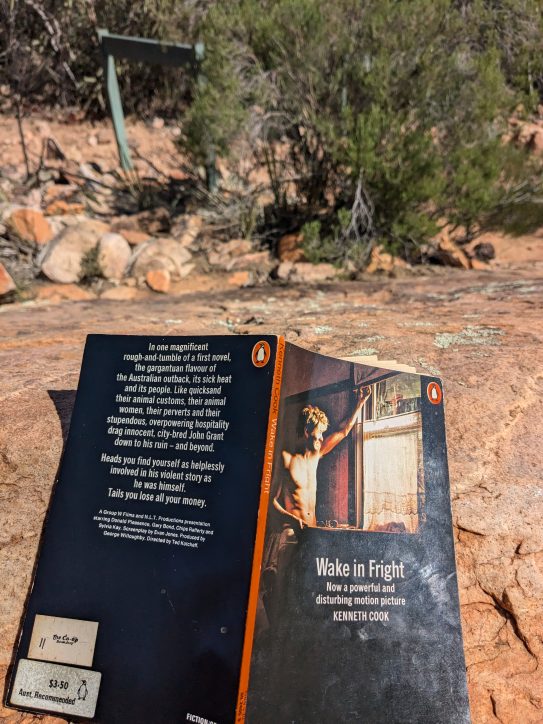
There is endless intrigue. The title ‘Wake in Fright’ (taken from an old curse, “may you dream of the Devil and wake in fright”); the occasional, extremely effective indenting of text that you’d expect in an E. E. Cummings poem; very rare changes in font that sharpen attention. Even the blurb is brilliant:
“In one magnificent rough-and-tumble of a first novel, the gargantuan flavour of the Australian outback, its sick heat and its people. Like quicksand their animal customs, their animal women, their perverts and their stupendous, overpowering hospitality drag innocent, city-bred John Grant down to his ruin – and beyond.
Heads you find yourself as helplessly involved in his violent story as he was himself.
Tails you lose all your money.”
The writing is versatile, subtle shifts of tone occurring like changes in the hot, dry wind. Wake in Fright begins with relief as John Grant concludes his term of teaching in the middle of nowhere. The heat physically assaults. The tiny community is claustrophobic. And he is leaving. The long journey to Sydney stretches out but is not endless – in days he will be underwater and cool and clean. Relief soon ebbs and gives way to the blankness of travelling through unchanging desert landscape for countless hours. A pit stop in Broken Hill before the flight to Sydney opens up an edge of irritation and disgust in John Grant, as the larger town imposes itself on his personal space. It’s here in Broken Hill that a two-up game drenched in heady greed leaves John Grant devoid of his money and a plan, and brutally exposed.
“But he stayed leaning against the wall saturated in the atmosphere of money. It had been so easy to win. Just a flicker of two coins and money doubled itself, and doubled itself and doubled itself. God! but the hunger for money was a gnawing, tearing thing.”
Kenneth Cook would find himself comfortable on the trading floor.
Wake in Fright is a gold-standard Australian novel, sitting confidently alongside Shirley Hazzard’s Transit in Venus and Jessica Anderson’s Tirra Lirra by the River.
It’s difficult for me to tabulate everything I loved about this novel because it is so richly crafted that one appreciation blurs into the next. The pacing is one aspect I must specifically commend. There are five (quite distinct) chapters, and each could be an episode in a television miniseries that you finish in a night, such is the force propelling them. The ‘thriller’ atmosphere is palpitating but paired back – there is a real threat and a heart-wrenching despair, which increases in intensity as the novel progresses, but it can hard to tell where it truly lurks, as it seems to invade everywhere and everyone.
The mystery: whether John Grant is broken by the Australian outback, or whether the Australian outback, in all its sparsity, leaves his inherent rot nowhere to hide.


Leave a Reply